The following is a pamphlet we produced to hand out at a local series of demonstrations in response to the Cornell Sexual Assault Scandal which a front group of PSL, a Stalinist organization, SFS has been invited to attend. We find this to be an example of their disgusting opportunism given their rampant history of abuse within their organization.
Here is a Tucson specific one that includes statistics about local chapter relations.
rape is systemic
The prevalence of sexual violence is not incidental.
Abuse is encouraged and protected by structures of power and control that place people in vulnerable positions and others in positions that incentivize and allow abuses of power.
The overall structure allowing this is capitalism, a system of class domination in which the majority of humanity is exploited by the few, and which more than any other system stratifies even the oppressed into positions of individual power over each other.
We won’t end this abuse until we end this system.
Not all groups that claim to oppose this system actually do, and not all groups that opportunistically denounce abuse fight to stop abuse in practice.
We can’t work with groups that perpetuate these systems and organize along the same controlling structures that enable and cause abuse if we actually want to put an end to them.
Biggest PSL Abuse Cases
We have provided our sources for these claims. All accusations shown here are representing the accusations of the victims. None of them have been explicitly proven in the US court system, however we believe in victims.
STEVEN POWERS
In 2020, a member of the Philadelphia Chapter of PSL, who chose to go by the pseudonym Griselda Aclarado, was allegedly sexually assaulted by another member, Steven Powers1
In response, PSL doxxed Griselda’s legal name and address.2 as well as allegedly kicking out around 1/3 of the local chapter members for having internally criticized the handling of the situation.3
In 2020, a central committee member was allegedly assaulted by executive committee member Eugene Puryear.
Ben Becker, co-founder of PSL allegedly told her not to tell anyone what had happened.
Other than Ben’s father Brian Becker and Ben’s Wife Karina Garcia, no one else in the executive or central committees was made aware.
When the victim told her party recruiter Chris, Ben was allegedly angered because he feared the recruiter would be upset since he got a more severe punishment for a “lesser allegation” against himself prior.
Eugene only took a month off of working with the party before returning to the same role.
After a few years, she broke “discipline” by telling friends within the party of her struggle with the abuse including her recruiter who had once again had to move cities due to another alleged sexual misconduct scandal of his own.
Only then, six years later did she leave, at which point Eugene later resigned.
PSL exercises a high level of control over members
PSL members are discouraged from openly communicating with members of other chapters.5
PSL members aren’t allowed to publicly criticize PSL
In founding member of PSL, Ben Becker’s 2018 essay “Social Media and Democratic Centralism: Opportunities and Challenges” he asserts that: “Leninist parties have been vertically organized — from bottom to top and top to bottom. Maintaining these Party internal norms is of maximum importance to defend the organization and preserve its unity in action. Social media poses considerable challenges to the Leninist party form and the broader socialist movement. It creates unlimited potential for horizontal communications between members, for gossip and innuendo in the movement, and for surveillance on members’ individual lives”
An organization limiting “horizontal communications” for vertical control is inexcusable. Their claim that these measures are in place to prevent gossip and innuendo, or for the privacy of members is laughable. There is no reason to restrict open communication among the members of your organization unless you want to control them.
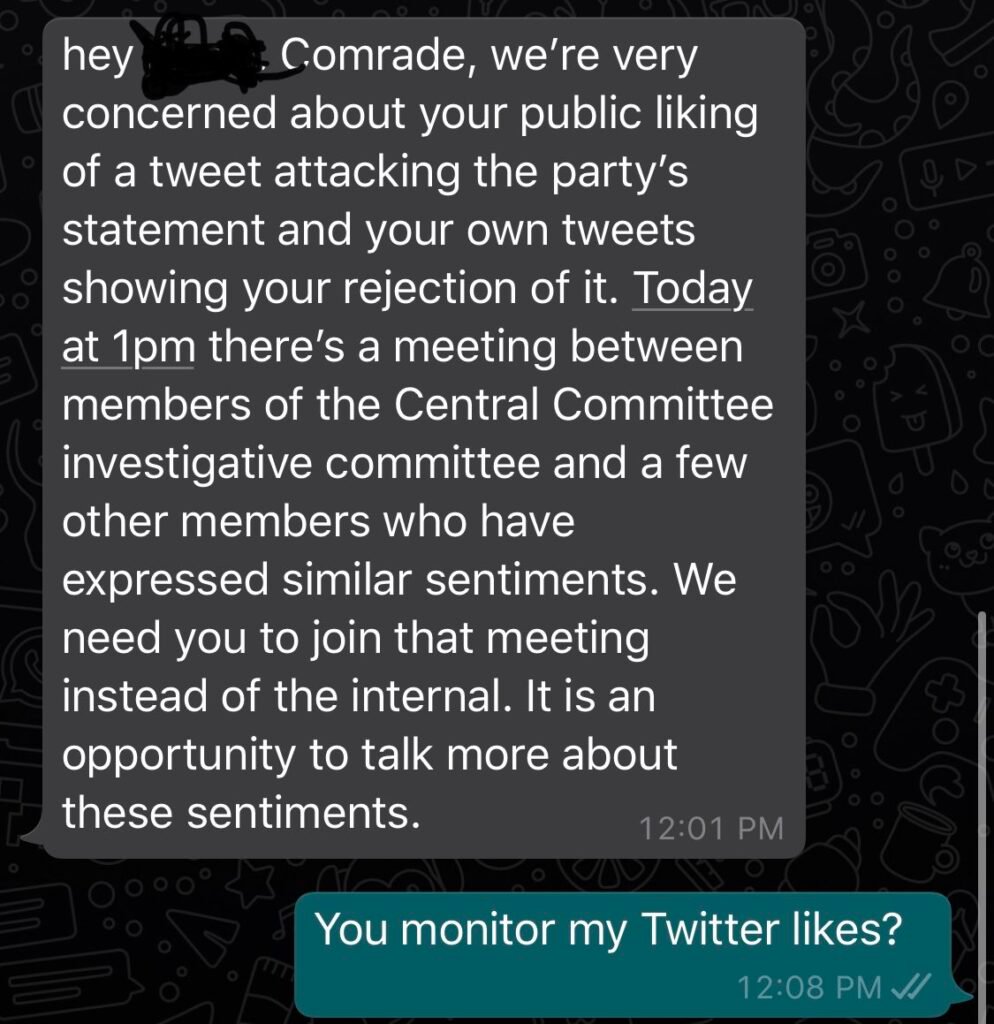
Leaked DM from PSL member during handling of alleged abuse scandal.6
psl is a secretive organization that lacks transparency and their central committee is all powerful and unaccountable
PSL’s central committee members are unknown to the public.
PSL’s party constitutions are not publicly available.
While PSL keeps all its internal documents a secret, the party constitution from the July 2022 PSL PSL fifth national convention was leaked, revealing the extent of central Committee control over the organization.
1.1 The Party Congress is the highest body of the Party. It has the authority to act on all aspects of Party policy and activity.
2. Delegates to the Congress
2.1 The Party Congress shall be comprised of voting delegates elected at the branch level and by the central Committee
2.3 The Party Congress may also have voting delegates nominated directly by the central committee, the maximum number of which shall not exceed 40 percent of the total elected delegates.
This means that the central committee handpicks 40% of the vote, requiring only 11% of the delegates to agree with them to get a majority
ARTICLE 10. AMENDING AND INTERPRETING THE CONSTITUTION
1. Amendment
1.1 The Party Constitution may be amended only by vote at the Party Congress.
2. Interpretation
2.1 The Central Committee and Executive Committee shall have the authority to interpret the Constitution and to create procedures not specifically covered by it. Interpretations made by the Executive Committee shall by submitted to the next Central Committee meeting for approval. All interpretations shall be submitted to the next Party Congress for approval. (Typo is theirs)
This means that the central committee has total power to dictate the meaning and interpretation of their constitution, and the constitution may only be amended by the party congresses which they control.
ARTICLE 4. NATIONAL ORGANIZATION
1.4 The Central Committee has the authority to make decisions and take action necessary and incidental to the good and welfare of the entire Party, and to act upon all problems and developments occurring between Congresses.
This means the Central Committee can do whatever they want.
where psl gets its funding and where the central committee gets its power
The Central Committee isn’t a magical body that exerts such a high level of control over its members because the members choose for this to occur nor because they are such great leaders but because of the amount of control their immense funding grants them institutionally.
PSL gets funding from Neville Roy Singham, an American citizen living in China worth over 750 million dollars.8 People’s Forum has received at least 20 million dollars in funding from him.9
Several members of the high command of PSL including Breakthrough News hosts such as Rania Khalek work directly for the Chinese and Russian States. (Rania is a journalist for the Russian state news outlet Russia Today)10
Eugene Puryear, another alleged abuser within the central committee and past Breakthrough News host worked as a talk show host for Russian State owned “Radio Sputnik”11
PSL’s finances are kept private and not shown to members.
THE PSL IS REGISTERED AS THE FOR PROFIT CORPORATION “LIBERATION NEWS, INC (3488507)12
The Global Justice Center, where Tucson PSL hosts the majority of its events, spent 54 million dollars in 2021, 100 dollars per resident of Tucson.13
silence is compliance
In the Cornell Case, messages were sent to a fraternity group chat with 57 members. The 50 members who didn’t directly participate in the abuse but didn’t say anything either aren’t innocent. These bystanders are abusers too.
Abusive organizations like PSL thrive on secrecy and taking advantage of those that don’t know any better about them.
Our comrades at the Sonoran Internationalists have brought forth two criticisms of the local movement against the Project Blue hyperscale datacenter. Their first, “Project Blue: Not in My Backyard,” was written at the peak of the movement’s limited success in its strategy to appeal to local government. Their second, “A Final Addendum to Project Blue,” has been written at the current low point in the movement.
We believe that while their analysis is worthwhile, they fail to appreciate the importance of engaging in local struggles and have a vastly expansive definition of “reformism”
Our definition of reformism is any movement which is involved in demanding reforms to the capitalist system from the ruling class.
The No Desert Data Center Coalition (NDDCC) is obviously reformist as the organization’s objective is to engage in electoral maneuvering (specifically through the Tucson City council and county board of supervisors) to beg the ruling class to not build a particular construction project. Reformism is to us not merely reform without communist aesthetics or words grafted on top.
This is the beginning of a trend in this text where the author seems to not understand the meaning of certain words.
that precludes them from supporting most worthwhile movement projects. In addition, we fear our comrades are less interested in building Communism than they are in providing critique from the sidelines, where their ideas cannot be tested and they are off the hook for actually solving difficult organizational problems.
History is the primary testing ground of strategies for our class movement. Our positions come from an analysis of the history of proletarian revolutions as well as our own experience in these exact kinds of leftist groups that we now critique from the outside.
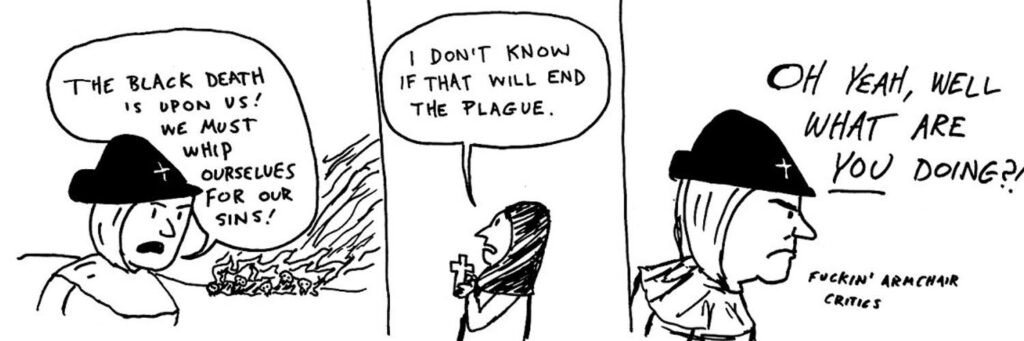
If all knowledge had to start at square one, instead of learning from the past, then we would also ask that you stop washing your hands until you can prove miasma theory to be incorrect.
In fact, we formed this organization because of our previous experiences in these kinds of reformist organizations. The lesson we learned from the foundational failures of those groups was that reformism itself was a complete pitfall, and we have gone on to engage in our activity with this new understanding.
There are criticisms to be made of our past writings and actions, and we have made those criticisms ourselves as part of our process for discovering how to be an effective Communist organization. We do not need to take a step back into the swamp of leftism to see once again the failures of these ideas.
If we have already learned the lesson, what reason do we have to repeat the mistake?
In their first article, the Internationalists argue that the data center in Tucson is one part of a larger worldwide increase in demand for computing technology, which is driven fundamentally by the profit motive and subsequently by capitalist competition. As a result, stopping the center in Tucson will require its construction elsewhere, because it is driven by these powerful economic forces.
They argue that even the best possible case for the anti-datacenter movement –.i.e. stopping the datacenter in Tucson – simply condemns some other community which is less capable of resistance.
In this criticism, we agree wholeheartedly!
Immediately the author has to concede that the entire existence of this organization (to stop one particular data center by appealing to local government) is a pointless endeavor. This should be beared in mind later when the author will then chastise us and repeatedly ask that we waste our time engaging in this same movement with the same useless objective.
An approach to this process wherein communities battle city governments and corporations to end data centers everywhere is impossible. We believe over-extraction and waste of resources is a fundamental facet of capitalism, and the only solution to over-extraction is Communism.
Next, they argue that instead of fighting the datacenter, “we can use this understanding to criticize the entire system as it stands, as an example of why we need something fundamentally different” (our emphasis). Their alternative is to organize a Socialist society based on worker’s council government,
While councils will exist during the transitory stage towards socialism, communism (which we use interchangeably with socialism as marx did) will not be a society of committee but something much more organic. Further, there will be no governance but rather coordination or resources.
We understand that this runs contradictory to our original article, (for which you are stating our stance as such), and we levy this criticism not against you but against our past selves. We merely wish to proceed with the furthest and most honest version of our current stance.
which confers with experts to properly govern society and organize the economy without competition and over-extraction.
“What is the problem”, says the Internationalists? Capitalism. “What is the solution?” A complete rupture of our capitalist society by a revolutionary moment which transitions society to total workers’ democracy.
Democracy is no more important to us than the right of kings.
As with the previous note, this is something that contradicts our original article and as such it is a criticism against our past selves in the spirit of honesty.
And, in terms of practical steps to build this world-historic moment and drive it to completion? Our comrades simply say, critique! All our friends can muster is a proposal that we critique the situation.
We believe that this sentence showcases the grand programmatic and theoretical error underlining TRAG. That they take our position of the only role of communist organizations and militants towards reformist organizations being to critique them to mean that the only role of communists in general is criticism shows that to them the entire theatre of militancy is limited entirely to intervention within such opportunist avenues.
As if the options are “join in this useless movement” or “do absolutely nothing”. We have rejected this false dichotomy that seeks to coerce us into joining an organization which does not share our principles or objectives.
Very good. Their criticism is well-received. And where is our revolution?
This is to us a disingenuous criticism. We could certainly ask the same of TRAG. If your strategy works so well why haven’t you started a revolution, or at least turned the NDDCC away from its reformism?
The fact that a revolution has not occurred right now is to us not an indictment of either of our strategies, and is an argument befitting only of someone who wishes to say that revolution is impossible, which we certainly hope TRAG is not; despite the fact that all of their organizing may point to the opposite.
Our argument is not that if all the “uneducated and infantile proles” (as TRAG may consider them as part of the “masses”) of the NDDCC simply joined our organization and became geniuses like us we would achieve revolution today, but rather that in times of the revolutionary cataclysm of capitalism such organizations will be inherently counter-revolutionary; and further that participation in them in times such as now will only lead to a lack of clarity within the communist movement when such a situation occurs.
This is where we take issue with the Internationalists’ conception of revolution. Revolution is not a long process, which we must work all our lives to build together. It is not a process which we must join together with the global working class in over a lifetime, in the hopes that one day, life on our world may live in harmony.
The revolution is certainly a long process, however; communism is not built piecemeal. The socialist movement grows not consistently and step by step, but rather in leaps and bounds; and it can do so only via possessing the clarity of mind and singleness of structure to be poised for the moment.
The basis of our work is a shared commitment to the revolutionary programme. We organize and act according to this principle. As such, despite geographic distance we are deeply embedded in the international Communist movement.
This organization on the other hand, spends its time organizing for local crosswalks and volunteers in any other cause that they believe can be used to make them look good.
Then, of course, they turn around and say we’re the ones doing useless non-work, because their emphasis on involvement in bourgeois politics as a poorly disguised recruitment drive, is obviously much superior to our activity.
The purpose of their “work” is to convince more and more proletarians to join up and then get involved in ever more bourgeois causes. They measure success in quantitive terms, how many poor wretches have been convinced to join the group and pay their weekly membership due for the right to vote.
Communists measure success not in terms of quantity of members, but quality. After all, it’s not as if we will reach some magic number in membership and then we will have the strength to carry out revolution. Rather, as exemplified most by the exponential growth of the Bolshevik party in the period of crisis in 1917, the revolutionary Communists of our class will always be a minority, but more and more proletarians will realize their own self interest lies with the Communist cause as the choice becomes either revolution or death by capitalism.
This is something which the tacticalism of groups like TRAG is ultimately counterproductive towards. It is ironic considering their charge against us, but we would in turn charge them with holding the positions they do because of their own impatience towards the revolution.
It is through an understanding of the revolution as a long drawn out process which is not necessarily built, but rather which is prepared for that we base our activity.
Revolution doesn’t require us to engage with the imperfect political situations in front of us in attempts to have our ideas adopted and our aims furthered. Instead, it is an idea which we can appeal to as we watch movements pass us by on Instagram.
Our comrades have valid criticisms, and we believe they should be taken seriously. In terms of immediate implementations, we think the local struggle to stop this datacenter must issue these criticisms as well, to avoid folks getting false illusions about the finality of their local project. In addition, we argue Marxists, Anarchists, and other revolutionaries should get involved as quickly as possible and begin building ties between this movement and other radical movements,
Something which runs completely counter to their supposed agreement on our criticisms. Perhaps they have understood our argument to be that we believe the NDDCC has certain flaws which we wish to see solved. Rather, we believe the NDDCC is itself inherently counter-revolutionary, and that any participation in it by “Marxist,” “Anarchist,” or “other” revolutionaries will itself be counter-revolutionary, drawing them inevitably into its gravity.
in the hopes of converting this mass practice into real movements for Socialism.
The problem arises when we ask our Internationalists for solutions. When we do this, we are left with much to desire, to say the least.
Likewise to before, this stems from their inability to see the whole picture of society. They see that we do not have solutions to their question because the problem they wish for us to solve is insolvable, that being what is the “correct” way to intervene within such organizations and make them revolutionary. Which we of course can not answer, in the same way as they could not answer from an even more plainly liberal organization: “How do we make the police revolutionary?”
Our “solution” is the one we have always maintained, although we are happy to restate: Abandon all reformist activism and opportunist organizations. Instead, start or join organizations that exist for the explicit purpose of unifying the proletariat towards the ultimate world Communist revolution, and not only in name. These organizations should engage in political education, connect and discuss with revolutionaries across borders, and at all times advocate for nothing short of International Proletarian Revolution. We are currently engaged in that work, despite the multiple accusations in this text stating otherwise.
We are given appeals to revolution, to the establishment of worker’s democracy, and at best we are asked only to issue critique. Our friends are idealists, meaning they have ideas of revolution, but no interest in practical transformation of the world according to these ideas.
This is a blatant misrepresentation of the definition of idealism, which we would encourage readers to look up on their own. Idealism is a philosophical conception of the world which says that ideas are what shape the material world and our consciousness. Rather than the material world shaping our ideas and consciousness, which is what Marxism is predicated on. Who knows what that has to do with this baseless accusation stemming from the author’s ignorance of both our real activity and positions.
What is more idealist than to believe that simply by injecting communist ideas into a bourgeois movement it will somehow evolve into a genuinely radical one?
Our refusal to involve ourselves in such a movement stems from the fact that we see it for its material and class character, and not just what it calls itself, and further because we understand that no amount of proselytizing will be able to turn an inherently reformist organization into something revolutionary.
In their second article, the Internationalists respond to a protest which was organized at the construction site last week. In an even more abrasive rhetorical style,
We appreciate your compliment on our writing style!
“Ruthless criticism of all that exists” – Karl Marx
the SI calls the demonstration a result of the movement’s failure. They call the protesters Live Action Role Players and bask in their correct analysis.
As we pointed out previously (and this author went on to agree with) even if NDDCCs objectives were somehow met, demand for data centers would not be changed, merely the supply. Another community would in turn have to bear this burden. By pointing out that this activity ultimately doesn’t benefit the overall environment and only shifts burden onto others, we believe it is fair to say that protesting despite this fact amounts to larping, acting for no real material purpose.
Of course, they don’t do anything in the material world about it.
The author seems to misunderstand what “the material world” actually is, as if our own activity takes place on another plane of existence. This is clearly another stint of TRAG’s idealism.
Since it is clear they do not know what idealism actually means when they throw it around in bastardized form and are clearly sufferers of it, we would like to recommend some good pieces for beginners to Marx on the issue.
Theses on Feuerbach is perhaps the most concise of Marx’s pieces on what materialism is and is not, as well as how it is unified in the Marxist tradition with consciousness, which TRAG has seemingly failed to comprehend.
For a longer piece on the issue, we wholeheartedly recommend the Feuerbach section of Marx’s “The German Ideology”
We were of course not brought onto this Earth in the form we are now, and many of our members have a storied history of making many of the mistakes that TRAG now makes prior to reading Marx in depth, so we hope that his works can be as enlightening to them and their practice as they were to ours.
What the Sonoran Internationalists might not know (because they don’t go into movements and talk to their activists) is that the demonstration had multiple strategic purposes. One major goal was to bring more people into the movement,
What TRAG might not know (because they lack critical thinking), is that we are aware of the fact that the NDDCC wishes to bring more people into its counter-revolutionary movement, which is precisely why we oppose joining it ourselves!
We would like to remind them also that a movement being large or based on “popular action” does not immediately make it of a proletarian character. Take for example the National Socialists of Germany, who took power via the popular mandate of the people.
Would TRAG critically support the Beer Hall Putsch for meeting the workers where they were at and having multiple strategic purposes including bringing more people into their movement?
Our goal as communists should be to sway people towards revolutionary movements, and away from counter-revolutionary ones. Why TRAG would defend the cancerous growth seeking opportunism of an organization they themselves admit as being “impossible” in its aims is beyond us, unless they themselves wish to see the growth of counter-revolutionary abstractions.
We do not go into these movements because we do not share their principles or objectives. Instead, we observe their activity from afar and provide them our analysis.
We were once in the same boat, in similar kinds of groups. We believed in these same ideas which we’ve come to learn are flawed. Our dialogue is intended to point out those shortfalls, to have a real effect on these activists who want to build a better world but are doing so with a flawed outlook.
in the hopes of mobilizing people to act on the world around them. The major aim is to convert this issue movement into a mass movement based in popular action.
The ultimate goal of Communism requires the entire masses to learn to govern themselves. To do this, the masses must start by developing organizations where they can act on the world as political agents.
With this, we wholeheartedly agree, although the specifics are of vital importance, for their is no single universal metric of capability to act as “political agents”.
We proudly admit that we are much worse at being political agents within the governmental system that currently exists than the Republicans, Democrats, or Tucson Red Action. This is because we seek not to influence the democratic system, but to subvert it.
What the history of the workers movement has taught us is that in revolutionary situations, the lessons learned via engagement in non-revolutionary politics become maladaptive rather than helpful. Perhaps the best example of this was during the revolutionary wave of 1917, where the German social democrats, who by far involved the most of the masses into their structure compared to the other parties of Europe, and yet insidiously used this control over the workers to smother any real chance at revolution while it was still in its cradle.
“When the time came for the armed insurrection against capitalism, however, it was seen that the only party to engage in that insurrection was the party that had the least experience “working among the masses” during the years of preparation, the one that more than any other had worked to preserve Marxist theory. It was then seen that those who possessed a solid theoretical training marched against the class enemy, while those who had a “glorious” patrimony of struggles shamefully choked on their own words and went over to the side of the enemy.” -Amadeo Bordiga, Activism
We feel that now the movement needs to pull the broader masses into a struggle
And this is precisely the issue. These great thinkers feel that it is necessary for “the movement” to pull the broader masses into a struggle; without remembering that the movement we are discussing is an electoral one built on class collaboration and the subservience of the proletariat to the interests of the organizations’ NGO backers.
We stand uncompromisingly for class independence, not class collaboration. We refuse to equivocate the self organization and revolutionary militance of workers with the NDDCC.
where they can organize together and learn how to be political and democratic. We feel engagement with this datacenter issue has the potential to create new Communists, new activists, and new organizers which our movement desperately needs. It will require us to work on organizational problems and not just theoretical ones, which is necessary to build revolution. We cannot wait for this process to happen on its own, we must make it happen by training ourselves and as many people as possible how to organize.
This is the utility and value in engagement with the datacenter movement. It is a movement that people are organizing together,
Every movement is one where people organize together, that’s the definition of the word.
This bizarre claim seems to say that anytime proletarians are gathered is an opportunity to “convert” those people into Communists, regardless of the movement. Why draw the line at this one, because of aesthetics? One could replace “datacenter movement” with “blue lives matter movement” and the argument here would be the same.
The underlying assumption here is that leftists are somehow closer to Communism than other groups like the democratic party, conservative groups, etc. We reject this idea because we recognize that Communism is a fully distinct political philosophy that cannot be compromised with the existing bourgeois society and the poltical strains that come from it.
This conception makes sense for TRAG as a Stalinist organization however, because their politics are not rooted in class struggle but rather the bourgeois battle of left (wing of capital) versus right (wing of capital).
where people have interest, and where people are cropping up who can organize. This is where Communists may grow. Activists from movement scenes like this are the most valuable recruits, because they care to work in the real world and when discussing theory, they can actually apply it to the experiences of organizing.
Like a tree grows fruit, the failures of such movements do in fact grow a more radical sect of workers. We do not deny this, if we didn’t feel it as such we would not put in the work of publishing our critiques of them.
What you mistake for us believing that there is not the capacity for communists to come out of this movement, is our refusal to pick these fruits while they are still unripe; which would both stop them from ripening, as well as poisoning ourselves.
Such a strategy has historically proven to be quite successful for various counter-revolutionary parties such as the PSL and yourselves, we do not deny this. We simply value our revolutionary nature above becoming the most powerful of the counter-revolutionary forces within bourgeois society.
We understand that you have started your organization because groups like PSL, FRSO, and the RCA are for whatever reason not to your liking. We will give you the benefit of the doubt and assume that it is not merely because you wish to be the ones in control of the hierarchical structure.
We must ask you, how is it that you believe you will implement what is ultimately the same strategy as the lot of these groups and have an outcome which is any different? None of them started as blatantly extractive, reformist, or opportunistic as they are now. Yet it was the entropy of their practice which led them down the path they now have reached the end of.
Is it because you have uniquely pure ideas sent down from the heavens that guarantee your revolutionary character? Is it because you’ve read Settlers? We have no idea.
What we suspect is that it is because you have not critically thought about why these groups are the way that they are. You take their surface level failures at face value, and tell yourselves that you will be different because you aren’t like them. Perhaps because they started with as little programmatic discipline as they have now (they didn’t).
These people make the best materialists and the best Communists. We should find them as quickly as we can, and work to become them.
The problem with this, for the SI, is that it is very hard, much harder than reading books and writing articles.
We are communist first and foremost because we wish to achieve a communist world. Perhaps the most important step in doing so, is to be serious militants whose actions are based wholly on programmatic questions of the furtherance of revolution. As part of this seriousness, we believe that an honest reflection on our weaknesses and realities is important.
We do not believe ourselves to be supermen, capable of sending ourselves into a wholefoods parking lot with a bag of mangoes seeking to bring class consciousness to hustlers selling stolen candy.
Our time is limited, such is the result of living under capitalism. We understand as much as you that everything is linked to capitalism. Where we perhaps differ, is that we take this reality to mean the opposite conclusions that you do. We do not have infinite time to deal with the infinite aspects of capitalism.
Society is already full of individuals who realize that capitalism is at fault, yet they lack the clarity necessary to fight against it in a productive way. There is no need in the class struggle for an organization which traps people at this early plateau.
TRAG does not realize that it is in fact quite easy to thrash around aimlessly to “do the hard work” of organizing with and helping our class enemies. The entire political system has been engineered to make it so.
We do not feel insulted when you claim that we are afraid to get our hands dirty as you stick them into the honey pot placed in front of you by the system because we know better than to fall for such tired tricks.
Much harder, is to have the restraint, patience, and singleness of mind to see past these opportunistic traps. To apply a revolutionary theory in revolutionary action; rather than allowing it to be inverted through the system as it has been for decades.
Capitalism has been able to fool its adversaries and their structures into supporting it not because its adversaries are idiots, but because it makes them believe that they are in fact the ones subverting the structures of capitalism towards their own goals.
You are not uniquely vulnerable to such tricks, but you are certainly not immune. Nor was Lenin, nor any other revolutionary.
It is easy to believe that the revolution is simply a question of working hard enough, we in fact wish it were so. What must be realized, however, is that it is not. It requires most principally the ability to plant our feet on the ground, and to look analytically at a reality which is inverted to us. Failing to do this, you will look back to realize that all the blood, sweat, and tears you put into organizing; was done not to destroy the system, but to reinforce it.
It requires us to work with people, to argue, to participate in movements which might fail. It requires us to show that our ideas are correct and therefore risk being wrong.
Given TRAG believes (falsely) that our entire activity is comprised by writing strongly written statements about our ideas, it feels a patent absurdity that they would accuse us of being uncomfortable with doing just that. By publicly releasing texts we are asking people to engage with them, and in that process we are very much at risk of being proven wrong.
It is likely that what they intend is that because we do not ourselves repeat the mistakes of the past (both our own and of our movement) that we are not allowing our ideas to be proven correct or not. This is the same ideology as that of a toddler who fails to comprehend that the stove is hot until they themselves touch it, rather than listening to their parents who have already learned the lesson for them.
Our mandate becomes action, guided by revolutionary ideas. It is much easier to live in texts and articles, where one may never have to prove themselves and they can forever point out problems they don’t care to work on. When the world brings forth to us an imperfect reality, we can decide that any kind of organizing which does not result instantly in revolution is simply making appeals to reforms, and therefore it is devilish reformism which only plays into the hands of the bourgeoisie.
Again the author makes the utterly bewildering argument that a group that is actively begging the ruling class to enact a reform (canceling a single construction project) is somehow not reformist.
We are not trying to magically enact a revolution next week, we are rightly (by your admission) pointing out that this activity is not revolutionary, therefore we should do activity which is revolutionary since we will need as much preparation as possible towards this end.
Such a misrepresentation of our argument would be respected even by the likes of Bernstein and Ebert. Our refusal to support such measures stems not from their failure to produce the revolution now, but from the fact that doing so would hamper the revolution during the crisis of capitalism.
It is expected that TRAG is incapable of seeing anything that isn’t right in front of them, and further of stepping outside of the historical moment to see the development of history in a Marxist sense. Without an understanding of the history of the workers movement, TRAG is doomed to make the same mistakes of the past over and over again, doomed to be capital’s left.
“it is characteristic of opportunism to suddenly set all its hopes on the great revolutionary deed. Its essence lies in always considering the immediate questions, not what lies in the future, and to fix on the superficial aspects of phenomena rather than seeing the determinant deeper bases. When the forces are not immediately adequate for the attainment of a certain goal, it tends to make for that goal by another way, by roundabout means, rather than strengthen those forces. For its goal is immediate success, and to that it sacrifices the conditions for lasting success in the future.” -Anton Pannekoek, World Revolution and Communist Tactics
We recommend TRAG read “The Past of Our Being” by Barbaria, as it is in our eyes the best analysis of their historical current of Leninism.
This is embarrassing behavior for so-called Communist militants.
We can no longer be satisfied with hefty books and lofty theories. We can only be satisfied by real Communist politics.
We agree! Our satisfaction only with real communist politics is precisely why we denounce this liberal schlock.
It is a disgrace that to these pseudo-revolutionaries, “Real communist politics” means begging our ruling class to cancel a data center, inflating leftist organizations, defending the infiltration of these organizations despite admitting their goals are pointless, and begging our ruling class to build a crosswalk.
Communist politics does not mean thinking the most correct ideas
You should consider yourselves lucky that we agree!
, nor does it mean constantly doing action again and again without thought. It means merging thought and action dialectically with comrades in struggle, and building real power by acting upon the world.
And yet, building “real power” within the capitalist world that they allude to is in reality the building of capitalist power.
Because TRAG is not guided first and foremost by militance, they see being a power within capitalism as the foremost goal of the workers movement; quite similarly to a trade union.
We agree with this sentence in principle, however it is clear that the thought they are merging with their action is not that of Marxism, but of opportunism. Which is itself the reason why the actions they choose to merge it with are of the same character.
This struggle is not perfect, it has many problems in idea and in practice. This we will concede to our comrades. Unfortunately, we are on the back foot. We suffer from a lack of organizers and a lack of a Communist movement. We can only build that movement by engaging with the world strategically
Are we supposed to treat this statement like it’s serious?
While arguing that we are failing because we aren’t engaging in the specific form of counter revolutionary activity (that you yourself admit is pointless except for use as a recruiting tool) you’ve inexplicably gone on to say that we don’t engage in the real world at all in the pursuit of our own goals.
If you want to argue that your form of engagement with bourgeois movements is good, alright, but why add a ridiculous and totally random claim which can be easily contradicted by asking anyone in our circle about our activities.
to further our ideals. We believe that this struggle is not hopeless, that this organization has the possibility for radical directions,
It seems as though you contradict yourself, arguing both at the same time that it is a movement which is indeed doomed to reformism, (in your fifth paragraph) but that we must engage to bring communists out, as well as saying that there is still potential for this reformist movement to somehow become radical.
We are sure that you will call this “contradiction” “dialectical” or perhaps “nuance”. We call this a lack of direction and failing to have an actual argument. Even middle schoolers learn that such waffling is lackluster, and we hope that in the future you will be able to create an internally consistent critique which has a point it builds towards.
We also understand however that this lack of direction comes not just from a general lack of skill in writing; but as a direct consequence of your lack of class independence. You must muddy the waters, play both sides, and lie to yourselves because its what your bourgeois masters require of you in order to stay in their good graces.
We are free in this way as you are not. Because we do not chain ourselves to entryism; we are able to stand unabashedly by our communist program and the truthful analysis of our world.
and that real wins for Communism can be made through engagement with this group.
Our Internationalists believe they can use their minds alone to prepare for the right moment in proletarian consciousness, wherein a revolution will occur by virtue of their preparation of mind.
A complete misrepresentation which could be cleared up through reading our previous works, or actually engaging in our real viewpoints in a serious capacity at all. This is a straw man argument, and not a convincing one at that.
This is simply ahistorical.
Regardless of our actual views on the above statement. Exactly how is it ahistorical? Based on what history? The decision to just throw this in here with not even one specific example is very obviously an attempted insult rather than a chance to argue logically through a real historical analogy.
You may not have learned this from reading settlers, which fails to cite any of its sources, but in the real world of polemics, it is generally advised to give historical backing and examples to elucidate and prove what you say, rather than simply uttering baseless claims.
To be militants, our comrades must go into the world as soon as possible. They must take their admirable zeal for liberatory Communism and put it into projects that attempt to realize this beautiful ideal. This means taking criticisms to the movement and applying them in practice.
We wrote an article criticizing a movement and explaining our divergence with the purpose of opening dialogue and encouraging members of this organization to think about their activity and goals. We are being condescended to because we:
1. Made criticisms of a movement we disagreed with, and made it clear we were willing to discuss our criticisms with them.
2. Live by our own principles rather then misrepresenting our full worldview when encountering others.
It seems the absolute only thing that would make the author happy would be for us to fall in line and spend our organizing time larping alongside them. Anything aside from that is “doing nothing”. What they really accuse of is “doing nothing to assist in our non-Communist organization”
If you want to end capitalism, then you must start the Socialist project. That means taking on tasks and pushing for Socialist directions. If you want to end capitalism, you should fight a datacenter with your comrades.
You are welcome to fight the data center with your other liberal, class collaborationist, bourgeoisie allies on the battleground of the state. We do not consider these people our allies nor our comrades.
This is not just out of a sense of moral purity as you may accuse us, but because as opposed to you; we see the counter-revolution not just as an idea but a material reality.
In the game of unity between classes, it is always the proletariat who must submit their will to the bourgeois; and who stand to lose not only their revolutionary aspirations but their lives.
It was the social democrats who in Germany called most for unity, who accused the radicals of having unrealistic and untempered expectations for the revolution to happen “right now”, and it was those same social democrats who ordered the Freikorps to kill those revolutionaries, among them Rosa Luxemburg and Karl Liebknicht, who you now opportunistically put on your posters as if you would not have followed the strategic order of your “organized” party to kill them for being ultra wreckers.
It is not surprising to us, not any more so than you praising Lenin while harboring within your ranks self described Stalinists; who historically killed any vestigial remains of the revolutionary militants within the bolshevik ranks following Lenin’s death in his own name.
History is full of examples of genuine militants being slaughtered wholesale by counter-revolutionaries in the garb of the revolution.
We make no claim as to whether or not you will go along with the democratic discipline of the “imperfect” organizational structure you aided in the creation of and kill those genuine revolutionaries; or whether you will eventually come to fight that structure when it is already too late. However we can confidently say that this lane of organization leads to only those two choices.
We refuse to kill our fellow revolutionaries, and we also refuse to throw our lives away for a meaningless cause; not because we fear death, but because we have important work to do ahead of us.
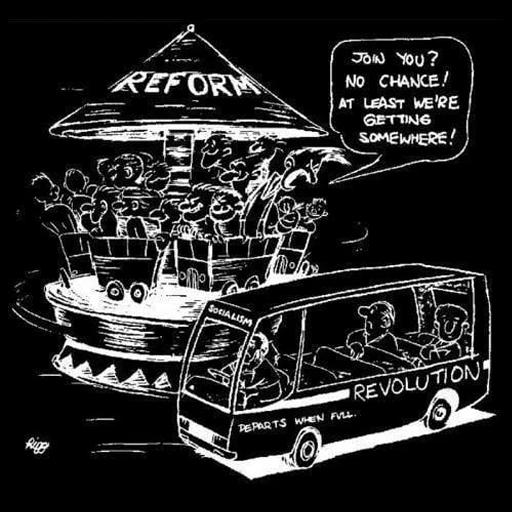
We will be fighting capitalism. When you are ready to get off your merry go round and join us on our seemingly stationary bus of revolution, we will be waiting.
Perhaps we can enlighten these Marxist Leninists with the actual words of Lenin, who had the correct stance on this issue:
“There can be no unity, federal or other, with liberal-labour politicians, with disruptors of the working-class movement(…) There can and must be unity among all consistent Marxists, among all those who stand for the entire Marxist body and for the uncurtailed slogans, independently of the liquidators and apart from them.
Unity is a great thing and a great slogan. But what the workers’ cause needs is the unity of Marxists, not unity between Marxists, and opponents and distorters of Marxism.” -Lenin, Unity
The revolution will take work or the revolution will fail.
Every critique of ours is based in the real activity and objectives of the organization we were discussing. All of these accusations appear to come out of either an egoistic desire to insult us, or a full misunderstanding of what we both believe and do.
By “work” we can only understand that you mean reformist activism, your specific brand of larp. The revolution does require active organization of the revolutionary minority of the class, but this activity must be towards our revolutionary end. It does not require engaging in everything and anything that seems vaguely left wing just because it involves painting slogans on cardboard, and is therefore “real”.
The following was written by a contact out of Southern Illinois named Elisha Moon Williams, however, we feel that the content rings just as true here as there. The original can be accessed here.
Over the past 5 years, it seems that there has been a noticeable uptick in “general strikes” declared in the United States. Despite the decades-long demobilization of the working class through de-industrialization, the gig economy and so on, “general strikes” are more numerous than ever! Of course, these strikes are not actually being mobilized by the masses of workers but instead declared ahead of time by liberal activist groups on social media and through press releases. The most recent of these farces is the “May Day Strong” coalition.
“… a network of hundreds of organizations and hundreds of thousands of working people coming together with a common purpose: standing together against the billionaires waging a war on working people.”
When looking at the organizations that make up the coalition, it is composed of a multitude of classes working together towards a common goal. From trade unions like the Chicago Teachers’ Union and SEIU, to liberal activist organizations like 50501 and Indivisible. What is that common goal?
As the Communist Party of the Unites States’ Labor Commission put it in their publication “People’s World:”
“… taxing the billionaires so working families, not big business, come first; no ICE; no war; no private army serving authoritarian power; expand democracy; hands off our vote.”
The CPUSA aren’t the only alleged socialists involved with this project, however. Overt sections of this coalition also include the Democratic Socialists of America (DSA), Party for Socialism and Liberation (PSL), the Freedom Road Socialist Organization (FRSO), and (allegedly) the Industrial Workers of the World.
Within my region of the country, the St. Louis DSA has openly declared its support for such a “strike” on May Day in a post:
“It’s up to us to organize and act together. The change we need has never come from voting harder or making one more phone call alone — every time abuse of power has been stopped, it’s been because labor and community moved in collective action.”
The PSL especially has been honing on the cross-class nature of this “strike” within their very own posts on social media. The St. Louis Section of the PSL has openly declared that they are using “outreach sessions” to “talk to our neighbors and small businesses about the May 1st General strike.” In another post, they endorsed a joint press conference they held in which member of the city’s Board of Aldermen, Daniela Velasquez endorsed the strike alongside Ward 3 Committee-person for the Democratic Party Maxi Glamour and a representative of the local 50501 chapter. How can you say that you have a general strike with any power when one of the members of the state, the “executive committee of the bourgeoisie” is endorsing it and allegedly urging their fellow members of the state into “participating?” How can you claim a “general strike” on the part of the workers when it’s being organized by coalition members like Maxi Glamour, member of a party of the owning classes, openly running a merchandise and entertainment business fueled by their brand?
As of writing this article, 4 more members of the Board of Aldermen have endorsed this “general strike:” Alisha Sonnier, Laura Keys, Rasheen Aldridge, and President of the Board of Aldermen Megan Green. Many of these representatives have been presiding over the city government for several years, administering the region’s managed decay across multiple mayors. The local police in 2017 brutalized working class people when they took to the streets to protest its murder of yet another civilian. The city government paid over 4 million dollars in settlements towards the victims of such police violence to shut them up. That cover-up of the police’s brutal violence towards workers in the courts was funded by the same alder-people that are now calling on you to join them in a “general strike” against Trump and the Republican Party’s takeover of the St. Louis Metropolitan Police. They continually increased the funding of a police force that, at any moment, could start a formal agreement with ICE to try and snatch immigrant workers off the streets and go beyond the individual reporting that seems to be happening already. These are people that represent another section of the owning class, simply another side of the same capitalist coin. They want to use the St. Louis working class and whatever activity it can muster to fight its own battle for control of the state and national government while supporting the very same systems that caused actors like Trump to rise in the first place.
In Chicago, the PSL has openly advised the workers on how they can “legally” call off work (calling off sick, using personal days, or asking off in advance) for May 1st. A strike with the owning class’s permission and made on an individual basis strips the very nature of why a strike is so powerful and how it has been used towards revolutionary ends. The strike is so transgressive and so feared as a method of struggle precisely because it disrupts the social relations that keep capitalism going. It is disrupting the self-alienation of the workers through the act of working for a boss in order to maintain themselves through wages, and also disrupting the profits of the bourgeoisie. With this action, the power of the worker is firmly, if temporarily, established so that the workers are able to extract concessions from the ruling classes. This can and has been used to spark a more fundamental change in society, even when that was not the intention of the workers themselves from the outset.
How can you justify working with a class of people whose interests fundamentally oppose that of the working class (careerists and small business owners)? How can you do so especially on a day that was made to commemorate the history of the working class’s immense power through their ability to stop working and collective organization? Was it the small business owners and artisans that slowed St. Louis to a halt in the first ever general strike in American history in solidarity with their black class-comrades in 1877? Was it the small business owners and artisans that were prosecuted and later executed by the American government during the Haymarket Affair, the whole cause of why May Day was created? Was it the small business owners and artisans that brought countries like Germany and Russia to their knees, overthrowing the Kaiser, Tsar and the Provisional government respectively in revolutionary uproar and collective strike tactics? The answer is clear!
“From the relationship of estranged labor to private property it follows further that the emancipation of society from private property, etc., from servitude, is expressed in the political form of the emancipation of the workers; not that their emancipation alone is at stake, but because the emancipation of the workers contains universal human emancipation – and it contains this because the whole of human servitude is involved in the relation of the worker to production, and all relations of servitude are but modifications and consequences of this relation.”
Marx and Engels understood very clearly the unique position the working class was in to move towards international socialism, and why they supported such a class so completely with the task of overthrowing the ruling classes. It’s not an arbitrary observation, but something they understood because of the very social relations that make someone working class and others not that give them the key to fighting for that better world.
Upon further investigation, the PSL within St. Louis are handing out pamphlets across the city within the weeks leading up to this “general strike.” It mostly takes aim at the Trump administration on the grounds that he is bad for “the people” (whoever they’re supposed to be) and that the war in Iran is illegal (as if a “legal” war would be better). Here are some choice excerpts regarding this “general strike:”
“It is clearer than ever that the majority of people in this country are opposed to Trump’s agenda of racism, war and attacks on working families. His approval rating is sinking, and today’s protests are taking place in every corner of the country from small towns to big cities. What’s the next logical step? To make the people’s opposition impossible to ignore with a general strike that shuts down work, school and shopping!
…
A general strike is when people from all walks of life stay home from work and school and boycott shopping. It shuts down profit making for the billionaire class who runs the government, and demonstrates beyond a shadow of a doubt that working people are the ones who make this country run.
On May 1st, unions, community groups and progressive organizations of all kinds are gearing up for another powerful day of protest. We need to do everything we can to get ready to make this day an expression of people’s power that can stop Trump in his tracks – a general strike!”
A PSL handout made to be distributed during their recent “outreach sessions” across the city of St. Louis.
This understanding of a general strike is incredibly misguided for many reasons. First and foremost, one cannot simply will a general strike into existence at a set date or time as if it were simply another protest or rally. You can no more declare a general strike into existence than you can declare a hurricane into motion! General strikes that have any real power are often spontaneously created due to a mixture of the working class’s own activity and the crises that animate the context of their actions. Like hurricanes, general strikes often occur as a culmination of ever-escalating forces that later dispense themselves in devastating fashion. Instead of the circling of cold and hot air at different pressures, the general strike is fueled by the conditions that make the maintenance of capitalism’s social relations unbearable and the self-activity of the working class in response to such crises that challenge these social relations.
The St. Louis General Strike of 1877 is a great example of this concept, as it even took the socialist party that would later be given control of it by complete surprise when it occurred. A general strike wasn’t declared until the conditions for it coming into being were already occurring within the bodies of railroad workers of East St. Louis.1 Also like hurricanes, you cannot declare that a general strike is occurring until one is already well underway. Not even the more self-aware sections of the working class (those self-declared as communists and organize themselves as such) can dictate such action over the whole working class and expect it to succeed with the same effect as the activity that belongs to the whole working class itself.
Even when such strikes are put under the helm of unions and parties, like in the case of 1877, the British General strike in 1926 and the French General Strike of 1968, even the unions and “socialist” parties that claim to represent them openly sabotaged the workers. They joined with the owning classes to maintain “order,” or worse, actively sabotaged the workers by refusing to help in their armament in order to defend themselves against the coming repression to end the strike with a genuine belief that they wish to enact this form of struggle in a “peaceful” manner.
We cannot know for certain what the outcome of this event will be. There have been plenty of genuine working class innovations even in the midst of movements that were, at their inception, led by the bourgeoisie. A big example of this innovation that the working class took very clearly to heart was the Petrograd Soviet during the 1905 Russian Revolution. In the midst of a struggle between the bourgeoisie, peasants, proletariat and the aristocracy came forth the Worker’s Council (or Soviet) in the Russian Empire’s largest city. A whole host of socialists participated in the event, ultimately being led by Leon Trotsky, who would later be a key part of the Russian Revolution and the Russian Civil War (for better and worse).
If there is to be an outburst of independent revolutionary energy by the working class either in St. Louis or elsewhere that threatens the control of the petty bourgeois activists and small business owners, then it will be in spite of the efforts made by all these groups and not because of them. In fact, much like the old Workingman’s Party, the British Trade Unions, and French Communist Party, they will likely be the first in line to put the workers back in their “rightful” place or maintain “order” when the fires of revolt become too hot for their liking. Others within this group may simply stand back and watch as their class partners within the bourgeoisie suppress the workers that they championed prior due to them moving in directions clearly counter to their own saintly ideas. They will, when the fires are extinguished and the books are written, then claim that the only problem with such a movement in retrospect was a “lack of revolutionary leadership.”
If such independent class action does occur in response to the conditions that are clearly escalating in this country, communists worthy of the name should welcome such action. If it is nearby, we should not seek to control and command such movements as the petty bourgeois activists and unions are clearly attempting. We should join alongside them as fellow members of the working class and bring whatever unfolds to its logical conclusion through ardent advocacy towards expanding the revolt at hand and refusing compromise with the bourgeoisie. As an unknown speaker during the St. Louis General Strike once declared, the masses of workers responding with prolonged cheers:
“Why this state of things? Because it’s so, according to the law. Well, if that’s the law, then damn the law. If that is the rule that governs society, then the sooner it is broken the better.”2
Kruger, Mark. The St. Louis Commune: Communism in the Heartland. Bison Books, 2021, pp. 198-199. ↩︎
Kruger, Mark. The St. Louis Commune: Communism in the Heartland. Bison Books, 2021, pp. 204. ↩︎