Category: Works

  • What We Do

    What We Do

    Intro

    In both our writing and our outreach to individual workers and organizations, the question we are most often asked is: “What do you do?” Usually this question carries an implied belief that our organization exists solely to criticize other groups. While this impression is understandable, it is not accurate. Much of our early work has focused on criticism of various non-Communist organizations and ideas, but this has only been a necessary first step to distinguish our methodology and ultimate goals from those groups. This is not our organization’s only focus.

    We acknowledge that up to now we have mostly mentioned our purpose and aspirations in bits and pieces across other texts. We write this document to clarify what we do as an organization, what we aim to do, and what actions we believe readers should take if they share our commitment to building a revolutionary force under capitalism.

    What we Do

    Four months ago, our founding members created this organization to fill a niche that did not exist in Southern Arizona. That being, a theoretically grounded revolutionary organization. Our principal task is to further the intellectual understanding and development of the class struggle within the class, and to organize towards the realization of Communism as a class. 

    To this end, our primary method has been the writing of a monthly publication in which we analyze the trends in our local area and connect them to the global class conflict through a materialist lens. Such writing is important not just because of the finished articles we have released, but for the development of our own theoretical understanding of the capitalist world through the collaborative writing process itself. 

    Connected to this is our hosting of group readings and discussions of Communist theory and the history of the class struggle. While reading a book will not overthrow Capitalism, the understanding and unity we have developed through such activities is the tantamount first step towards the realization of the movements of Capital towards its own destruction.

    Further, we have (albeit to a small capacity) intervened in local demonstrations to be the militant presence at these events. Contrary to the false binary of showing critical support to non-communist movements or being completely absent, we believe that an active presence outside and counter to such movements is a key task of militants.

    To put it succinctly, our primary purpose is to provide a resolute analysis of the past, present, and future of the class struggle. We succeed when we help someone deepen their existing class consciousness, of their position within the global class struggle, and of the long history of proletarian victories and defeats.

    What we Aim to Do

    In the few months of our existence our membership has grown alongside our understanding of numerous topics, providing us with both more organizational capacity and greater clarity, enabling us to expand our work.

    Alongside our reading groups, writing sessions, and discussions with comrades from around the world, we will soon start hosting regular in person meetings, which we will announce on our website and Instagram.

    Lastly, we aim to intervene at more events where discontented workers are likely to be present, particularly those seeking an alternative to the capitalist system. This will help us build connections, better clarify our positions, and encourage further learning and militancy.

    We realize that our viewpoint is not palatable to most workers at this time, because (given historical patterns) the working class can only be radicalized in great numbers by the inevitable intensification of capitalist crisis. For this reason, we do not “meet the class where they are at.” Rather, we prepare for the moment when more and more of the class can meet us, and hopefully even surpass us.

    At a time when the contradictions of the capitalist system are increasingly undeniable, and so interest in an alternative to the current social model is growing, clarifying what communism is and is not must be understood as active work. When “Communism” is constantly misidentified as Mamdani’s idea of municipal grocery stores, Chinese state capitalism, or as any of the other countless distortions put forward by capital, fighting to develop and defend theoretical clarity is not merely an academic exercise, it is a necessary and material form of intervention.

    Our goal is to help ensure that the future revolutionary moment becomes a genuine transformation of society from capitalism to Communism, rather than another reorganization of capital, as has happened in the past. This will be achieved by helping to develop a coherent Communist program and by advocating for its implementation by the larger working class. We see ourselves as simply the local contingent of the global revolutionary movement of the working class.

    It is worth restating that while the theoretical defense of Communism is our primary purpose, it is not our only purpose.  While the crisis that radicalizes workers is made by capitalism, the movement that turns this crisis into a revolution is not an automatic process that will complete itself without any work. 

    For now, since we are only just starting in person events, we cannot provide a full picture of everything our work will entail yet. However, we can say this: it will no doubt involve skill sharing, presentations, continued engagement with local struggles, further exploration of the class history of our region, and other group activities that align with the purpose of our organization. By steadily cultivating and renewing our revolutionary consciousness, we ensure that our actions remain effective, advance our development, and strengthen the class movement in our area.

    What Should You DO?

    We consider all people and organizations who share our key positions to be in the “proletarian camp”, that is, part of the Communist movement, of which we are only a small part. This movement consists of the minority of workers who recognize themselves as part of the larger working class and genuinely advocate for it to achieve its ultimate goal: the creation of a Communist society through an international proletarian revolution. The establishment of such a society represents the liberation of all life on Earth from our irrational and uncaring system. 

    Communist revolutionaries have the task of helping point the larger class in the direction towards Communism. Anyone who wants to see human history advance towards a free, Communist world, should become organized with those who share that vision of our collective future. We formed this organization out of that conviction, and we are now confident that we provide a space for this necessary work.

    To those who share our commitment to rebuilding and advancing the international organization of the working class, we invite you to reach out to us (or any other Communist organizations listed in our External Links page) with any questions, comments, ideas, criticisms, or requests to get involved.

    Socialism or Barbarism, Communism or Extinction, there is no third way!

  • National Liberation Will Not Save Palestinian Lives

    National Liberation Will Not Save Palestinian Lives

    Also in Español

    We Are Firmly Against This Genocide

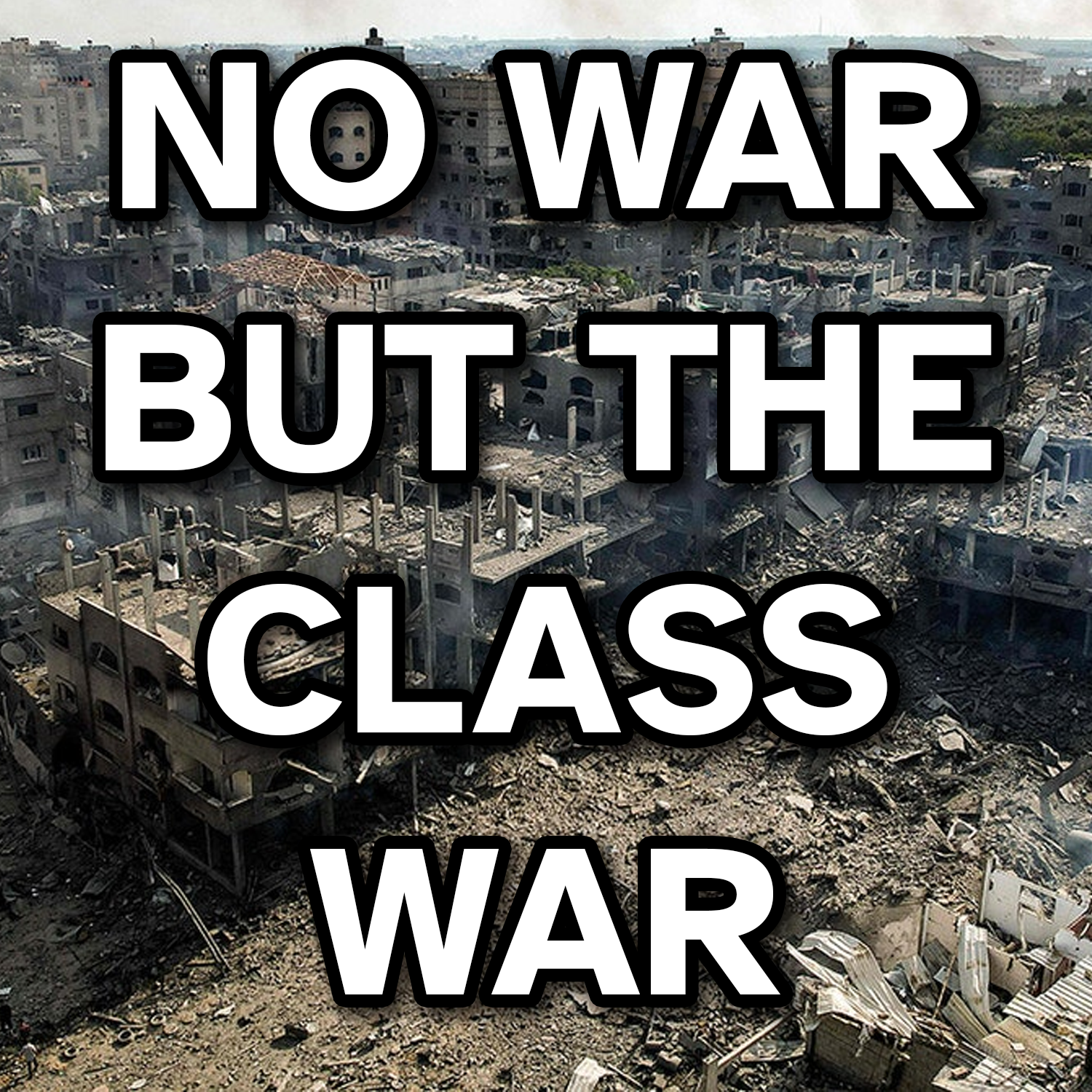
    Over the last 2 years, Israel has killed anywhere from 65,000 to 680,000 Palestinians.1 In a campaign of indiscriminate bombing, land invasion of the entire Gaza Strip, and the forced relocation of nearly the entire civilian population. It is obvious that the actions of the Israeli state constitute mass ethnic cleansing to make way for the benefit of global capital’s accumulation. Important to note is also that such policies have not been taken only in the past two years, but are merely an escalation of the ethnic cleansing that Israel has been engaged in since the Nakba in 1948. Anyone who refuses to acknowledge this reality cannot be taken seriously on the subject. 

    In response to this extermination presented for the world to see, movements dedicated to opposing material aid to Israel have appeared across the planet. We write this article primarily for the members of these movements, because we sympathize with them greatly. Yet it was in our time taking part in and observing the actions of these movements that we have come to believe that a full theoretical understanding of the causes of this genocide is rarely held, and the conclusions that are drawn as a result of such lack of a materialist worldview will lead to nothing but further inability to effectively confront the system of capitalism, the ultimate cause of this genocide. 

    It is not enough to discuss events past or present and to act without full theoretical clarity. We must think critically about the full implications of them, what caused them, as well as what course of action we must take to actually end such atrocities. Capitalism, which the entire world finds itself struggling under, exists precisely because it captures revolutionary energy that might supersede it (alongside its massacres) into organizational dead ends that seek only to target its worst manifestations. We must attack its roots and not its branches. What this means is that in order to actually end such massacres, we must first educate ourselves to know how to overthrow capitalism, and further, to know what it actually means to overthrow capitalism.

    Idealist Abstractions of The Non-Communist Left

    Certainly, it may be quite a controversial statement to say that capitalism is the cause of the ongoing Palestinian genocide. Rarely is it denied by those opposed to the genocide that capitalism has provided the framework for such a genocide to happen, even that capitalism has incentivized it to happen. Yet despite this, there is still an apprehension by many organizations and individuals to admit that the ongoing genocide was caused and continues to happen inseparably because of capitalism.

    This apprehension has many causes, most obviously among them the lack of a materialist understanding of how capitalism directly causes and then informs other oppressive systems and beliefs such as racism, nationalism, imperialism and sexism. Such a flawed idealist conception of the world can be seen quite clearly in the broadly accepted notion of “Intersectionality” within the non-communist left. Taken definitionally, intersectionality is:

    “The interconnected nature of social categorizations such as race, class, and gender, regarded as creating overlapping and interdependent systems of discrimination or disadvantage; a theoretical approach based on such a premise.”

    -Oxford Dictionary

    At first glance, this seems to be a correct understanding of how the world works. Certainly we do not deny that Capitalism is interconnected with systems such as Racism, Sexism, and Imperialism. Where we do disagree is in the notion that class is (if even present) portrayed as on equal footing to and in some respects independent of other forms of oppression. Such is a notion that has been demonstrably proven false historically. Modern racism as a social institution did not exist prior to mercantilist (early capitalist) chattel slavery, which necessitated its creation to justify its means of exploitation. Sexism has existed since ancient times, yet its manifestation has always been dependent on the class relations that enforced and created it. Imperialism became a global institution only as capital, driven by its own growth, necessitated new markets for continued growth and exploitation.

    A lack of such understanding, and more importantly its consequences, can be seen in the propaganda and subsequent actions of the various non-communist left organizations that constantly pin the genocide on individuals, ideas, or nations; rather than on the all encompassing global system of capitalism. And which subsequently argue (purposefully or unwittingly) that we must fight these individuals, ideas, or nations rather than their source, capitalism. Take for example the Party for Socialism and Liberation’s article “Trump a full partner in Israel’s onslaught against Iran, risks wider war”2 which states:

    “Donald Trump is the co-architect of the Israeli war against Iran and shares full responsibility with Benjamin Netanyahu for the extraordinary danger facing the whole world.”

    -The Party for Socialism and Liberation

    Notably, this article contained zero mentions of capital, capitalism, capitalists, profit, socialism, labor, the proletariat, or workers. Something which is certainly strange for a supposedly socialist organization. Surprising even to us was their decision not to even mention as much as the fact that such imperialist policies were similarly taken by the government prior to Trump. As a result, they place the blame squarely on the shoulders of individual heads of state and feuds between particular nations, rather than on the ruling class of all nations, the international bourgeoisie. Essentially repeating the nationalistic propaganda of the ruling class and spinning it as communist rhetoric for them.

    Claim as they may that such blatant abandonment of the class struggle was partaken as part of a strategy of “meeting the working class where they’re at,” the result of such a strategy is the same; venting of actual class struggle into reformism. They betray the fact that they do not wish to overturn the existing bourgeois world system, but instead see themselves as the vanguard of international bourgeois law by their statement in the same article:

    “Make no mistake, the Israeli war against Iran is a clear violation of the UN Charter, and thus a violation of international law.”

    -The Party for Socialism and Liberation

    Refusing to spread the actual aims of communism is non-communist, but to reify the institutions of bourgeois control over the world is undeniably anti-communist. Such doctrine comes not from thin air, but as a direct result of an idealistic understanding of what causes atrocities such as the Palestinian genocide.

    Why Does Capitalism Cause Such Atrocities?

    Put most simply, Capitalism causes such atrocities due to its tendency to make redundant swathes of the working class through its necessary development of capital accumulation. Such is not a novel or new tendency that must be uniquely resisted separate to capitalism (nor can it be), but an intrinsic part of the system that has existed for as long as capitalism itself.

    As a brief explanation of why this occurs, the bourgeoisie (who gain their wealth only by the expropriation of surplus value produced by the proletariat), due to their competition amongst one another are forced to produce commodities for as little value as possible. Value (which under capitalism is determined solely by socially necessary labor time) must in this way be optimized either by using capital (machinery) to reduce the labor time spent on the production of any given commodity, or by increasingly exploiting the working class (paying them less for their labor, etc). What this means is that due to their own competition, the bourgeois must lay off workers whose jobs are made redundant, leaving vast sections of the proletariat impoverished. A further explanation of the actual economics behind this has been linked at the bottom of the work.

    What is important for the topic at hand here is that in response to this mass impoverishment, the proletariat, in leaps and bounds, realizes its collective interest against the system, and will take whatever course of action they feel will best preserve their own survival. This radicalism within the working class, brought about by the material conditions of capitalism represents the source of capital’s destruction; but is also something which the bourgeoisie, in an effort to preserve their own survival as a class, has learned to warp through obfuscation and lies into non-communist forms through the division of the working class via arbitrary distinctions such as nationality, race, religion, sexuality, and gender.

    In the United States, this process can be seen most clearly through the historical shifts in immigration policy taken at different stages in capitalism’s development, and the subsequent spread of racist attitudes and oppression that followed. It is possible to track like clockwork the cyclical nature by which the bourgeois state, according to the needs of the class it represents, either allows or expels migrants from abroad. During both the first and second world wars, the state, in a situation in which capital necessitated large amounts of growth, relaxed immigration policy to allow large numbers of migrant workers to enter the country. Programs that were then reversed and replaced with state oppression of migrants in the following periods of stagnation.

    Such oppressive government policy was undertaken not because the government was evil, but because the proletariat, faced with impoverishment as a consequence of their increasing redundancy, could only be prevented from overthrowing capitalism by sacrificing a section of themselves to prolong their usefulness to the rest of the economy.

    This is not a uniquely American phenomenon, of course, as similar patterns are visible globally. The Holocaust3, the Armenian Genocide4, and of course the Palestinian genocide are but a few examples of how economic realities under capitalism lead to genocide. The Nakba quite clearly began not due to an intrinsic Jewish hatred towards the Palestinian population or vice versa, but because Palestinians needed to be forced out to allow for the appropriation of property for the vast number of Israeli settlers that capital felt best suited their interests to have inhabit the region. Palestinians have since been kept in the region by capital as a disenfranchised reserve army of labor, callable upon when necessitated by capital’s growth, and dismissible when necessitated as a concession from capital to the Israeli proletariat. In the current economic conditions of both Israel and the rest of the global capitalist system, there simply is no room for Palestinians in the capitalist economy. To attempt to resist this specific manifestation of capital without resisting the system of capitalism in its entirety is to try to change the laws of nature.

    The role of communist militants must always be to connect the struggles of any particular section of the working class at any one time to the historical oppression of the whole working class. Our task is to continually point to the fact that similar genocides have occurred in the past and that it is possible to not only discern why they occurred (as we have just done) but also to use the lessons learned in blood of how they were opposed in the past, in order to teach those who want to truly oppose genocide what will and will not achieve this goal. In furthering this theoretical understanding we help inform strategy and action, ensuring that the misconceptions and pitfalls of various kinds that have been fallen into in the past are avoided. This is not a history lecture; it is a critical analysis of the mistakes and successes of our past, it is the continuation of lessons the militant workers of the world have learned themselves through lifetimes of effort. When we criticize these ideas and those who believe them, it is for the benefit of future victims of imperialist slaughter and for all of humanity, who serve to be liberated by our cause.

    Against Full Support of National Liberation

    The most clearly non-Communist and thus ineffectual form that this activism has taken is through the organizations that proclaim full support for the national liberation of Palestine (and as such the concept of nationality) as a worthwhile or necessary end in and of itself. These organizations fall into two broad categories. Firstly, those that solely exist to advocate national liberation. Secondly, those who falsify the doctrine of Socialism, and as such claim that it should support such national liberation. Both of these groups ultimately fail to address the underlying causes of the genocide, and it is these organizations that advocate for nationalism and national liberation as part of a socialist strategy that represent the most dangerous tendency within the left.  Hereafter, we will refer to the organizations that comprise this ideological tendency, which advocates national liberation as a method to advance Communism, with an unsettling yet accurate title for their beliefs, National Socialists. 

    Advocating solely for the national liberation of Palestine as the National Socialists do, is ultimately a disservice to the people who are being genocided along its national lines. This approach only addresses the imperialist component of capital without challenging the greater system that ultimately produces it. Anti-imperialism without anti-capitalism is ultimately fighting a symptom rather than a cause, and this avenue will lead only to further genocides and imperialist wars. Such an approach fundamentally leads to a struggle that (if it succeeds) will only lead to a new state which must then itself engage in the imperialist system of capitalism. Such a fact is not merely theoretical but backed up by the history of national/ethnic liberation movements. 

    Would these National Socialists have supported the struggle of the Hutu people to overthrow the colonial backed Tutsi regime in Rwanda prior to 1990? It is undeniable that prior to their overthrow, the Hutus were oppressed by the Tutsis in a very real and material way. Similar to Israel, the Tutsi regime was also backed by the Imperialist capitalist blocs for the purposes of neocolonialism. The circumstances are of course different in the way that the Tutsi did not themselves come from abroad and force the Hutus off the land, yet if genetic ties to land or historical tradition is the sole reason for a supposedly socialist organization’s stance on which nations should be supported in their right to violently take claim to a piece of land, it is hopefully clear that they are not at all socialist, but reactionary defenders of the doctrine of blood and soil. 

    For decades, various Hutu ethnic liberation groups attempted to overthrow the Tutsi regime and failed quite similarly to the Palestinian national liberation movement. This of course, all changed when the imperialist powers decided it was in their best interest to instead back the Hutus instead of the Tutsis. While the interests of American capital are today very linked to that of the Israeli state, it is already known today that Hamas was funded by Israel and Qatar. It is also a readily available fact that Syria and Iran have participated by proxy in the region’s conflict.

    In 1972, an issue of “Workers Vanguard” (A Trotskyist newspaper with which we do not fully share our views with) wrote “Nor is the nationalism of the oppressed any more noble. Let it not be forgotten that the Palestinian Arabs are victims of the nationalism of the oppressed turned oppressor. In Burundi, had the Hutu’s coup against the ruling minority Tutsi been successful, the tribalism of the oppressed would have translated itself into the genocidal nationalism of the oppressor, All nationalism is reactionary, for successful nationalism equals genocide.”5 Certainly a shockingly clairvoyant prediction given our hindsight of what happened in 1994 when the Hutu indeed did succeed in their coup against the Tutsi. 

    While it may be hard for us to today comprehend a world in which the tables suddenly flip and it is the Palestinians who have the power under capitalism to engage in an ethnic cleansing campaign against the Israelis (who contrary to the racist dogmatism of National Socialist parties like PSL are not are all nepo babies who willingly came to Israel from Brooklyn), all that it would take for the balance of power in the region to suddenly shift would be for the Western powers to decide that support for a Palestinian satellite state is better suited to their goals or for Chinese capitalism to decide that competition against the western powers in the region is necessary for its continued growth and for it to successfully enforce the creation of a Palestinian state within their sphere of influence.

    In such a turn of events, the entire movement of entryism and rallying around the national liberation of Palestine would all at once turn on the National Socialists’ heads and, as all non-communist movements do, be co-opted by capital into something that even more directly serves its interests.

    Though it’s impossible to tell whether or not a Palestinian national liberation movement would succeed at overthrowing Israeli nationalism; the results of either the failure or success of such a movement are, from analysis of history, crystal clear. Rwanda is but one example. We could also look to Cambodia under the Khmer Rouge, Bosnia in 1995, Darfur since 2003, the Rohingya in Myanmar, Tigray in Ethiopia, or currently the Masalit, a non-Arab population in Sudan to see the same process repeating itself across time. 

    There is no method by which national liberation can be in any way a building block of Communist society, and there is no method by which Communists can support it without themselves becoming the pawns of Capitalism.

    What Does it Actually Mean to Support or Not Support National Liberation Movements

    With this in mind, we must also ask what such support given by such organizations within the non-communist left actually means. Within this wider discussion, we see a lot of confusion and false understanding about the nature by which we can actually give support to Palestinians in their resistance to this genocide. Contrary to the lies repeated by the propaganda machine of the ruling class, no American protester is sending weapons to Hamas. No, all that the talk and moralizing of support for national liberation amounts to is using mechanisms of political pressure on our ruling class through protest campaigns with the hope of forcing them to stop the genocide.

    This objective of the Pro-Palestine protest movement, putting pressure on our government to stop sending weapons, will absolutely never be enough. Under capitalism, protest movements do not and cannot force these concessions to happen. Because the power lies fully with the ruling class, they are fully able to choose how long to ignore any given protest movement or any minority political movement asking them for some demand. All that political pressure achieves in the decision making process of the ruling class is to help them calculate exactly what mechanisms are best to achieve their goal (profit extraction through ethnic cleansing and Israeli settlement). If the US is forced to stop sending weapons, it can give those weapons to Germany and in turn Germany will give the IDF the weapons instead. Alternatively, the US military could decide that because this is a conflict, it can simply hide its activity from the public, claiming to stop assisting this genocide while continuing to do so. We fundamentally do not live in a society where working people have full knowledge of exactly what any government is doing, we only know what they themselves tell us. Accordingly, there are endless ways that the ruling class can co-opt, mislead, or fully ignore pressure put on them by the protest movements of the working class who ask them for change, because this process is all taking place in a situation where the ruling class holds all the leverage.

    This lack of effect that declaring support for the various national liberation movements around the world actually has (even in helping the national bourgeois of any given region to establish their own exploitation of one sect of the international proletariat over another imperialist bloc, which is all that national liberation actually represents) must then be contrasted with the immense destructive impact such blatant disregard for internationalism has on the function of any organization that calls itself Communist in the actual struggle between the proletariat and bourgeoisie. Communist organizations cannot themselves defend the rights or lives of workers under capitalism, they cannot lead and win the revolution themselves, and they cannot in any serious way lead capitalism towards better outcomes. The sole vector by which organizations of militant workers (or anyone) can actually do anything to save both our species and our planet from the all encompassing system of global Capitalism is by preparing to turn the crisis of capital into a revolution that will supersede it. Key to this preparation is being the consistent body that develops the memory of the class as to its historic interests and the consistent voice that spreads this knowledge amongst the working class. In both of these domains, support for national liberation by Communist organizations serves only to play into the abstractions of the capitalist system and to divide the international among nationalist lines. For this reason, it can be considered only to be an anti-communist and counter-revolutionary practice, and one which actual Communists must make a concerted point to denounce as such.

    Against Opportunist Critical Support

    In contrast to full support for the national liberation of Palestine, there is a countervalent logic within certain sects of the left who, rather than support the national liberation of Palestine as an end goal in and of itself, advocate it on the grounds of national liberation weakening “The Empire” and being an example of successful working class mobilization that can push further action.  We often even see a hybrid approach where a group may flip back and forth between both perspectives. For example the PSL says in a separate article of theirs:

    “This (support of national liberation) is not only a morally correct position for the U.S. movement but a strategic necessity. The capitalist class that supports and profits from the oppression of Palestinians is the same capitalist class that creates poverty, inequality, and insecurity within the United States. Thus, if those capitalists lose their domination over Palestine, the working class movement here will benefit. So too would the Palestinian liberation struggle benefit if those capitalists lose their domination over the U.S. working class. International solidarity is a necessary tool to build a strong working class movement on many fronts against a common enemy.”

    -The Party for Socialism and Liberation6

    It would be understandable to read this position and agree that it represents true proletarian internationalism, they are correct after all, that we have a duty to fight against our own national bourgeoisie during all wars and with the necessity of international solidarity. The problem arises when we look at what is meant by their exact form of solidarity with “Palestinian liberation” because in effect they mean support for the national liberation of Palestine, not support for the liberation of the Palestinian working class. 

    If we confuse national liberation for a substitute for or a stepping stone to international proletarian revolution, then we continue in a direction away from Communism. Nationalism of all kinds, even underdog nationalism, is an anti-communist goal. Class collaboration is similarly a measure that has only led to disaster and death for those who want to bring about a liberated humanity without borders or a ruling class.

    Because we exist in a world with large imperialist power blocs constantly competing with one another for influence, we have to ensure that our theory and actions are directly opposed to the capitalist system itself, rather than in support of one component of the system or one section of the ruling class against another.

    We know that the leadership of Hamas operates as a militia for the capitalist ruling class of other imperialist blocs, principally Iran, and it uses an ideology of Palestinian nationalism for propaganda to cloak its particular form of oppressive control. This means that if we hold our noses and give critical support, we are opening the door to a very dangerous move, collaboration and sympathy with nationalist movements and capitalist states. If there is any lesson that Communists have learned in the last 100 years of counterrevolution, it is that we cannot work with, or support in any form, any cause that does not support our goal of a united and liberated humanity. It should be clear that the creation of an independent Palestinian state, regardless of other effects, would not assist the international working class in its task of organizing a revolution and the establishment of a new society.

    As the Internationalist Communist Tendency so eloquently puts it:

    “The project of national liberation, the so-called “right of nations to self-determination” is the project of the bourgeoisie that was completed as the imperialist phase of capitalism began. Today [the] ability of a national bourgeoisie to realize its project of national liberation hinges entirely in its capacity to mobilize backing and capital from a major imperialist power. This was clear from the very struggles that created Israel itself”7

    -The Internationalist Communist Tendency

    The dissolution and creation of nation-states is firmly in the framework of competition and struggle between the various capitalist blocs, and therefore not for the workers of the world to treat with any real legitimacy. This is evidenced when the Soviet Union supported the creation of the state of Israel in 1947, both diplomatically by being the first state to officially recognize them and by materially sending arms from Czechoslovakia, then part of the Soviet bloc, to aid them in their establishment. Such support was given by the “great and authentic” Soviet Union, not because they wanted to support the right of national determination for a group who had just come out of a genocide, but because they felt it would deal a decisive blow to the imperialist British and French control of the region and support their own ambitions as a bourgeois world power.

    “As we know, the aspirations of a considerable part of the Jewish people are linked with the problem of Palestine and of its future administration. This fact scarcely requires proof. … During the last war, the Jewish people underwent exceptional sorrow and suffering. …

    The United Nations cannot and must not regard this situation with indifference, since this would be incompatible with the high principles proclaimed in its Charter. …

    The fact that no Western European State has been able to ensure the defence of the elementary rights of the Jewish people and to safeguard it against the violence of the fascist executioners explains the aspirations of the Jews to establish their own State. It would be unjust not to take this into consideration and to deny the right of the Jewish people to realize this aspiration.” 

    -Soviet ambassador Andrei Gromyko 14 May 1947

    What Should We Actually Be Doing?

    If supporting national liberation will not actually save Palestinian lives or bring an end to capitalism, but will more likely than not achieve the exact opposite, then what is it that we can actually do to end the genocide? 

    We express our solidarity with Palestinians, not a Palestinian nation, because nations are merely a form of political division of people. We express our support for the working class of Palestine through our continued struggle to achieve true liberation alongside them, as a part of our shared liberation along the identity that we have in common, as members of the working class. We do not fetishize the Palestinian population as victims who need special treatment, but rather we treat them as human beings with the same agency and the same herculean task as the rest of us. 

    Support for the oppressive rulers of an oppressed people so that they won’t fall under the rule of a different ruling class is a massive disservice to a population that has already suffered incredible hardship. When we express solidarity with Palestinians, is it based on ethnicity, nationality, and political orientation, or is it because even though they live thousands of miles away, we have more in common with them than we do with our national ruling class?

    To show solidarity with the working class of Palestine is important; in fact it is unavoidable for anyone with even a shred of empathy. But no matter the intention, the outcome of transforming this solidarity with Palestinians into critical support of its capitalist regime is a dangerous misstep that leads only to the continuation of the myths of nationalism and the legitimacy of the nation-state. In effect, this muddling of theory leads to confusion for the whole working class and its revolutionary movement, harming the possibility of freedom for the Palestinian people and all the workers of the world. 

    Until the time for global revolution is at hand we can only organize ourselves and the wider class so that all workers, including Palestinian workers, will be able to overthrow the oppressive system of capitalism that has caused such atrocities. When that time comes the Palestinian working class will play their own part in defeating the capitalist system in their own locale as well as the forces of counterrevolution that will inevitably attempt to respond to this radical act of liberation. Until then, it is nonsensical and directly harmful to give support to the very forces that play a role in the repression and control of the Palestinian working class. 

    Perhaps the hardest part of this struggle is to accept that as of now the class movement can only have a negligible effect on this ongoing Genocide, a massacre happening before the eyes of the whole globe. Yet the purpose of Communist organizing is not to do what makes us feel morally righteous, but to be radically honest with ourselves, to be brave enough to accept the truth of our abilities at this moment so that we may act in accordance with reality. We cannot stop this, neither through reformist demands nor rallying to the ideologies of National Socialists, opportunists, or outright reactionary nationalists.

    We cannot stop this slaughter, in the same way we cannot stop the slaughters in Sudan, in Myanmar, or Ukraine. Our duty as Internationalist communists who hold solidarity for all the world’s workers, to tirelessly organize and further our capacity for change in this horrific world, which can only mean building towards an international revolution to overthrow this world encompassing system. This means continuous defense of our hard learned positions and strategies, not only in the times where it is easy to do so, but especially in the times such as these where it is most difficult.

    We have a world to win, but we also have a world to lose. We can either learn from the mistakes of the past or repeat them. If you want to overthrow capitalism and build a world in which all people are free, only Communist organizations prepared to meet the revolutionary wave will be able to do so. If you want to support one imperialist bloc against another, join one of the various National Socialist organizations that warp the doctrine of Communism into the destruction of the working class.

    And Remember…

    Socialism or Barbarism, Communism or Extinction – There is no Third Way!


    Further Reading

    Capitalism’s Economic Foundations – The ICT

    The Invention of the White Race – Theodore W Allen

    1. https://www.ochaopt.org/content/reported-impact-snapshot-gaza-strip-22-october-2025 ↩︎
    2. https://liberationnews.org/psl-statement-trump-a-full-partner-in-israels-onslaught-against-iran-risks-wider-war/ ↩︎
    3. https://libcom.org/article/auschwitz-or-great-alibi ↩︎
    4. https://www.leftcom.org/en/articles/2015-08-06/1915-to-2015-a-century-of-genocide ↩︎
    5. https://www.marxists.org/history/etol/newspape/workersvanguard/1972/0012_00_10_1972.pdf ↩︎
    6. https://liberationnews.org/palestine-the-struggle-for-national-liberation-and-the-role-of-the-u-s-working-class/ ↩︎
    7. https://www.leftcom.org/en/articles/2002-11-01/against-israel-against-palestine-for-class-struggle ↩︎
  • Reformism and Leftist Infighting, The Future Martyrs and Renegades of DSA

    Reformism and Leftist Infighting, The Future Martyrs and Renegades of DSA

    Intro

    The following is our critique of both the Democratic Party of the United States; and more specifically the Democratic Socialists of America within them. We have prefaced this critique with (in order) a reminder of what socialists should be organizing for, the inherent flaws of reformist policy (with historical and current examples), and a defense of the need for an independent communist movement against ideas such as leftist infighting (with historical proof). 

    We feel it important to note that the critiques expressed here are aimed at the organizations themselves as well as the role that they actually play in the struggle between the bourgeois and the proletariat, not at the individual members of these organizations (many of whom we have personal connections with and believe are true socialists that are merely misguided in their efforts). We write this critique because we understand historically that when the proletariat allows the Communist movement to be funneled into such compromised reformist culs-de-sac; it benefits only the repression of the masses and the furtherance of the aims and existence of capital. 

    If you are a part of these reformist organizations or sympathetic to them, we ask only that as leftists you listen to what we have to say with an open mind and consider if the actions you take (or might potentially take) inside of them are truly productive to the movement, if they are ultimately fruitless, or if they are even harmful.

    The Goal of Communist Organizing is to be Prepared for Revolution

    The primary objective of the Communist movement, and therefore The Sonoran Internationalists, is to further the cause of the international proletarian revolution. This is a fact that, consciously or not, is widely betrayed by various groups in the “left.” We seek to build a regional organization that will one day become a part of an Internationalist Party of the Proletariat that can be capable of fully supporting and advising the entirety of the working class. To that end, we seek to build a precursor organization, a “Tucson Communist Party” if you will. We recognize that the revolution is the only pathway that will lead all life on earth away from the inevitable consequences of the furtherance of Capitalism. Furthermore, we recognize that the various groups portraying their non Communist ideals as such are actively harmful to the revolution.

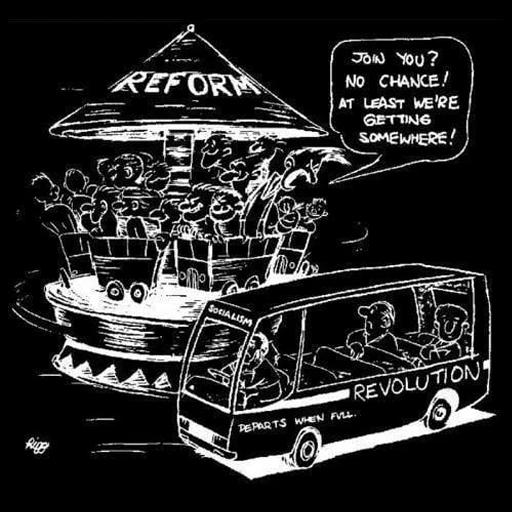
    Reformism Sustains Capitalism and Kills Proletarians

    It should be obvious by now that the Democratic Party is a stalwart defender of the status quo. Whatever infographics and catchy slogans they employ, they are the party of continuing the system of global imperialism, genocide, ecocide, and class domination. They are a party of millionaire representatives funded by billionaires. It is a capitalist party that advocates passively for minor reforms. Rather than a possible avenue for achieving an anti-capitalist future, the Democratic party is just one of many ways the capitalist class divides and distracts workers away from any class politics and towards movements for useless reforms. 

    Their role is to convince the naive and inexperienced that their hardships aren’t a result of a global system of exploitation, but of a particularly bad group of people that they also don’t like. Every time a proletarian sees their healthcare taken, their rights repealed, their home foreclosed on, the Dems are there appealing to the victim. Yet as soon as they hold a majority, their fiery rhetoric disappears, instead talking about sensibilities and moderation. This isn’t a result of particular politicians or of the Party being temporarily misguided; it is a repeated pattern that helps reveal their ultimate motivations of maintaining class domination. This is proven again every time a truly conscious independent movement has ever organized in this country. They have always faced the same reaction from the Democrats: a crackdown on the radicals with the full force of the state, and then absorption and pacification of the moderates.

    History is full of examples of social movements that attempted to reform their society for the better and did so through means both within and without the system. Through analysis of these movements as well as the material conditions of capitalism that surrounded them, we can confidently assert that reformism will not lead to any progressive outcomes in our current situation of the 21st century’s capitalist crisis. It should be clear to anyone willing to logically analyze the Capitalist system that it cannot be reformed, it cannot be tamed, it is working as it always has and will always continue to. 

    We understand that in this case, evidence is needed to back up these arguments, so we will provide examples both historic and current.

    Historical Example: German Revolution

    In the period before the First World War the ideology of social democracy was widely popular across Europe. The Social Democrats believed that the Communist revolution and transformation of society could be achieved through legal and parliamentary methods. They came to believe that the path to socialism was through the infiltration of the capitalist state and subverting it to their own ideas. This brought them popular success as well as the opportunity to acquire property of their own. The Social Democratic Party of Germany was particularly successful in this endeavor, becoming the largest political party in Germany and acquiring all the privileges that accompanied this. 

    There were also those who disagreed entirely with this line of reasoning. What we can generally call the “revolutionary Communist left” of Europe had a contingent in every Socialist Party in Europe, with some breaking free from their larger reformist party (such as the Bolsheviks in Russia) or remaining united for the sake of leftist unity (such as in Germany). Instead of social democracy, they argued, as the original scientific socialists did, that an international working class revolution was the only path to the abolition of class domination. In 1907 a proposal from the Revolutionary left members of the 2nd International (made up of the Socialist Organizations of Europe) passed, which called all Socialists to use their economic and political power to oppose war, and should it break out to turn that imperialist war into a revolutionary movement to bring about “the abolition of capitalist class rule”. The SPD as a member of the 2nd International also adopted this as official party policy. This policy was re-affirmed in 1912, and even as late as July 1914.

    Yet because the SPD had chosen the path of reform and infiltration of the bourgeois, and as a result saw the interests of their leadership now become those of the left wing of Capital in the country, this policy of anti-war internationalism could go no further than rhetoric.

    When the great imperialist war everyone had anticipated was finally upon them in 1914 the SPD had the opportunity to oppose the budget for the German Government as they had done many times before. Instead they proclaimed their loyalty to the German Empire and voted to give the State the funding necessary to wage the war. This became known as “The Great Betrayal” as the revolutionary communists of Europe saw with horror as their respective Social Democratic parties followed the SPDs example in supporting their national bourgeois and their efforts of imperialist war. 

    But why did the leadership of the SPD make this decision? Was it because they were evil and engaged in a grand conspiracy to warp the Communist SPD into a party of the bourgeois? No. It was in fact because under the lens of reformism, betraying the class struggle and the proletariat was the only possible course of action to preserve their party, their individual positions, and the progress they had made through state reforms. If indeed socialism was possible through the reform of the bourgeois state; better to go along with the imperialist war so that the process of reform could continue afterwards than to throw everything away. Under such a lens in which the state is the key factor in achieving socialism; the defense of the nation against the more backwards and less socialist nation of Russia was even honorable.

    This is how in a few short years the socialists of Europe went from being resolute in their stance against imperialist wars that would lead to the mass slaughter of working class people for nothing more than bourgeois power struggles, to instead being in full support of this very kind of conflict. In the years to come over 17 million people would die. It was largely because of the mass poverty, famine, and loss of life all resulting from this, that class tensions would again reach a boiling point after years of pointless and brutal war. 

    This led to a spontaneous revolution within the German military and eventually the larger working class in 1918, now known as the Spartacist revolution. Caught in the middle of this, the leadership of the SPD was terrified as the workers and soldiers were not participating in their form of non-violent, legal, civil, electoralist politics and instead were seizing all political and economic power themselves. After all, the property that the revolutionaries began to occupy was not just owned by the aristocracy, but also by the wealthy and privileged SPD leadership. 

    As a result of this, the SPD chose to publicly support the movement while actually plotting its downfall in secret. 

    After the initial successes of the revolution, the people of Germany found themselves in a dual power situation in which two groups, the Liberals (SPD) and the revolutionaries, now competed for legitimacy. To resolve this, a vote was to be held amongst the German Left to decide the country’s new system. The choices consisted of either formalizing the spontaneous workers council system inspired by the Russian soviets, which was advocated by the radical left, or a parliamentary republic, which was advocated by the SPD and moderates. 

    During these tenuous months, the SPD ordered their most loyal members to infiltrate the councils one by one and bring them back from the ledge of revolutionary consciousness and action. Because of the immense and longstanding popularity of the SPD, the newly conscious workers slowly began to support the ideas of these infiltrators who represented a party they had known for so long, rather than continuing to participate in the newly formed revolutionary organizations.

    One of the most pivotal moments in this stage of the counterrevolution occurred on December 19th, 1918, during the National Congress of Workers’ and Soldiers’ Councils. Where the councils voted against formalizing their own power with a permanent council system as the basis for a new constitution, handing over their newly seized power to the SPD dominated provisional government. With this, the provisional government created a plan to hold nationwide elections for a constituent national assembly. Effectively turning a spontaneous mass movement against the imperialist war and indeed all of Capitalism, and centralizing, co-opting, and largely pacifying it back into the fold of the left wing of capital.

    When only the most dedicated revolutionaries remained willing to stand in the way of the bourgeois government, the SPD gave full support to the proto-fascist Freikorps (who would eventually become the militias of the Nazi movement) and allowed the wholesale slaughter of the remaining Communist revolutionaries. This would lead directly to the eventual overthrow of their own government by the fascists, ultimately digging the graves of not only the Communists, but also their future selves.

    Historical Example: Chile 1970-1973

    A second and more recent example of the way capital utilizes reformist policy to curb, weaken, and ultimately crush actual working class struggle is the reign of Salvador Allende’s “Popular Unity” (UP) coalition; which similarly to many modern reformist movements, branded itself as a coalition of everyone from revolutionary Communists to social democrats before selling out the workers and allowing for fascist reaction to take over the country. 

    Its ascension occurred primarily as a result of the rising crisis of capital, as well as bourgeois fears over the increasing militancy of the working class (who had begun independently organizing), with the bourgeois seeing nationalization of key industries as well as other welfarist policies as necessary evils to stabilize the system (The right wing parties which held the parliamentary majority even supported the nationalization of the mines). Notably, none of these reforms put production or exchange into the hands of actual proletarians; instead transferring them from individual bourgeois firms to the bourgeois state. 

    While these policies did increase the rate of profit and stabilize the economic and social situation (which was their primary purpose); when another crisis came (as they always do) and the rate of profit once again fell, both the bourgeois and the proletariat came into conflict with the reformist policies of the UP. Workers had at this point been autonomously seizing the means of production for themselves; from the scale of single factories, all the way to entirely worker controlled districts called cordones. The supposedly socialist state’s response to these measures (which they were previously forced to acquiesce to by a stronger more independent working class) was to accuse the workers of being members of the “labor aristocracy” and to order the ending of strikes, return of the means of production to the bourgeois, and the disarmament of the workers.

    Were the working class movement more united under a non-reformist banner; it is likely that they would have been able to resist these measures. Unfortunately; years of propaganda and union support for the reformist UP meant that what resistance there was to these crackdowns was isolated and disorganized. Despite this, several local groups managed to keep their control of the means of production in spite of the best efforts of the democratic socialists; much to the chagrin of capital. 

    When none of the conciliatory measures proved sufficient enough to the bourgeois, who no longer believed the social democrats could contain the revolutionary proletariat, they instead backed a military coup, which ousted the UP in favor of a fascist military dictatorship. Many of the aforementioned autonomous workers’ groups attempted to resist this coup just as they had the UP; but their disarmament and fracturing by the social democrats meant that any efforts were too little too late.

    Short Review of the Fundamental Reasons Reform is Harmful

    In short, reformism inherently prevents the working class from building its own independent movement to overthrow capitalism, thus allowing for the consolidation of power by the bourgeois and further exploitation of the proletariat. Given that the goal of reform (known by its proponents or not) is the prolongation or improvement of Capitalism, it should be clear to communists that the reformist organizations of capital are not allies in our struggle to establish Communism, but in fact are some of our most insidious opponents. 

    Despite this fact, there often exists the tendency of the liberals to proclaim that they are on the same side as the Communists. That in the face of Fascism’s rise (which they directly cause), it is “dogmatism” or more commonly today “leftist infighting” to defend the independence of the Communist movement. That we should put our programs and goals aside for the defense of the current or past form of Capitalism from its increasingly worse manifestations. There are also those self described Communists who have adopted this parasitic brain worm of an idea as their own. This is to us the primary point of importance for this whole conversation, as the various “Communist” organizations of Tucson, as well as the potentially truly Communist members within them, have been deluded into forming an alliance with the bourgeoisie, and have as such become nothing more than appendages of the entire capitalist machine.

    The Bolsheviks, Dogmatic Leftist Infighters

    There are numerous examples of Communists collaborating with reformists and subsequently being totally defeated. As important as these examples are for revolutionary education, it is just as necessary to discuss a situation where a movement instead chose to pursue “leftist infighting” and as a result succeeded in their ultimate goals. We are speaking of course, about the Bolsheviks of the Russian Empire. 

    The Russian Empire was a powerful force of reactionary and absolute monarchist power for centuries, for reasons that are more complex than can be done justice here. What is important for this work is that the nature of the Russian state was heavily reliant on the suppression of all subversive political action. That is to say, anyone who argued against absolutist monarchy, from liberals to socialists. This is how the Tsarist regime maintained its power. The working class was also relatively small in proportion to the total population, as Russian Capitalism was still fairly new and underdeveloped, with only 6.5% of the total population of the Empire being working class and the vast majority of the population being peasants. These realities and the disagreements in policy that would result from them would prove to cause some of the largest divides between all those within the Russian left. 

    Within the Russian Social Democratic Labour Party, the predominant belief was that Communism simply was not possible in Russia because it was a majority peasant country. These members instead believed that the educated bourgeois of Russia would have to take power and install liberal democracy until the majority of Russians were converted from peasants to the industrial working class. They were known as the Mensheviks and they wanted a semi-legal bourgeois revolution that would take the existing but very weak Russian Parliament and convert it into a strong bourgeois democracy like in Western Europe.

    But there were also those in the party who had analyzed the history of class struggle within the Empire (especially the Russian revolution of 1905 where Soviets/workers councils were invented) and concluded that the only system that Communists should be advocating for was a Communist one. Rather than waiting for the bourgeois to build industry through capitalism, the working class could achieve this itself. After all in 1905 the capitalists and professors were not the ones to resist the monarchy; it was the small yet powerful working class. They could not compromise on the necessity for the working class to form its own independent organizations and to use them to achieve Communism; there was simply no other way.

    These factions agreed on many things, that the monarchist Russian Empire had to be abolished, that religious authority was a tool of state repression, and that the working class would eventually take all power for itself and abolish all of class society. Even still, this disagreement over the nature of the future revolution was enough for those who wanted illegal and non-reformist working class revolution (the Bolsheviks) to split from the larger party. The Mensheviks aspired to be like the German SPD, organized, electorally successful, and able to achieve reforms from their government. But the crackdowns from the Russian state made any reformist activism much more dangerous and less effective than it was in Western Europe. Unions had no leverage when there were no laws guaranteeing them, and election laws would be rewritten to ensure only conservative parties had power in the Empire’s Parliament. This would help ensure illegal and revolutionary tactics remained relevant as the risks for advocating revolution were similar to those of advocating for liberal democracy. The Bolsheviks could have decided that because of this dire situation, it was best to maintain unity, as their comrades in the SPD were doing, but instead they made the conscious decision that it was their duty to advocate uncompromisingly for Communist values. If it would cost them allies in the reformist left to stand against the war, for workers councils, and for power to be immediately held by workers rather than capitalists, then so be it.

    From both exile and the underground, the Bolsheviks would ceaselessly argue for years the points of the larger Revolutionary Communist Left. They were among the first and most consistent members of the Second International to argue for working class revolution during any future imperialist war. They were also the most passionate advocates of the idea that the only way to achieve Communism was for the working class to form independent workers councils, and that under absolutely no circumstances could independent working class power be undermined.

    In February of 1917 when the people of Russia rose in revolution against the Tsarist monarchy, the Bolsheviks applauded this. During this time, the workers again formed independent Soviets (councils) where affairs would be decided democratically. Meanwhile, the Russian Parliament would be strengthened, and it was made up of the liberal parties, including a large section of Mensheviks. The parliament formed a separate competing power structure from the Soviets and took on the affairs of the old Russian state, including the continuation of the unpopular imperialist war. Meanwhile, the Bolsheviks had emerged from exile and the illegal underground to continue to argue as they always had, that the workers’ councils should be the only organizations to hold power. As the months went on, the Parliament was unable to crush the workers councils, thanks to their popularity and support from the organized and militant Bolsheviks. The longstanding reputation of the Bolsheviks for absolute support of the working class and its councils would continue to strengthen the bond between the party and the larger class.

    So in November of that year, when the Liberal Parliament had proven itself politically bankrupt by continuing the imperialist war and doing little to stop the famines within the Empire, the people were again ready to revolt. With the Soviets continuing to operate for months at this point, and with a large group of Communist revolutionaries all this time encouraging the working class to take power for itself and establish a new system, the working class finally overthrew the Russian Parliament and proclaimed the slogan of the Bolsheviks for themselves “All Power to the Soviets!”. With this, the Russian working class had established the most successful Communist revolution in history.

    The Democratic Socialists of America (Liberalism)

    Although we have already talked about the Democrats, we feel it important to repeat ourselves while specifically naming the Democratic Socialists of America. They represent to us the most clearly Capitalist party that the vulgar Communist movement has allowed directly into its big tent coalition of class collaboration.

    On the Tucson DSA’s website, they proclaim that “A spectre is haunting the Sonoran Desert.” Certainly, they would not have us believe that this spectre is that of reformist advocacy for the state ownership of Capital. One which asks the proletariat to expend its effort into fighting for various reforms that the Capitalist system ultimately sees as a useful distraction rather than any real threat. Their spectre is the rebuilding of the Capitalist Democratic party into an organization that workers will once again believe in.

    The DSA is of course not a monolith, as the members of its various caucuses are so eager to explain; but a broad coalition of everyone from social democrats to Anarchists and Communists. What must be understood; however, is that regardless of the personal beliefs of any member, their participation in the DSA necessarily means that they all ultimately collaborate in the slaughter of the class struggle.

    The Right Wing of the DSA (Future Renegades)

    This is, in much the same way as the Democratic Party proper, most evident in the right wing of the DSA, which makes up the entirety of their officially elected members (and not by coincidence, which will be elaborated on later). Their program of welfare, state ownership, and imperialism (through unequal exchange, rather than the direct warfare of the right) is, (hopefully) quite obviously, not in the best interests of the working class or the process of superseding Capitalism. Similar to Chile’s UP, the right wing of the DSA has also supported the disarmament of the proletariat via gun control bills. As well as a number of other measures which seek only to parasitically use the real pressure created by the class struggle before pacifying class antagonisms and allowing for the slaughter of proletarians by the state.

    The signs of their upcoming betrayal of the proletariat and the class struggle are already apparent. Their elected officials; even when the government has not yet fully done away with its own propagandistic notions of democracy as it always does during the imperialist war, bow down to the warmongering imperialism that capital demands to satiate its need for growth in both Palestine and Ukraine. It doesn’t take much reasoning to envision what course of action they will take under the third imperialist war, as they already engage in the demonization of the more repressive capitalist countries around the globe in the name of defense of our more progressive capitalist utopia, just as the SPD did.

    We must however, give them credit in that they have also paid lip service to police defunding, the ending of the most atrocious results of Capitalist imperialism (such as the Palestinian genocide), and the decriminalization of certain forms of unionist labor activism; although curiously enough, these principals seem to last only until an individual is actually elected to public office. This can be seen in candidates elected to real positions of state power such as AOC and Bernie Sanders, who despite their previous messaging, eventually became little more than slightly left democrats due to the real courses of actions that the bourgeois government forced them to take. This of course happened not just because those elected officials were bad guys, but because of the essential flaws of parliamentary strategy. By their very nature, successful attempts to create change under capitalism can only be capitalistic, and as a result can only be undertaken by capitalist entities. 

    This is precisely the reason aforementioned that the rightmost wing of the DSA is the only faction that has seen any sort of parliamentary success. Via any faction’s introduction into the committee of the affairs of the whole bourgeois (also known as the state) its role will necessarily shift to exercise the role of their office, class domination. Certainly the further left factions may eventually see parliamentary success as the independent class movement grows, (as the bourgeois system may see it as necessary to contain and extinguish the class struggle on their own terrain), yet by the left wing of the DSA’s very participation in the system; they will eventually transform into the right wing of the DSA that they sought to replace.

    This leads to another of the key points that we wish to get across to the various members of the reformist left. That their obsession with what they perceive as real change and the chasing of immediate results rather than sticking to any real revolutionary program (also known as opportunism) will effectively only lead to a reconstitution of the capitalist system. We believe that these strategies occur because of a failure to recognize two specific facts. First, that Capitalism by its very nature trends towards crisis and as such can not be improved via reform of itself. That the progressive era of capitalism occurred not because progressives were better organized but because progressivism was what best suited the needs of capital. Secondly, that the work of educating and preparing the working class for the revolution is in and of itself active work, not merely theoretical, in other words “armchair leftism.” We recommend Amadeo Bordiga’s “Activism” as a more thorough explanation of this point, but to sum it up here: In the party, which is the determinant factor in the transformation of the bourgeois crisis into a revolutionary struggle, consciousness precedes action. For when the entirety of the capitalist machine is dedicated to the disorientation and obfuscation of the revolutionary means and aims of communism, is the defense of its doctrine and program a merely theoretical task?

    Locally, we can see this play out with the DSA’s focus on the public power campaign, which seeks to have the city of Tucson buy TEP, the local electric utility, from its current private owner Fortis. For “democratic socialists” this is a shockingly non socialist policy, unless of course your definition of socialism is “when the government does stuff.” Even the right wing Republican party under Trump was able to secure a large share of a private company, Intel, without so much as paying the bourgeois owners. Perhaps if the DSA truly wishes to pursue these state capitalist measures they would do well to ally with the conservatives similarly to how the SPD did in 1918. This would not even truly require a change in their messaging; which constantly focuses not on the exploitation of the profit motive itself, but rather on the fact that Fortis is run by a dirty foreign conglomerate (globalism). 

    Assuming the DSA is able to get public power passed, we must look at what it would actually achieve and who it ultimately benefits. Being that TEP is a natural monopoly, the trust busting measures taken towards the railroads that the American bourgeois state implemented in the late 19th century serve as a good example. Touted often by state capitalists as an example of the government working for the good of the people rather than the big businesses; it was in reality a tactically necessary concession given to ease the class tensions of the rail workers in the country, as well as to the industrial and petite bourgeois of the cities who felt that the surplus value of their production was being unfairly stolen from their workers and given to the railroad owners, rather than stolen from their workers and given to them. It is not unreasonable therefore to assume a similar course of events following the state takeover of TEP. Certainly lowered electricity costs would be greatly appreciated by the corporations like Amazon that wish to build electricity and water intensive data centers for example.

    We can imagine that in response, the supporters of public power will likely be bringing up two key responses. Firstly, that while yes it would certainly support capital; it would also have a real impact on the quality of life for the proletariat in Tucson. Our response is to what degree and for what amount of time? As a commodity under the profit motive, labor will over time fall in value to that of its cost of reproduction. As such, any lowering in the cost of living in one area will lead only to the increased cost of living in another by another sector of the bourgeois, or a lowering of real wages. It is for example very easy to imagine that a lowering in cost of electricity would lead to an increase in rent as demand to live in the city increases, and while any measure by which the cost of living is increased can be resisted; all of them cannot. 

    The second retort we can imagine in response to this is that state capitalism is the natural highest stage of capitalism. This was after all a point espoused by Engels in “Socialism: Utopian and Scientific.” From there, the reasoning goes that for as long as the bourgeois system has any methods with which to retreat, revolution will not and cannot occur. While we do appreciate this dialectical materialist understanding of capitalism, the implication that it is the job of socialists to work towards the furtherance of capital towards its highest stage has been proven fundamentally wrong by the history of class struggle. This is a lesson we feel is best taught by the history of the European socialist revolutions of the 1910s, in which the German Social Democracy (which took this approach of defending higher stage capitalism until it was sufficiently developed) ultimately succumbed to the capitalist machine, and the Bolsheviks; who occupied a country of far more regressive capitalism succeeded (as was explained prior). 

    This idea also represents a misunderstanding of the societal factors that cause such reforms to take place. As briefly mentioned earlier in the section on Chile, such measures are taken by the bourgeois government not due to the pressures of social democrats themselves as it is often attributed post hoc by the capitalist media machine, but as a response to pressure from independent proletarian class antagonism and struggle. And only in order to placate the masses and curtail the real movement to abolish the present state of things. When this occurs, we will not oppose it, we will oppose only the notion that it represents any sort of socialist or pro worker shift in the capitalist system. 

    However, we must, as communists, ask why a supposedly socialist organization is arguing directly for the measures that have historically been employed solely to crush socialist movements; if for any reason other than the reality that they are indeed not socialist.

    The Left Wing of The DSA (Future Martyrs)

    This naturally leads us to the question of the left wing of DSA, which to us means solely the factions of the party that participate only to attempt to shift the organization away from reformist policy and towards a more revolutionary outlook. (As opposed to the factions whose conception of radicalism is the forming of a new bourgeois electoral party rather than the usage of the existing bourgeois electoral party, and who to us represent only a more naive version of the right wing of the DSA). 

    This faction often fashions itself similarly to the likes of the Spartacists, whose resistance within the structure of the SPD has been immortalized as one of the great examples of communist martyrdom. Honorable and true as their communist doctrine may have been, however, we must remember that the point of communist organizing is not to become martyrs, but to succeed in the organization of the working class for the overthrow of capitalism. 

    It was of course their participation in the reformist party of the SPD that led to the Spartacist’s ultimate demise. Had the seriously revolutionary aspects of the SPD broken away from its reformist faction decades prior, and pursued a platform of leftist infighting similar to the bolsheviks (rather than of unity between the class struggle and the class traitors), the German revolution may have very well turned out quite differently.

    “When the time came for the armed insurrection against capitalism, however, it was seen that the only party to engage in that insurrection [The Bolsheviks] was the party that had the least experience “working among the masses” [in the left DSA’s terminology, base building] during the years of preparation, the one that more than any other had worked to preserve Marxist theory. It was then seen that those who possessed a solid theoretical training marched against the class enemy, while those who had a “glorious” patrimony of struggles shamefully choked on their own words and went over to the side of the enemy.”

    -Amadeo Bordiga, Activism

    We then ask the left wing of the DSA; when will the time come for you to break from the reformist section of your party? History shows to those willing to analyze it that by the time the reformists openly betray the revolutionaries, and the revolutionary working class has not yet established an independent movement, it is already too late. If it is your wish to be killed by whatever reactionary militia the democrats and republicans decide to unleash when that time comes, we can do nothing to stop you.

    Conclusion

    As a brief summary, reformism is a capitalistic policy that ensures the deaths of proletarians and the furtherance of capitalism. It exists primarily to destroy the class struggle and those that fight for it. There are examples historic and current that show this truth, and we have no indication that anything different will occur if it is attempted today. 

    In 1914, Lenin wrote the following in response to a reformist paper asking for unity among the left:

    “This, however, is not unity, but a flouting of unity, a flouting of the will of the workers. This is not what the Marxist workers mean by unity. There can be no unity, federal or other, with liberal-labour politicians, with disruptors of the working-class movement, with those who defy the will of the majority. There can and must be unity among all consistent Marxists, among all those who stand for the entire Marxist body and for the uncurtailed slogans, independently of the liquidators and apart from them. Unity is a great thing and a great slogan. But what the workers’ cause needs is the unity of Marxists, not unity between Marxists, and opponents and distorters of Marxism. And we must ask everyone who talks about unity: unity with whom? With the liquidators? If so, we have nothing to do with each other.”

    -VI Lenin, Unity

    We say all of this not because we hate you, but because we love you. We have spent years side by side with you and seen our organizations, our movements, and our comrades go down the path that leads inevitably to disaster. History shows that the path of entryism and reformism leads only to one choice for those that engage in the system of capital: turn your backs on the proletariat and the class struggle, or be killed. We believe that it is only someone that does not love you that pats you on the back so that you may continue on the wrong road.

    If you should accuse us of leftist infighting; we do not deny it, for it is the ruthless criticism of all that exists that leads to the destruction of the current order. If, however, you should accuse us of being your enemies for critiquing you, and you truly are communist; we do deny that. 

    We understand how hard it can be to accept that all the work you’ve done to try to make the world a better place was misguided, as we too spent the better part of our lives working towards the same reformist dead ends. We do not ask that you immediately cut all ties with the reformist left so that you may join us, only that you seriously consider what we have said and make an effort to consider what part in the class struggle you truly wish to play.

    If you want to get involved with us or have questions or critiques of your own, you can reach us Here.

    And remember…

    Socialism or Barbarism, Communism or Extinction – There is no third way!


    further reading/resources

    Crisis
    Behind the Crisis: Marx’s Dialectic of Value and Knowledge, Guglielmo Carchedi
    Capitalism’s Economic Foundations (Part I)
    And of course: Capital, Karl Marx

    Bolshevik Revolution
    Russia: Revolution and Counter-Revolution, 1905-1924 – A View from the Communist Left

    Chile under Allende
    Strange defeat: The Chilean revolution, 1973 – Pointblank!

    Popular Unity vs Class War

    Germany in 1918
    The German Revolution of 1918: How it All Began
    The German Revolution of 1918: Revolutionary November
    The Violent End of the German Revolution

    Activism and The Work of Education
    Activism – Amadeo Bordiga
    Theses on Feuerbach, Karl Marx
  • Platform of The Sonoran Internationalists

    Platform of The Sonoran Internationalists

    Foreword

    The following is the platform of the Sonoran International. Its purpose is to outline our general beliefs and principles, as well as the doctrine of Communism. Many of the theses we put forth here are not elaborated upon fully within this document due to this narrow purpose, but as we continue to further analyze and release more works; these points will be further solidified and proven elsewhere. This platform is also heavily guided by our current situation, and as such it will evolve as both the class struggle and our place within it grows over time.

    Where We Are In the Modern Day

    Today the international working class must face one of its greatest challenges in its history. Everywhere, capital is strengthening its control and has become so confident in its authority that it feels empowered to take the new measures of exploitation that are necessary to maintain profits in the increasingly competitive world market.


    Meanwhile, the doctrine of Communism is actively misrepresented by both those who fear it and those who use its bastardization for their own gain. The motive for this misinformation is irrelevant, for the outcome is the same: the discrediting of the idea that the working class must fight and defend itself against the bourgeoisie. This is contradicted by the reality of the majority of people’s lived experience, which instead point to the truth: the world is based on classes of people, and one small class, the bourgeoisie, holds all the power over the vast majority of humanity, who survive by earning a wage, the proletariat. 


    We find ourselves in a new period of ever worsening crisis due to the contradictions of this system, and this time, the survival of all life on Earth depends on how this crisis is navigated. Symptoms of this crisis of capital include the climate crisis, a potential third World War, and countless other societal threats. Whether we can avert disaster and extinction depends entirely on whether or not the working class can supersede the capitalist class by seizing all power for itself, making decisions not for the profits and maintenance of power for some, but for the liberation and benefit of all. 

    How the Relations of Production Have Historically Informed Society

    Economic realities do not fall from the sky, nor are they revealed to great men in dreams. Social systems are informed overwhelmingly by the material realities of how value is produced, and the social relations involving who is given its final rights.

    Under feudalism, guilds existed in the cities where the key form of capital existed in tools and the knowledge of how to use them while serfs were bound to farmland in the countryside that was owned by nobility. This material reality led to the development of societal relations along the lines of guilds that would spread knowledge from master to apprentice. As well as serfs dominated by local lords, reporting to the royalty and the religious order that would reinforce them.

    Over the centuries, advancements in technology brought increased efficiency but often required increased complexity. The need to manage this complicated technology necessitated a similarly complex social hierarchy. This cycle of increasing technological innovation inspiring social change, is what brought the higher stages of feudal society, defined by production from specialized craftsmen in workshops, worldwide exchange by merchants, and governance conducted by centralized nation states and religious institutions.

    In the mid 18th century the industrial revolution paved the way for the end of late feudalism and the rise of the capitalist mode of production. Technological innovations allowed for mechanized factories to produce goods of higher quality and with greater efficiency than the old tools of workshop workers. Because these new machines were so expensive yet easy to operate, a new class of capitalists emerged who had the funds to buy these machines and factories, as well as to pay a low wage to workers in exchange for operating them. This is the origin of the capitalist system.

    The Tendencies of Capitalism

    There are several phenomena that are inherent to this economic model that we can analyze. First is the fact that as it enters its highest stages, Capital will continually find itself in crisis. This is primarily due to the tendency of the rate of profit to fall. The result of this is that Capital has to resort to every possible measure in order to maintain profitability. Everything external to Capital, the environment, working conditions, human lives themselves, anything and everything that stands between Capital and profitability, no matter how sacred or treasured, will eventually be abandoned or commodified for the sake of Capital accumulation.

    Also inherent to this system are cycles of economic depression and recovery. This has been noted by many bourgeois economists as unavoidable, yet they often miss that the ultimate expression of this cycle is the necessity of war. Modern war is an inevitable manifestation of the competition between capitalist power blocs. It is a consequence of global imperialism. Thus, it cannot be solved by supporting one side or another, and it will continue for as long as Capitalism exists.


    Following these devastating conflicts there is usually a period of recovery, as the economy can again shift to peace time needs and entire societies are rebuilt, with particular economic benefits being achieved by the victorious side. An example of this is the massive economic boom in the United States following the Second World War. But these periods of prosperity and the seemingly progressive social developments that accompany them are eventually lost in later periods of depression.

    What must be therefore understood of the nature of Capitalism is that its place as a progressive force in history is over. Those in the reformist left (whether or not they admit it as such) who advocate for a fairer and more progressive form of Capitalism fundamentally fail to understand this reality. They point to the grand reforms made during the growth of Capital and proclaim that such a tendency will continue until capitalism reforms itself into a progressive utopia, without seeing the historical tendency of Capital to begin reforming itself towards fascism in times of crisis when its growth slows.

    Summary of the Nature of Bourgeois Government and the Role of Reform

    First and foremost, it must be understood that the state (regardless of its exact form) existing under a capitalist mode of production is not a neutral entity between classes but a mechanism for the exertion of the power of the ruling class over the oppressed class. 


    Under Capitalism, Capital is held as private property. It is owned by an individual or a small group of individuals who dictate everything relating to these assets. As these relations of production first appeared, new forms of government were established, nakedly in the interests of the Capitalist class in their earliest appearances, and still ultimately serving their interests today.


    Even voting, which is advertised as the ultimate form of democratic government, came into its modern form with the exclusion of all who did not own sufficient property or pay a high enough tax. 

    What must be understood is that despite the apparent extension of voting rights to previously disenfranchised groups; state power under Capitalism is still ultimately held by the bourgeoisie. As Capitalism developed further and a larger number of educated workers were needed; educated workers eventually began to demand more rights and powers. For each movement that grew in strength enough to challenge the status quo; Capital responded with a strategy of violence against its radical elements and active support for those willing to work within the system. Examples of this include the suffragettes in 1920 and the Civil Rights Acts of 1964 and 1968. 

    Because the aftermath of these movements amounted to mere concessions from the ruling class, they had no true guarantee. During times of crisis and class struggle, and especially as technology allows for more efficient means of surveillance and control, the state can be directed to take rights and privileges away just as quickly as they were once granted. These supposed guarantees are not new universal liberties written in stone, but tactical decisions to be applied or repealed freely, as necessitated by what best supports the continuation of Capital at any given moment. 

    Politics and economics are today falsely understood as separate concepts, but in actuality are inextricably linked. For as long as the basis of our society is the profit motive, any state that exists will always exist at the behest of the profit motive. To attempt to change such a state of affairs in order to improve the lives of the local or national working class, without fundamentally addressing the base means of production that underlie it, is an exercise in futility. Likenable to throwing oil onto a grease fire in order to smother it.

    There exists also those organizations that attempt to reform and improve Capitalism through means outside of the state. Whether charity, non-profit, or mutual aid network; they attempt to, through great effort (often of the proletariat) improve the lives of those most harmed by the Capitalist system. Though this is an admirable goal, we must judge organizations not based on their names or goals (stated or believed) but by their actual place in the struggle between the bourgeois and proletariat.

    Such organizations allow only for the further exploitation of the proletariat and the continuation of Capital. Like any other commodity under Capitalism, labor will inevitably fall in value towards its value of reproduction. As such, any effort which seeks to improve the lives of the proletariat under capitalism will ultimately lead to a subsequent lowering of wages provided by the bourgeois and a temporary upturn in the rate of profit.

    Whether through means inside or outside the political system, reform of capitalism will, by its very nature, always reinforce capital. Whether by materially increasing the state’s strength and proletarian reliance upon it, or simply via acting as a distraction for the radical elements of the proletariat from true revolutionary change; any effort to reform such a system will be incapable of transforming its inherent nature as one based on class domination.

    What is Communism

    What we advocate for is Communism, in essence, a system where the proletariat as a whole holds political and economic power in society. Politically, this power will be held by directly democratic organizations known as workers’ councils. This form of organization has formed spontaneously numerous times in the past and is the historically discovered method of bringing about directly democratic control of governance and the economy. Workers’ councils of some form or another can be the only authority to govern in the wake of the bourgeois state. 

    Economically, a socialist system necessitates the abolition of both private property and the profit motive, which will be superseded by direct democratic ownership of all means of both production and exchange. In effect workers themselves will decide all matters of their workplace, community, and ultimately their lives, with deference to higher or lower councils as is appropriate for the topic at hand. 

    The structure of the economy will represent a fundamental break with the capitalist system and its distribution of power. This new society will not be one of renters and laborers earning a wage at a workplace owned by someone else, and for the purposes of that individual’s profit. A socialist economy will be a society of freely associated producers who work only as is necessary to fulfill human needs, and no further. 

    History of Left Communism

    These ideas do not come to us in a vacuum, from either intense self-reflection or divine revelation. These analyses on the nature of Capitalism, the class struggle, socialism, etc, have been continually passed down and updated by the experiences of the working class and the Communist Left within it, from all across the world. While much better described elsewhere, it is possible to give a brief introduction to the history of our ideological tendency.  

    In September of 1915, during the opening stages of the First World War, the Zimmerwald Conference was held in Switzerland. It was attended by representatives of various socialist organizations around Europe who were disgruntled by their larger leftist parties, which had agreed to support their respective national governments in the imperialist slaughter of the war. This was the start of the break of the revolutionary Left in Europe, where revolutionaries found themselves abandoned by their larger organizations that had moved away from their previously stated duty to the international proletariat and the necessity of revolution, and instead towards reformism and assimilation into the bourgeois state. 

    It was only in the former Russian Empire that, for a time, the working class managed to take power in 1917 before finally succumbing to a slow and inevitable counterrevolution throughout the 1920s following the total isolation of the USSR and the number of intense wars and humanitarian disasters in such a short time.

    There were Communists around the world (largely in Europe and especially Italy) who had organized and agitated throughout this time and saw this counterrevolution for what it was, denounced it, and continued to organize in the hopes of another eventual wave of global revolution, such as in 1917. This tradition has survived decades of attacks, exiles, and betrayals by Stalinists and Fascists alike. These revolutionaries were known by many identifiers, Committees, and Organizations. The term we find most succinct is: ”The Internationalists”. 

    The Circumstances of The Sonoran Internationalists

    Today, Capitalism is increasingly strained. Both the US and, more recently, China, have saturated the world market. With the rate of profit falling (albeit more quickly in the West), the interests of the bourgeoisie have begun to tighten the screws on the proletariat. With the support of various reactionary currents, supposedly “universal and unalienable” rights are being taken away while proletarians the world over are being prepared for inter-imperialist war. Such conditions both necessitate and create the impetus for the class struggle. In Tucson, where we are located, the currently existing left currents are largely opportunist and reformist. Our purpose, as The Sonoran Internationalists, is to analyze the ongoing class struggle in our area, and further to connect it to what is happening in the larger world. We will focus the majority of our analysis on the reformist left, that is, the left wing of capital. As we believe that it is their deception of the proletariat that proves the largest obstacle to true revolutionary class consciousness.

    What We Are Not

    As a result of such deception, intentional or not, the nature of what actual Communist organizing means, is largely misunderstood by not only the wider working class but even self-professed Communist agitators. 

    Firstly, we are not social democrats or any other flavor of reformist. As stated in our above section, reform is first and foremost a mechanism by which capital stabilizes itself and is a vent of proletarian struggle away from class consciousness towards temporary gains. Historically speaking, social democratic parties have either become subsumed into the bourgeois system or been violently expelled from it.

    Secondly, we are not Marxist-Leninists. While we uphold the 1917 revolution as part of the only successful Communist revolution in history we also understand the fact that many of the measures taken by the Bolsheviks were compromises rather than a revolutionary starting point, as well as the fact that such compromises directly contributed to the counterrevolution within the state. While these actions were taken out of necessity, there was never an opportunity to actualize the goals of the Communist revolution. 

    Thirdly, we are not Trotskyists. As stated in the previous paragraph, we believe that the degeneration of worker democracy in the Soviet Union was first and foremost due to their foundational decisions following isolation as the sole proletarian outpost, not due to the actions of a few great men. We also contend that the Trotskyist stance that National Liberation is revolutionary in character is fundamentally wrong. We stand firm that all class collaboration, even to defeat imperialism, is no substitute for international proletarian revolution. We believe “No War But The Class War” is not just a slogan, but a revolutionary imperative. We also disavow the belief that reformist structures can be on any large scale infiltrated in order to either turn them into revolutionary movements or to gain members, as such strategies have historically led to either absorption or expulsion.

    Fourthly, we are not anti-fascists, we are not interested in forming a broad coalition with the left wing of Capital to stop the rise of the right wing of Capital, and we understand that Fascism, as a form of Capitalism, will only be stopped by ending Capitalism through class revolution.

    Fifth, we are not humanitarians. Regardless of aesthetic or ideological differences; charity only serves to reinforce the Capitalist system of exploitation by allowing the bourgeoisie to provide less and less to its workers. Mutual aid has an important place in fostering community connections and building resilience within the revolutionary movement but it can never be the foundation of any organizational effort.

    Finally, we are not adventurists. Participating in individual acts of violence does not further the cause of revolution; it actively damages it. Furthermore; pointless activism serves only to vent real class conflict into what is ultimately reformism.

    There is no substitute for international proletarian revolution. 

    Reactionary Beliefs and Social Structures

    We are staunchly opposed to all forms of bigotry and discrimination within and without our organization. Racism, Sexism, and other such reactionary tendencies; while not directly stemming from Capitalism, are directly and intentionally reproduced by it. In times of Capital entering crisis, the bourgeoisie has historically attempted to divide the proletariat against each other so that they do not unite against their true enemy.

    That being said, such bigotry is not the sole responsibility of the bourgeoisie. Racism, Sexism, and other reactionary beliefs spread among the proletariat not due to the prevalence of morally bad people, but because those proletarians at the top of the social pyramid often benefit directly and materially from these structures. 

    Such mechanisms of stratification amongst the proletariat exist most clearly internationally; where the exploitation of proletarians in peripheral regions of the world and the profits taken from them are used in order to fund social programs that improve the lives of the proletariat in the imperial core.

    For as long as capitalism remains in place; such bigoted abstractions and social structures will continue to exist. For as long as it remains useful for the bourgeoisie to propagate these myths and as long as the proletarians that are given status by them continue to believe these lies, they will persist.

    What is to be Done

    The task of revolutionaries in the modern day is a daunting one; however the alternative to revolution is to accept extinction. It is our work as organizations, not individuals, that can build what is desperately needed to achieve socialism: a clear programme for the working class and its organizations to uphold as its own. 

    While we cannot induce genuine revolution, any crisis of Capital without widespread class consciousness will necessarily amount to a rebellion rooted in localized goals, either temporally or geographically, or it will unite around some kind of Non-Communist ideology. Thus, a clear Socialist programme is necessary to achieve the liberation of the proletariat as a whole, which is the only measure that can truly solve the myriad of interconnected problems that we face.

    Our organization’s goals are as follows. 

    Firstly, to critique and attempt to win over those who advocate for Anti-Socialist ideas within the left.

    Secondly, to spread class consciousness and the necessity of revolution within the larger working class.

    Thirdly, to continually analyze Capitalist society and its newest developments, especially in our geographic area, and to contribute to the programme and eventual creation of an Internationalist Communist party in the future.

    The Revolutionary Refrain

    As has been said countless times; we have a world to win. In the contemporary era, however, we must add that we quite literally have a world to lose. Long gone are the days when the working class could wait for Capitalism to destroy itself. For every decade wasted in the delay of the revolution, the future of all life on earth is brought closer to its end. It is the duty of the working class to fight for its freedom, and it is the duty of its revolutionaries to remember:

    Socialism or Barbarism, Communism or Extinction

    There is no third way!