The following is a pamphlet we produced to hand out at a local series of demonstrations in response to the Cornell Sexual Assault Scandal which a front group of PSL, a Stalinist organization, SFS has been invited to attend. We find this to be an example of their disgusting opportunism given their rampant history of abuse within their organization.
Here is a Tucson specific one that includes statistics about local chapter relations.
rape is systemic
The prevalence of sexual violence is not incidental.
Abuse is encouraged and protected by structures of power and control that place people in vulnerable positions and others in positions that incentivize and allow abuses of power.
The overall structure allowing this is capitalism, a system of class domination in which the majority of humanity is exploited by the few, and which more than any other system stratifies even the oppressed into positions of individual power over each other.
We won’t end this abuse until we end this system.
Not all groups that claim to oppose this system actually do, and not all groups that opportunistically denounce abuse fight to stop abuse in practice.
We can’t work with groups that perpetuate these systems and organize along the same controlling structures that enable and cause abuse if we actually want to put an end to them.
Biggest PSL Abuse Cases
We have provided our sources for these claims. All accusations shown here are representing the accusations of the victims. None of them have been explicitly proven in the US court system, however we believe in victims.
STEVEN POWERS
In 2020, a member of the Philadelphia Chapter of PSL, who chose to go by the pseudonym Griselda Aclarado, was allegedly sexually assaulted by another member, Steven Powers1
In response, PSL doxxed Griselda’s legal name and address.2 as well as allegedly kicking out around 1/3 of the local chapter members for having internally criticized the handling of the situation.3
In 2020, a central committee member was allegedly assaulted by executive committee member Eugene Puryear.
Ben Becker, co-founder of PSL allegedly told her not to tell anyone what had happened.
Other than Ben’s father Brian Becker and Ben’s Wife Karina Garcia, no one else in the executive or central committees was made aware.
When the victim told her party recruiter Chris, Ben was allegedly angered because he feared the recruiter would be upset since he got a more severe punishment for a “lesser allegation” against himself prior.
Eugene only took a month off of working with the party before returning to the same role.
After a few years, she broke “discipline” by telling friends within the party of her struggle with the abuse including her recruiter who had once again had to move cities due to another alleged sexual misconduct scandal of his own.
Only then, six years later did she leave, at which point Eugene later resigned.
PSL exercises a high level of control over members
PSL members are discouraged from openly communicating with members of other chapters.5
PSL members aren’t allowed to publicly criticize PSL
In founding member of PSL, Ben Becker’s 2018 essay “Social Media and Democratic Centralism: Opportunities and Challenges” he asserts that: “Leninist parties have been vertically organized — from bottom to top and top to bottom. Maintaining these Party internal norms is of maximum importance to defend the organization and preserve its unity in action. Social media poses considerable challenges to the Leninist party form and the broader socialist movement. It creates unlimited potential for horizontal communications between members, for gossip and innuendo in the movement, and for surveillance on members’ individual lives”
An organization limiting “horizontal communications” for vertical control is inexcusable. Their claim that these measures are in place to prevent gossip and innuendo, or for the privacy of members is laughable. There is no reason to restrict open communication among the members of your organization unless you want to control them.
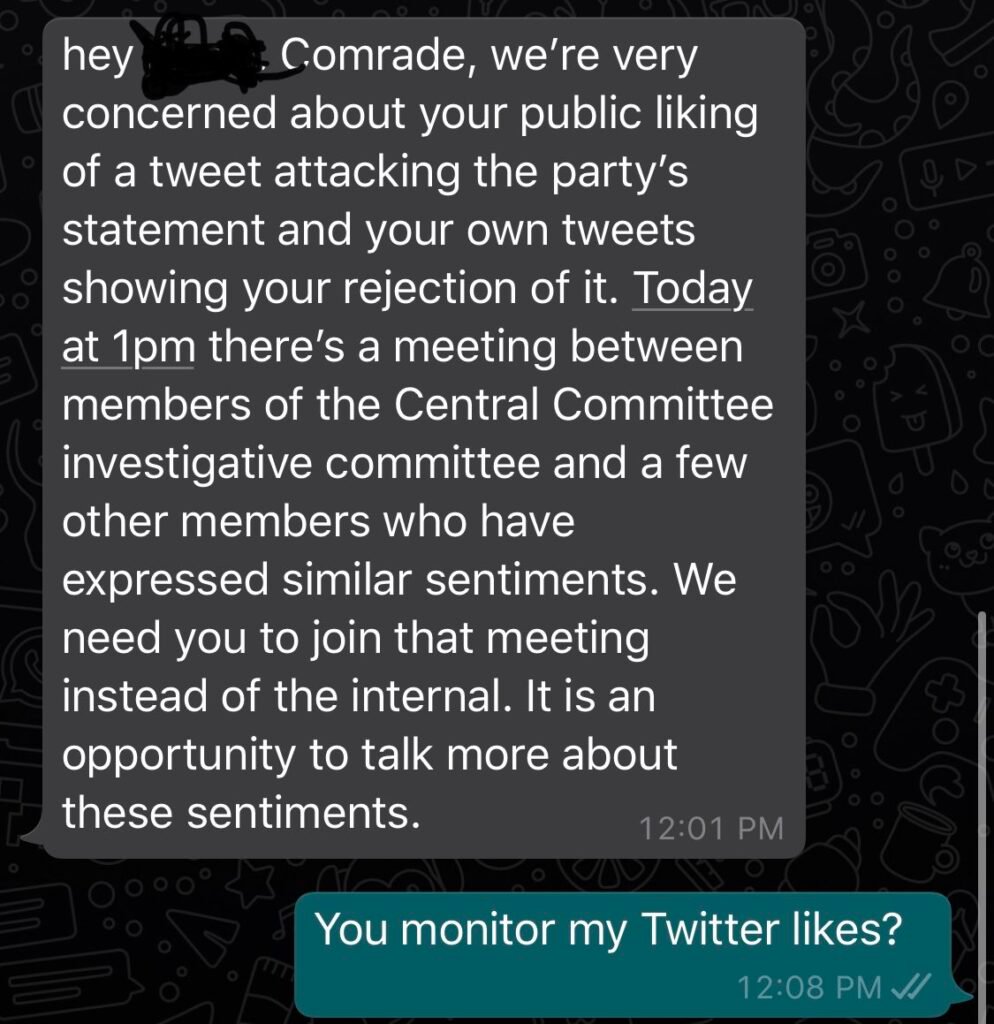
Leaked DM from PSL member during handling of alleged abuse scandal.6
psl is a secretive organization that lacks transparency and their central committee is all powerful and unaccountable
PSL’s central committee members are unknown to the public.
PSL’s party constitutions are not publicly available.
While PSL keeps all its internal documents a secret, the party constitution from the July 2022 PSL PSL fifth national convention was leaked, revealing the extent of central Committee control over the organization.
1.1 The Party Congress is the highest body of the Party. It has the authority to act on all aspects of Party policy and activity.
2. Delegates to the Congress
2.1 The Party Congress shall be comprised of voting delegates elected at the branch level and by the central Committee
2.3 The Party Congress may also have voting delegates nominated directly by the central committee, the maximum number of which shall not exceed 40 percent of the total elected delegates.
This means that the central committee handpicks 40% of the vote, requiring only 11% of the delegates to agree with them to get a majority
ARTICLE 10. AMENDING AND INTERPRETING THE CONSTITUTION
1. Amendment
1.1 The Party Constitution may be amended only by vote at the Party Congress.
2. Interpretation
2.1 The Central Committee and Executive Committee shall have the authority to interpret the Constitution and to create procedures not specifically covered by it. Interpretations made by the Executive Committee shall by submitted to the next Central Committee meeting for approval. All interpretations shall be submitted to the next Party Congress for approval. (Typo is theirs)
This means that the central committee has total power to dictate the meaning and interpretation of their constitution, and the constitution may only be amended by the party congresses which they control.
ARTICLE 4. NATIONAL ORGANIZATION
1.4 The Central Committee has the authority to make decisions and take action necessary and incidental to the good and welfare of the entire Party, and to act upon all problems and developments occurring between Congresses.
This means the Central Committee can do whatever they want.
where psl gets its funding and where the central committee gets its power
The Central Committee isn’t a magical body that exerts such a high level of control over its members because the members choose for this to occur nor because they are such great leaders but because of the amount of control their immense funding grants them institutionally.
PSL gets funding from Neville Roy Singham, an American citizen living in China worth over 750 million dollars.8 People’s Forum has received at least 20 million dollars in funding from him.9
Several members of the high command of PSL including Breakthrough News hosts such as Rania Khalek work directly for the Chinese and Russian States. (Rania is a journalist for the Russian state news outlet Russia Today)10
Eugene Puryear, another alleged abuser within the central committee and past Breakthrough News host worked as a talk show host for Russian State owned “Radio Sputnik”11
PSL’s finances are kept private and not shown to members.
THE PSL IS REGISTERED AS THE FOR PROFIT CORPORATION “LIBERATION NEWS, INC (3488507)12
The Global Justice Center, where Tucson PSL hosts the majority of its events, spent 54 million dollars in 2021, 100 dollars per resident of Tucson.13
silence is compliance
In the Cornell Case, messages were sent to a fraternity group chat with 57 members. The 50 members who didn’t directly participate in the abuse but didn’t say anything either aren’t innocent. These bystanders are abusers too.
Abusive organizations like PSL thrive on secrecy and taking advantage of those that don’t know any better about them.
A 1996 text by Quinterna (N+1) translated into English by Balance y Avante. We are hosting this because we believe it to be an incredibly important text and the English translation is not readily available.
Our comrades at the Sonoran Internationalists have brought forth two criticisms of the local movement against the Project Blue hyperscale datacenter. Their first, “Project Blue: Not in My Backyard,” was written at the peak of the movement’s limited success in its strategy to appeal to local government. Their second, “A Final Addendum to Project Blue,” has been written at the current low point in the movement.
We believe that while their analysis is worthwhile, they fail to appreciate the importance of engaging in local struggles and have a vastly expansive definition of “reformism”
Our definition of reformism is any movement which is involved in demanding reforms to the capitalist system from the ruling class.
The No Desert Data Center Coalition (NDDCC) is obviously reformist as the organization’s objective is to engage in electoral maneuvering (specifically through the Tucson City council and county board of supervisors) to beg the ruling class to not build a particular construction project. Reformism is to us not merely reform without communist aesthetics or words grafted on top.
This is the beginning of a trend in this text where the author seems to not understand the meaning of certain words.
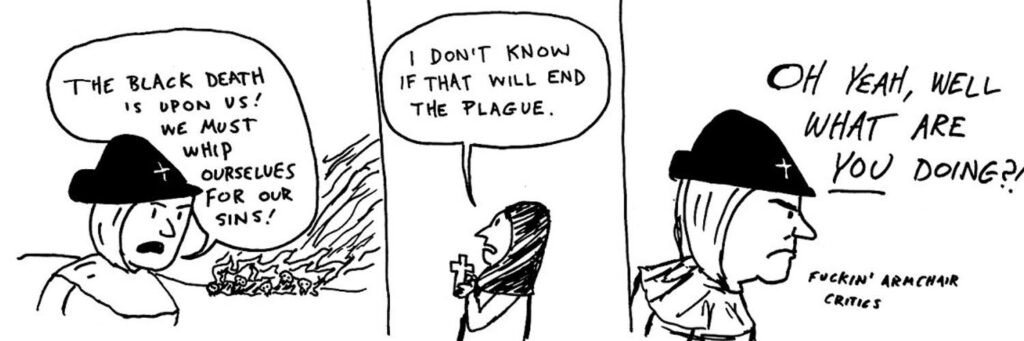
that precludes them from supporting most worthwhile movement projects. In addition, we fear our comrades are less interested in building Communism than they are in providing critique from the sidelines, where their ideas cannot be tested and they are off the hook for actually solving difficult organizational problems.
History is the primary testing ground of strategies for our class movement. Our positions come from an analysis of the history of proletarian revolutions as well as our own experience in these exact kinds of leftist groups that we now critique from the outside.
If all knowledge had to start at square one, instead of learning from the past, then we would also ask that you stop washing your hands until you can prove miasma theory to be incorrect.
In fact, we formed this organization because of our previous experiences in these kinds of reformist organizations. The lesson we learned from the foundational failures of those groups was that reformism itself was a complete pitfall, and we have gone on to engage in our activity with this new understanding.
There are criticisms to be made of our past writings and actions, and we have made those criticisms ourselves as part of our process for discovering how to be an effective Communist organization. We do not need to take a step back into the swamp of leftism to see once again the failures of these ideas.
If we have already learned the lesson, what reason do we have to repeat the mistake?
In their first article, the Internationalists argue that the data center in Tucson is one part of a larger worldwide increase in demand for computing technology, which is driven fundamentally by the profit motive and subsequently by capitalist competition. As a result, stopping the center in Tucson will require its construction elsewhere, because it is driven by these powerful economic forces.
They argue that even the best possible case for the anti-datacenter movement –.i.e. stopping the datacenter in Tucson – simply condemns some other community which is less capable of resistance.
In this criticism, we agree wholeheartedly!
Immediately the author has to concede that the entire existence of this organization (to stop one particular data center by appealing to local government) is a pointless endeavor. This should be beared in mind later when the author will then chastise us and repeatedly ask that we waste our time engaging in this same movement with the same useless objective.
An approach to this process wherein communities battle city governments and corporations to end data centers everywhere is impossible. We believe over-extraction and waste of resources is a fundamental facet of capitalism, and the only solution to over-extraction is Communism.
Next, they argue that instead of fighting the datacenter, “we can use this understanding to criticize the entire system as it stands, as an example of why we need something fundamentally different” (our emphasis). Their alternative is to organize a Socialist society based on worker’s council government,
While councils will exist during the transitory stage towards socialism, communism (which we use interchangeably with socialism as marx did) will not be a society of committee but something much more organic. Further, there will be no governance but rather coordination or resources.
We understand that this runs contradictory to our original article, (for which you are stating our stance as such), and we levy this criticism not against you but against our past selves. We merely wish to proceed with the furthest and most honest version of our current stance.
which confers with experts to properly govern society and organize the economy without competition and over-extraction.
“What is the problem”, says the Internationalists? Capitalism. “What is the solution?” A complete rupture of our capitalist society by a revolutionary moment which transitions society to total workers’ democracy.
Democracy is no more important to us than the right of kings.
As with the previous note, this is something that contradicts our original article and as such it is a criticism against our past selves in the spirit of honesty.
And, in terms of practical steps to build this world-historic moment and drive it to completion? Our comrades simply say, critique! All our friends can muster is a proposal that we critique the situation.
We believe that this sentence showcases the grand programmatic and theoretical error underlining TRAG. That they take our position of the only role of communist organizations and militants towards reformist organizations being to critique them to mean that the only role of communists in general is criticism shows that to them the entire theatre of militancy is limited entirely to intervention within such opportunist avenues.
As if the options are “join in this useless movement” or “do absolutely nothing”. We have rejected this false dichotomy that seeks to coerce us into joining an organization which does not share our principles or objectives.
Very good. Their criticism is well-received. And where is our revolution?
This is to us a disingenuous criticism. We could certainly ask the same of TRAG. If your strategy works so well why haven’t you started a revolution, or at least turned the NDDCC away from its reformism?
The fact that a revolution has not occurred right now is to us not an indictment of either of our strategies, and is an argument befitting only of someone who wishes to say that revolution is impossible, which we certainly hope TRAG is not; despite the fact that all of their organizing may point to the opposite.
Our argument is not that if all the “uneducated and infantile proles” (as TRAG may consider them as part of the “masses”) of the NDDCC simply joined our organization and became geniuses like us we would achieve revolution today, but rather that in times of the revolutionary cataclysm of capitalism such organizations will be inherently counter-revolutionary; and further that participation in them in times such as now will only lead to a lack of clarity within the communist movement when such a situation occurs.
This is where we take issue with the Internationalists’ conception of revolution. Revolution is not a long process, which we must work all our lives to build together. It is not a process which we must join together with the global working class in over a lifetime, in the hopes that one day, life on our world may live in harmony.
The revolution is certainly a long process, however; communism is not built piecemeal. The socialist movement grows not consistently and step by step, but rather in leaps and bounds; and it can do so only via possessing the clarity of mind and singleness of structure to be poised for the moment.
The basis of our work is a shared commitment to the revolutionary programme. We organize and act according to this principle. As such, despite geographic distance we are deeply embedded in the international Communist movement.
This organization on the other hand, spends its time organizing for local crosswalks and volunteers in any other cause that they believe can be used to make them look good.
Then, of course, they turn around and say we’re the ones doing useless non-work, because their emphasis on involvement in bourgeois politics as a poorly disguised recruitment drive, is obviously much superior to our activity.
The purpose of their “work” is to convince more and more proletarians to join up and then get involved in ever more bourgeois causes. They measure success in quantitive terms, how many poor wretches have been convinced to join the group and pay their weekly membership due for the right to vote.
Communists measure success not in terms of quantity of members, but quality. After all, it’s not as if we will reach some magic number in membership and then we will have the strength to carry out revolution. Rather, as exemplified most by the exponential growth of the Bolshevik party in the period of crisis in 1917, the revolutionary Communists of our class will always be a minority, but more and more proletarians will realize their own self interest lies with the Communist cause as the choice becomes either revolution or death by capitalism.
This is something which the tacticalism of groups like TRAG is ultimately counterproductive towards. It is ironic considering their charge against us, but we would in turn charge them with holding the positions they do because of their own impatience towards the revolution.
It is through an understanding of the revolution as a long drawn out process which is not necessarily built, but rather which is prepared for that we base our activity.
Revolution doesn’t require us to engage with the imperfect political situations in front of us in attempts to have our ideas adopted and our aims furthered. Instead, it is an idea which we can appeal to as we watch movements pass us by on Instagram.
Our comrades have valid criticisms, and we believe they should be taken seriously. In terms of immediate implementations, we think the local struggle to stop this datacenter must issue these criticisms as well, to avoid folks getting false illusions about the finality of their local project. In addition, we argue Marxists, Anarchists, and other revolutionaries should get involved as quickly as possible and begin building ties between this movement and other radical movements,
Something which runs completely counter to their supposed agreement on our criticisms. Perhaps they have understood our argument to be that we believe the NDDCC has certain flaws which we wish to see solved. Rather, we believe the NDDCC is itself inherently counter-revolutionary, and that any participation in it by “Marxist,” “Anarchist,” or “other” revolutionaries will itself be counter-revolutionary, drawing them inevitably into its gravity.
in the hopes of converting this mass practice into real movements for Socialism.
The problem arises when we ask our Internationalists for solutions. When we do this, we are left with much to desire, to say the least.
Likewise to before, this stems from their inability to see the whole picture of society. They see that we do not have solutions to their question because the problem they wish for us to solve is insolvable, that being what is the “correct” way to intervene within such organizations and make them revolutionary. Which we of course can not answer, in the same way as they could not answer from an even more plainly liberal organization: “How do we make the police revolutionary?”
Our “solution” is the one we have always maintained, although we are happy to restate: Abandon all reformist activism and opportunist organizations. Instead, start or join organizations that exist for the explicit purpose of unifying the proletariat towards the ultimate world Communist revolution, and not only in name. These organizations should engage in political education, connect and discuss with revolutionaries across borders, and at all times advocate for nothing short of International Proletarian Revolution. We are currently engaged in that work, despite the multiple accusations in this text stating otherwise.
We are given appeals to revolution, to the establishment of worker’s democracy, and at best we are asked only to issue critique. Our friends are idealists, meaning they have ideas of revolution, but no interest in practical transformation of the world according to these ideas.
This is a blatant misrepresentation of the definition of idealism, which we would encourage readers to look up on their own. Idealism is a philosophical conception of the world which says that ideas are what shape the material world and our consciousness. Rather than the material world shaping our ideas and consciousness, which is what Marxism is predicated on. Who knows what that has to do with this baseless accusation stemming from the author’s ignorance of both our real activity and positions.
What is more idealist than to believe that simply by injecting communist ideas into a bourgeois movement it will somehow evolve into a genuinely radical one?
Our refusal to involve ourselves in such a movement stems from the fact that we see it for its material and class character, and not just what it calls itself, and further because we understand that no amount of proselytizing will be able to turn an inherently reformist organization into something revolutionary.
In their second article, the Internationalists respond to a protest which was organized at the construction site last week. In an even more abrasive rhetorical style,
We appreciate your compliment on our writing style!
“Ruthless criticism of all that exists” – Karl Marx
the SI calls the demonstration a result of the movement’s failure. They call the protesters Live Action Role Players and bask in their correct analysis.
As we pointed out previously (and this author went on to agree with) even if NDDCCs objectives were somehow met, demand for data centers would not be changed, merely the supply. Another community would in turn have to bear this burden. By pointing out that this activity ultimately doesn’t benefit the overall environment and only shifts burden onto others, we believe it is fair to say that protesting despite this fact amounts to larping, acting for no real material purpose.
Of course, they don’t do anything in the material world about it.
The author seems to misunderstand what “the material world” actually is, as if our own activity takes place on another plane of existence. This is clearly another stint of TRAG’s idealism.
Since it is clear they do not know what idealism actually means when they throw it around in bastardized form and are clearly sufferers of it, we would like to recommend some good pieces for beginners to Marx on the issue.
Theses on Feuerbach is perhaps the most concise of Marx’s pieces on what materialism is and is not, as well as how it is unified in the Marxist tradition with consciousness, which TRAG has seemingly failed to comprehend.
For a longer piece on the issue, we wholeheartedly recommend the Feuerbach section of Marx’s “The German Ideology”
We were of course not brought onto this Earth in the form we are now, and many of our members have a storied history of making many of the mistakes that TRAG now makes prior to reading Marx in depth, so we hope that his works can be as enlightening to them and their practice as they were to ours.
What the Sonoran Internationalists might not know (because they don’t go into movements and talk to their activists) is that the demonstration had multiple strategic purposes. One major goal was to bring more people into the movement,
What TRAG might not know (because they lack critical thinking), is that we are aware of the fact that the NDDCC wishes to bring more people into its counter-revolutionary movement, which is precisely why we oppose joining it ourselves!
We would like to remind them also that a movement being large or based on “popular action” does not immediately make it of a proletarian character. Take for example the National Socialists of Germany, who took power via the popular mandate of the people.
Would TRAG critically support the Beer Hall Putsch for meeting the workers where they were at and having multiple strategic purposes including bringing more people into their movement?
Our goal as communists should be to sway people towards revolutionary movements, and away from counter-revolutionary ones. Why TRAG would defend the cancerous growth seeking opportunism of an organization they themselves admit as being “impossible” in its aims is beyond us, unless they themselves wish to see the growth of counter-revolutionary abstractions.
We do not go into these movements because we do not share their principles or objectives. Instead, we observe their activity from afar and provide them our analysis.
We were once in the same boat, in similar kinds of groups. We believed in these same ideas which we’ve come to learn are flawed. Our dialogue is intended to point out those shortfalls, to have a real effect on these activists who want to build a better world but are doing so with a flawed outlook.
in the hopes of mobilizing people to act on the world around them. The major aim is to convert this issue movement into a mass movement based in popular action.
The ultimate goal of Communism requires the entire masses to learn to govern themselves. To do this, the masses must start by developing organizations where they can act on the world as political agents.
With this, we wholeheartedly agree, although the specifics are of vital importance, for their is no single universal metric of capability to act as “political agents”.
We proudly admit that we are much worse at being political agents within the governmental system that currently exists than the Republicans, Democrats, or Tucson Red Action. This is because we seek not to influence the democratic system, but to subvert it.
What the history of the workers movement has taught us is that in revolutionary situations, the lessons learned via engagement in non-revolutionary politics become maladaptive rather than helpful. Perhaps the best example of this was during the revolutionary wave of 1917, where the German social democrats, who by far involved the most of the masses into their structure compared to the other parties of Europe, and yet insidiously used this control over the workers to smother any real chance at revolution while it was still in its cradle.
“When the time came for the armed insurrection against capitalism, however, it was seen that the only party to engage in that insurrection was the party that had the least experience “working among the masses” during the years of preparation, the one that more than any other had worked to preserve Marxist theory. It was then seen that those who possessed a solid theoretical training marched against the class enemy, while those who had a “glorious” patrimony of struggles shamefully choked on their own words and went over to the side of the enemy.” -Amadeo Bordiga, Activism
We feel that now the movement needs to pull the broader masses into a struggle
And this is precisely the issue. These great thinkers feel that it is necessary for “the movement” to pull the broader masses into a struggle; without remembering that the movement we are discussing is an electoral one built on class collaboration and the subservience of the proletariat to the interests of the organizations’ NGO backers.
We stand uncompromisingly for class independence, not class collaboration. We refuse to equivocate the self organization and revolutionary militance of workers with the NDDCC.
where they can organize together and learn how to be political and democratic. We feel engagement with this datacenter issue has the potential to create new Communists, new activists, and new organizers which our movement desperately needs. It will require us to work on organizational problems and not just theoretical ones, which is necessary to build revolution. We cannot wait for this process to happen on its own, we must make it happen by training ourselves and as many people as possible how to organize.
This is the utility and value in engagement with the datacenter movement. It is a movement that people are organizing together,
Every movement is one where people organize together, that’s the definition of the word.
This bizarre claim seems to say that anytime proletarians are gathered is an opportunity to “convert” those people into Communists, regardless of the movement. Why draw the line at this one, because of aesthetics? One could replace “datacenter movement” with “blue lives matter movement” and the argument here would be the same.
The underlying assumption here is that leftists are somehow closer to Communism than other groups like the democratic party, conservative groups, etc. We reject this idea because we recognize that Communism is a fully distinct political philosophy that cannot be compromised with the existing bourgeois society and the poltical strains that come from it.
This conception makes sense for TRAG as a Stalinist organization however, because their politics are not rooted in class struggle but rather the bourgeois battle of left (wing of capital) versus right (wing of capital).
where people have interest, and where people are cropping up who can organize. This is where Communists may grow. Activists from movement scenes like this are the most valuable recruits, because they care to work in the real world and when discussing theory, they can actually apply it to the experiences of organizing.
Like a tree grows fruit, the failures of such movements do in fact grow a more radical sect of workers. We do not deny this, if we didn’t feel it as such we would not put in the work of publishing our critiques of them.
What you mistake for us believing that there is not the capacity for communists to come out of this movement, is our refusal to pick these fruits while they are still unripe; which would both stop them from ripening, as well as poisoning ourselves.
Such a strategy has historically proven to be quite successful for various counter-revolutionary parties such as the PSL and yourselves, we do not deny this. We simply value our revolutionary nature above becoming the most powerful of the counter-revolutionary forces within bourgeois society.
We understand that you have started your organization because groups like PSL, FRSO, and the RCA are for whatever reason not to your liking. We will give you the benefit of the doubt and assume that it is not merely because you wish to be the ones in control of the hierarchical structure.
We must ask you, how is it that you believe you will implement what is ultimately the same strategy as the lot of these groups and have an outcome which is any different? None of them started as blatantly extractive, reformist, or opportunistic as they are now. Yet it was the entropy of their practice which led them down the path they now have reached the end of.
Is it because you have uniquely pure ideas sent down from the heavens that guarantee your revolutionary character? Is it because you’ve read Settlers? We have no idea.
What we suspect is that it is because you have not critically thought about why these groups are the way that they are. You take their surface level failures at face value, and tell yourselves that you will be different because you aren’t like them. Perhaps because they started with as little programmatic discipline as they have now (they didn’t).
These people make the best materialists and the best Communists. We should find them as quickly as we can, and work to become them.
The problem with this, for the SI, is that it is very hard, much harder than reading books and writing articles.
We are communist first and foremost because we wish to achieve a communist world. Perhaps the most important step in doing so, is to be serious militants whose actions are based wholly on programmatic questions of the furtherance of revolution. As part of this seriousness, we believe that an honest reflection on our weaknesses and realities is important.
We do not believe ourselves to be supermen, capable of sending ourselves into a wholefoods parking lot with a bag of mangoes seeking to bring class consciousness to hustlers selling stolen candy.
Our time is limited, such is the result of living under capitalism. We understand as much as you that everything is linked to capitalism. Where we perhaps differ, is that we take this reality to mean the opposite conclusions that you do. We do not have infinite time to deal with the infinite aspects of capitalism.
Society is already full of individuals who realize that capitalism is at fault, yet they lack the clarity necessary to fight against it in a productive way. There is no need in the class struggle for an organization which traps people at this early plateau.
TRAG does not realize that it is in fact quite easy to thrash around aimlessly to “do the hard work” of organizing with and helping our class enemies. The entire political system has been engineered to make it so.
We do not feel insulted when you claim that we are afraid to get our hands dirty as you stick them into the honey pot placed in front of you by the system because we know better than to fall for such tired tricks.
Much harder, is to have the restraint, patience, and singleness of mind to see past these opportunistic traps. To apply a revolutionary theory in revolutionary action; rather than allowing it to be inverted through the system as it has been for decades.
Capitalism has been able to fool its adversaries and their structures into supporting it not because its adversaries are idiots, but because it makes them believe that they are in fact the ones subverting the structures of capitalism towards their own goals.
You are not uniquely vulnerable to such tricks, but you are certainly not immune. Nor was Lenin, nor any other revolutionary.
It is easy to believe that the revolution is simply a question of working hard enough, we in fact wish it were so. What must be realized, however, is that it is not. It requires most principally the ability to plant our feet on the ground, and to look analytically at a reality which is inverted to us. Failing to do this, you will look back to realize that all the blood, sweat, and tears you put into organizing; was done not to destroy the system, but to reinforce it.
It requires us to work with people, to argue, to participate in movements which might fail. It requires us to show that our ideas are correct and therefore risk being wrong.
Given TRAG believes (falsely) that our entire activity is comprised by writing strongly written statements about our ideas, it feels a patent absurdity that they would accuse us of being uncomfortable with doing just that. By publicly releasing texts we are asking people to engage with them, and in that process we are very much at risk of being proven wrong.
It is likely that what they intend is that because we do not ourselves repeat the mistakes of the past (both our own and of our movement) that we are not allowing our ideas to be proven correct or not. This is the same ideology as that of a toddler who fails to comprehend that the stove is hot until they themselves touch it, rather than listening to their parents who have already learned the lesson for them.
Our mandate becomes action, guided by revolutionary ideas. It is much easier to live in texts and articles, where one may never have to prove themselves and they can forever point out problems they don’t care to work on. When the world brings forth to us an imperfect reality, we can decide that any kind of organizing which does not result instantly in revolution is simply making appeals to reforms, and therefore it is devilish reformism which only plays into the hands of the bourgeoisie.
Again the author makes the utterly bewildering argument that a group that is actively begging the ruling class to enact a reform (canceling a single construction project) is somehow not reformist.
We are not trying to magically enact a revolution next week, we are rightly (by your admission) pointing out that this activity is not revolutionary, therefore we should do activity which is revolutionary since we will need as much preparation as possible towards this end.
Such a misrepresentation of our argument would be respected even by the likes of Bernstein and Ebert. Our refusal to support such measures stems not from their failure to produce the revolution now, but from the fact that doing so would hamper the revolution during the crisis of capitalism.
It is expected that TRAG is incapable of seeing anything that isn’t right in front of them, and further of stepping outside of the historical moment to see the development of history in a Marxist sense. Without an understanding of the history of the workers movement, TRAG is doomed to make the same mistakes of the past over and over again, doomed to be capital’s left.
“it is characteristic of opportunism to suddenly set all its hopes on the great revolutionary deed. Its essence lies in always considering the immediate questions, not what lies in the future, and to fix on the superficial aspects of phenomena rather than seeing the determinant deeper bases. When the forces are not immediately adequate for the attainment of a certain goal, it tends to make for that goal by another way, by roundabout means, rather than strengthen those forces. For its goal is immediate success, and to that it sacrifices the conditions for lasting success in the future.” -Anton Pannekoek, World Revolution and Communist Tactics
We recommend TRAG read “The Past of Our Being” by Barbaria, as it is in our eyes the best analysis of their historical current of Leninism.
This is embarrassing behavior for so-called Communist militants.
We can no longer be satisfied with hefty books and lofty theories. We can only be satisfied by real Communist politics.
We agree! Our satisfaction only with real communist politics is precisely why we denounce this liberal schlock.
It is a disgrace that to these pseudo-revolutionaries, “Real communist politics” means begging our ruling class to cancel a data center, inflating leftist organizations, defending the infiltration of these organizations despite admitting their goals are pointless, and begging our ruling class to build a crosswalk.
Communist politics does not mean thinking the most correct ideas
You should consider yourselves lucky that we agree!
, nor does it mean constantly doing action again and again without thought. It means merging thought and action dialectically with comrades in struggle, and building real power by acting upon the world.
And yet, building “real power” within the capitalist world that they allude to is in reality the building of capitalist power.
Because TRAG is not guided first and foremost by militance, they see being a power within capitalism as the foremost goal of the workers movement; quite similarly to a trade union.
We agree with this sentence in principle, however it is clear that the thought they are merging with their action is not that of Marxism, but of opportunism. Which is itself the reason why the actions they choose to merge it with are of the same character.
This struggle is not perfect, it has many problems in idea and in practice. This we will concede to our comrades. Unfortunately, we are on the back foot. We suffer from a lack of organizers and a lack of a Communist movement. We can only build that movement by engaging with the world strategically
Are we supposed to treat this statement like it’s serious?
While arguing that we are failing because we aren’t engaging in the specific form of counter revolutionary activity (that you yourself admit is pointless except for use as a recruiting tool) you’ve inexplicably gone on to say that we don’t engage in the real world at all in the pursuit of our own goals.
If you want to argue that your form of engagement with bourgeois movements is good, alright, but why add a ridiculous and totally random claim which can be easily contradicted by asking anyone in our circle about our activities.
to further our ideals. We believe that this struggle is not hopeless, that this organization has the possibility for radical directions,
It seems as though you contradict yourself, arguing both at the same time that it is a movement which is indeed doomed to reformism, (in your fifth paragraph) but that we must engage to bring communists out, as well as saying that there is still potential for this reformist movement to somehow become radical.
We are sure that you will call this “contradiction” “dialectical” or perhaps “nuance”. We call this a lack of direction and failing to have an actual argument. Even middle schoolers learn that such waffling is lackluster, and we hope that in the future you will be able to create an internally consistent critique which has a point it builds towards.
We also understand however that this lack of direction comes not just from a general lack of skill in writing; but as a direct consequence of your lack of class independence. You must muddy the waters, play both sides, and lie to yourselves because its what your bourgeois masters require of you in order to stay in their good graces.
We are free in this way as you are not. Because we do not chain ourselves to entryism; we are able to stand unabashedly by our communist program and the truthful analysis of our world.
and that real wins for Communism can be made through engagement with this group.
Our Internationalists believe they can use their minds alone to prepare for the right moment in proletarian consciousness, wherein a revolution will occur by virtue of their preparation of mind.
A complete misrepresentation which could be cleared up through reading our previous works, or actually engaging in our real viewpoints in a serious capacity at all. This is a straw man argument, and not a convincing one at that.
This is simply ahistorical.
Regardless of our actual views on the above statement. Exactly how is it ahistorical? Based on what history? The decision to just throw this in here with not even one specific example is very obviously an attempted insult rather than a chance to argue logically through a real historical analogy.
You may not have learned this from reading settlers, which fails to cite any of its sources, but in the real world of polemics, it is generally advised to give historical backing and examples to elucidate and prove what you say, rather than simply uttering baseless claims.
To be militants, our comrades must go into the world as soon as possible. They must take their admirable zeal for liberatory Communism and put it into projects that attempt to realize this beautiful ideal. This means taking criticisms to the movement and applying them in practice.
We wrote an article criticizing a movement and explaining our divergence with the purpose of opening dialogue and encouraging members of this organization to think about their activity and goals. We are being condescended to because we:
1. Made criticisms of a movement we disagreed with, and made it clear we were willing to discuss our criticisms with them.
2. Live by our own principles rather then misrepresenting our full worldview when encountering others.
It seems the absolute only thing that would make the author happy would be for us to fall in line and spend our organizing time larping alongside them. Anything aside from that is “doing nothing”. What they really accuse of is “doing nothing to assist in our non-Communist organization”
If you want to end capitalism, then you must start the Socialist project. That means taking on tasks and pushing for Socialist directions. If you want to end capitalism, you should fight a datacenter with your comrades.
You are welcome to fight the data center with your other liberal, class collaborationist, bourgeoisie allies on the battleground of the state. We do not consider these people our allies nor our comrades.
This is not just out of a sense of moral purity as you may accuse us, but because as opposed to you; we see the counter-revolution not just as an idea but a material reality.
In the game of unity between classes, it is always the proletariat who must submit their will to the bourgeois; and who stand to lose not only their revolutionary aspirations but their lives.
It was the social democrats who in Germany called most for unity, who accused the radicals of having unrealistic and untempered expectations for the revolution to happen “right now”, and it was those same social democrats who ordered the Freikorps to kill those revolutionaries, among them Rosa Luxemburg and Karl Liebknicht, who you now opportunistically put on your posters as if you would not have followed the strategic order of your “organized” party to kill them for being ultra wreckers.
It is not surprising to us, not any more so than you praising Lenin while harboring within your ranks self described Stalinists; who historically killed any vestigial remains of the revolutionary militants within the bolshevik ranks following Lenin’s death in his own name.
History is full of examples of genuine militants being slaughtered wholesale by counter-revolutionaries in the garb of the revolution.
We make no claim as to whether or not you will go along with the democratic discipline of the “imperfect” organizational structure you aided in the creation of and kill those genuine revolutionaries; or whether you will eventually come to fight that structure when it is already too late. However we can confidently say that this lane of organization leads to only those two choices.
We refuse to kill our fellow revolutionaries, and we also refuse to throw our lives away for a meaningless cause; not because we fear death, but because we have important work to do ahead of us.
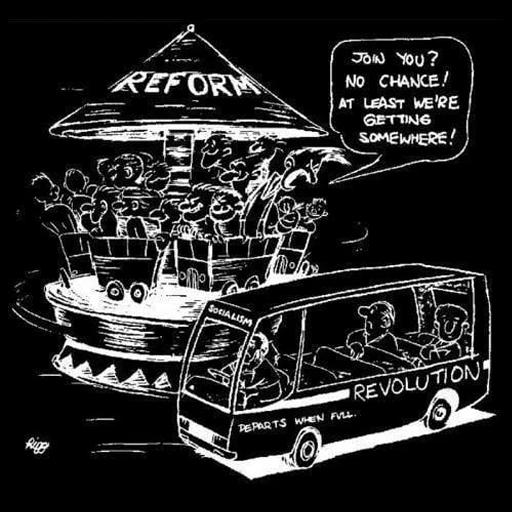
We will be fighting capitalism. When you are ready to get off your merry go round and join us on our seemingly stationary bus of revolution, we will be waiting.
Perhaps we can enlighten these Marxist Leninists with the actual words of Lenin, who had the correct stance on this issue:
“There can be no unity, federal or other, with liberal-labour politicians, with disruptors of the working-class movement(…) There can and must be unity among all consistent Marxists, among all those who stand for the entire Marxist body and for the uncurtailed slogans, independently of the liquidators and apart from them.
Unity is a great thing and a great slogan. But what the workers’ cause needs is the unity of Marxists, not unity between Marxists, and opponents and distorters of Marxism.” -Lenin, Unity
The revolution will take work or the revolution will fail.
Every critique of ours is based in the real activity and objectives of the organization we were discussing. All of these accusations appear to come out of either an egoistic desire to insult us, or a full misunderstanding of what we both believe and do.
By “work” we can only understand that you mean reformist activism, your specific brand of larp. The revolution does require active organization of the revolutionary minority of the class, but this activity must be towards our revolutionary end. It does not require engaging in everything and anything that seems vaguely left wing just because it involves painting slogans on cardboard, and is therefore “real”.
It has recently been revealed that project blue will be built just outside of Tucson, and that it will be cooled entirely using water directly taken from the aquifer1. This is because doing so will be profitable and make lots of money. Given the falling rate of profit, speculation into such projects has become increasingly necessary for capitalism to sustain itself. It is also important to note that such data centers exist not only to host the leftist boogey-man of “AI” but all internet infrastructure, including that on which the impressionable young proles of the PSL reach the liberation store to consume their own brand of commodities. As long as capital reigns, all this demand must be met somehow.
Originally, the center was planned to be built within the city limits of Tucson. In response to this, leftist activists mobilized to oppose construction, successfully lobbying the Tucson city council to ban the construction of the data center in Tucson, a major win for the public image of the Democrats as defenders of the local TuKKKsonian. Yet, the center is still being constructed, right outside the city’s jurisdiction, and therefore without any of the (admittedly worthless) environmental protections and municipal benefits that construction within the city would have provided.
The resources for this data center now come directly from the aquifer rather than the middle-man of Tucson water, since the city’s rights to these water resources is being enforced with the full extent of the law, something which represents a complete victory for the no desert data center coalition.2
Outside of any real governmental control, the construction down south is now being protested through symbolic demonstrations (also known as Live Action Roleplay or LARP), acts which are happening because the movement has lost, something which is itself a result of a flawed outlook from the start.
Video of one such live action roleplay demonstration taken from Tucson PSL’s Instagram
These activists can go no further than a shallow defense from immediate threats to our state’s resources. This is because they still operate with an ideology that ultimately stems from capitalism.
Those who are engaging in the Project Blue half-measure movement do so because they fail to recognize a major component of the world today: Governments in capitalist society (whether federal, state, local, even international) are not neutral territories where we can fight it out with our overlords. They are institutions which are inherently a major component of the capitalist system. They exist only for the efficient operation of capital by making sure each individual capitalist plays fair with the others, and occasionally to placate the working class to keep them servile. There is no “rallying” of the working class or “education” of them on the training wheels of such activism because the only lessons that can be learned are that reform works (when it is incidentally so) or that their effort is meaningless.
In the game of activism, if surrendering to this or that progressive demand ultimately poses little threat to the bourgeois, then they have every incentive to play ball. After all, it sure makes us proles feel good when it happens, as if we’ve won something for once. In this way we are made to feel as if we have real power, and so don’t need to organize beyond the electoral spectacle.
On the other hand, when an action is genuinely necessary for the accumulation of more capital, regardless of official rules, regulations are always able to be sidestepped, as is happening right in front of us. Yet our bourgeois system of democracy is so ingrained that after all is said and done the activists can comfort each other and say “Well sometimes we win, sometimes we lose, we just have to keep trying. There’s nothing else to do anyways!”. So we move deeper and deeper into the catastrophic environmental and economic crisis, one pat on the back at a time.
Our prediction from August of last year was that regardless of the city council’s ban, the data center would be built, which is now coming to pass. This analysis did not come from us being either prophets or geniuses, but rather because our framework is derived from the material analysis of the history of the Proletarian movement. The lessons that come out of the successes and failures of the past have long made it clear that reformism of all kinds is not only useless but an actively harmful strategy. That lesson has been laid bare once again, with this situation now serving only as yet another parable for revolutionaries of the future to learn from. We cannot fight our way out of capitalism through its reform in the same way that we cannot stop the environmental crisis by buying shirts from the liberation store.
Socialism Through Barbarism, Communism or Extinction – There is no Third Way!
Klopatek, J. M., & Oltjen, J. W. (2022). Water use and its impact on beef sustainability in the United States. Journal of Animal Science, 100(2), skab369. https://doi.org/10.1093/jas/skab369 (Peer-reviewed source for 275 gal/lb blue-water intensity.)
United States Department of Agriculture, Economic Research Service. (2024). Livestock, Dairy, and Poultry Outlook (November 2024). https://www.ers.usda.gov/publications/pub-details/?pubid=107736 (Government source for annual and daily U.S. beef production volume.)
Lawrence Berkeley National Laboratory. (2023). Data Center Water Efficiency. https://datacenters.lbl.gov/water-efficiency (Research-lab estimate confirming similar magnitudes.)
Mytton, D. (2021). Data centre water consumption. npj Clean Water, 4(10), 1-7. https://doi.org/10.1038/s41545-021-00113-9 (Peer-reviewed study giving 0–2.18 L/kWh water intensity range.)
Li, S., Deng, C., Jin, Y., & Chen, Y. (2024). Making AI less “thirsty”: Uncovering and addressing the secret water footprint of AI models. Communications of the ACM (preprint). https://doi.org/10.48550/arXiv.2304.03271 (Peer-reviewed methods paper for ChatGPT per-prompt water: 0.01–0.05 L.)
On January 3rd, 2026, the United States launched a military attack on the Venezuelan capital which resulted in the capture and removal of then President Maduro and his wife.
Regardless of whatever the justification given by the imperialist bourgeois state for doing so, it is very clear that this was little more than jockeying for control of evermore depleted natural resources and a portion of the Earth’s surplus value by ensuring the political domination of the Venezuelan working class. The United States has just engaged in an act of imperialist aggression to attempt to maintain its current position as the strongest capitalist power. Meanwhile Russia and China also engage in imperialist aggression, but for the purposes of furthering their own ambitions as up and coming powers. These imperialist actions must be recognized as nothing more than a manifestation of global capitalist competition.
Whenever the ruling class of a nation sees it necessary to engage in warfare to enlarge its own market share they send proletarians off to the battlefield, off to kill some other proletarians who follow the bidding of their own national ruling class. Whatever the outcomes of the battles or wars, the only ones who stand to gain in these conflicts are the ruling class, while the costs are always borne by the working class across all sides. Whether a bullet fired is from a gun on the defensive side or the offensive, the result is a dead worker who never should have been forced to die for the profit of others.
The signs are quite clear that Capitalism, which has already outlived its historical condition, grows closer and closer to a third imperialist world war. Palestine and Ukraine are two other examples of Imperialist powers vying for resources and strategic edge. Such military intervention will only continue to become more and more frequent and intense as the capitalist system draws closer to crisis.
It must be understood that such competition is unavoidable under Capitalism. It can not be avoided by getting a good member of the bourgeoisie to rule over us, nor even (though this would of course never happen) a truly revolutionary member of the proletarian class party into the bourgeois government. War will likewise not be avoided by allowing a different imperialist bloc to hold sway over Venezuela, nor any other region of the world.
Our only path towards a future without futile and highly destructive wars is the coming together of the workers of the world, united by our common interests. The abolition of nations, wars, wage slavery, and all the other manners of oppression present in our current system is an imperative that must guide us all. To achieve this there must be a refusal to compromise on our revolutionary ends. Support for a capitalist power for any reason at all can only be understood as a counterrevolutionary betrayal.
As such, our opposition is not to Capitalist aggression, but rather to the Capitalist system itself. Our support does not go critically to the Venezuelan nation or government, but uncritically to the proletariat of all nations. We stand for a united humanity, and we recognize that this cannot be achieved through the support of any nation or side in current imperialist conflicts. What we see today are symptoms of our own barbarism, of our continued existence within a system that has long outlived its usefulness and needs to be put to an end.
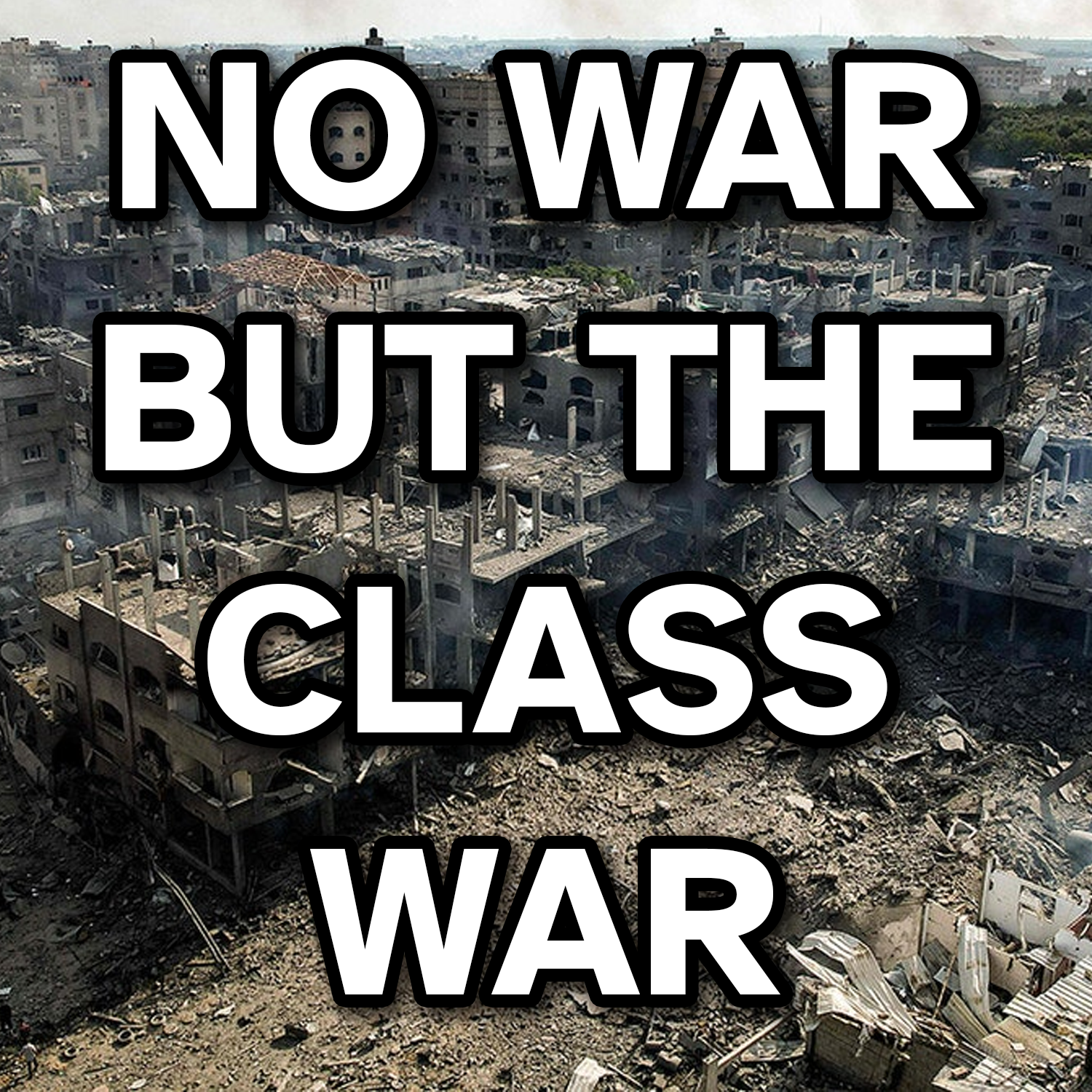
No war but the class war!
No defense of the homeland! No alliances with the bourgeoisie!
International unity of the working class!
After all,
Socialism or Barbarism, Communism or Extinction – There is no third way!
In both our writing and our outreach to individual workers and organizations, the question we are most often asked is: “What do you do?” Usually this question carries an implied belief that our organization exists solely to criticize other groups. While this impression is understandable, it is not accurate. Much of our early work has focused on criticism of various non-Communist organizations and ideas, but this has only been a necessary first step to distinguish our methodology and ultimate goals from those groups. This is not our organization’s only focus.
We acknowledge that up to now we have mostly mentioned our purpose and aspirations in bits and pieces across other texts. We write this document to clarify what we do as an organization, what we aim to do, and what actions we believe readers should take if they share our commitment to building a revolutionary force under capitalism.
What we Do
Four months ago, our founding members created this organization to fill a niche that did not exist in Southern Arizona. That being, a theoretically grounded revolutionary organization. Our principal task is to further the intellectual understanding and development of the class struggle within the class, and to organize towards the realization of Communism as a class.
To this end, our primary method has been the writing of a monthly publication in which we analyze the trends in our local area and connect them to the global class conflict through a materialist lens. Such writing is important not just because of the finished articles we have released, but for the development of our own theoretical understanding of the capitalist world through the collaborative writing process itself.
Connected to this is our hosting of group readings and discussions of Communist theory and the history of the class struggle. While reading a book will not overthrow Capitalism, the understanding and unity we have developed through such activities is the tantamount first step towards the realization of the movements of Capital towards its own destruction.
Further, we have (albeit to a small capacity) intervened in local demonstrations to be the militant presence at these events. Contrary to the false binary of showing critical support to non-communist movements or being completely absent, we believe that an active presence outside and counter to such movements is a key task of militants.
To put it succinctly, our primary purpose is to provide a resolute analysis of the past, present, and future of the class struggle. We succeed when we help someone deepen their existing class consciousness, of their position within the global class struggle, and of the long history of proletarian victories and defeats.
What we Aim to Do
In the few months of our existence our membership has grown alongside our understanding of numerous topics, providing us with both more organizational capacity and greater clarity, enabling us to expand our work.
Alongside our reading groups, writing sessions, and discussions with comrades from around the world, we will soon start hosting regular in person meetings, which we will announce on our website and Instagram.
Lastly, we aim to intervene at more events where discontented workers are likely to be present, particularly those seeking an alternative to the capitalist system. This will help us build connections, better clarify our positions, and encourage further learning and militancy.
We realize that our viewpoint is not palatable to most workers at this time, because (given historical patterns) the working class can only be radicalized in great numbers by the inevitable intensification of capitalist crisis. For this reason, we do not “meet the class where they are at.” Rather, we prepare for the moment when more and more of the class can meet us, and hopefully even surpass us.
At a time when the contradictions of the capitalist system are increasingly undeniable, and so interest in an alternative to the current social model is growing, clarifying what communism is and is not must be understood as active work. When “Communism” is constantly misidentified as Mamdani’s idea of municipal grocery stores, Chinese state capitalism, or as any of the other countless distortions put forward by capital, fighting to develop and defend theoretical clarity is not merely an academic exercise, it is a necessary and material form of intervention.
Our goal is to help ensure that the future revolutionary moment becomes a genuine transformation of society from capitalism to Communism, rather than another reorganization of capital, as has happened in the past. This will be achieved by helping to develop a coherent Communist program and by advocating for its implementation by the larger working class. We see ourselves as simply the local contingent of the global revolutionary movement of the working class.
It is worth restating that while the theoretical defense of Communism is our primary purpose, it is not our onlypurpose. While the crisis that radicalizes workers is made by capitalism, the movement that turns this crisis into a revolution is not an automatic process that will complete itself without any work.
For now, since we are only just starting in person events, we cannot provide a full picture of everything our work will entail yet. However, we can say this: it will no doubt involve skill sharing, presentations, continued engagement with local struggles, further exploration of the class history of our region, and other group activities that align with the purpose of our organization. By steadily cultivating and renewing our revolutionary consciousness, we ensure that our actions remain effective, advance our development, and strengthen the class movement in our area.
What Should You DO?
We consider all people and organizations who share our key positions to be in the “proletarian camp”, that is, part of the Communist movement, of which we are only a small part. This movement consists of the minority of workers who recognize themselves as part of the larger working class and genuinely advocate for it to achieve its ultimate goal: the creation of a Communist society through an international proletarian revolution. The establishment of such a society represents the liberation of all life on Earth from our irrational and uncaring system.
Communist revolutionaries have the task of helping point the larger class in the direction towards Communism. Anyone who wants to see human history advance towards a free, Communist world, should become organized with those who share that vision of our collective future. We formed this organization out of that conviction, and we are now confident that we provide a space for this necessary work.
To those who share our commitment to rebuilding and advancing the international organization of the working class, we invite you to reach out to us (or any other Communist organizations listed in our External Linkspage) with any questions, comments, ideas, criticisms, or requests to get involved.
Socialism or Barbarism, Communism or Extinction, there is no third way!
Over the last 2 years, Israel has killed anywhere from 65,000 to 680,000 Palestinians.1 In a campaign of indiscriminate bombing, land invasion of the entire Gaza Strip, and the forced relocation of nearly the entire civilian population. It is obvious that the actions of the Israeli state constitute mass ethnic cleansing to make way for the benefit of global capital’s accumulation. Important to note is also that such policies have not been taken only in the past two years, but are merely an escalation of the ethnic cleansing that Israel has been engaged in since the Nakba in 1948. Anyone who refuses to acknowledge this reality cannot be taken seriously on the subject.
In response to this extermination presented for the world to see, movements dedicated to opposing material aid to Israel have appeared across the planet. We write this article primarily for the members of these movements, because we sympathize with them greatly. Yet it was in our time taking part in and observing the actions of these movements that we have come to believe that a full theoretical understanding of the causes of this genocide is rarely held, and the conclusions that are drawn as a result of such lack of a materialist worldview will lead to nothing but further inability to effectively confront the system of capitalism, the ultimate cause of this genocide.
It is not enough to discuss events past or present and to act without full theoretical clarity. We must think critically about the full implications of them, what caused them, as well as what course of action we must take to actually end such atrocities. Capitalism, which the entire world finds itself struggling under, exists precisely because it captures revolutionary energy that might supersede it (alongside its massacres) into organizational dead ends that seek only to target its worst manifestations. We must attack its roots and not its branches. What this means is that in order to actually end such massacres, we must first educate ourselves to know how to overthrow capitalism, and further, to know what it actually means to overthrow capitalism.
Idealist Abstractions of The Non-Communist Left
Certainly, it may be quite a controversial statement to say that capitalism is the cause of the ongoing Palestinian genocide. Rarely is it denied by those opposed to the genocide that capitalism has provided the framework for such a genocide to happen, even that capitalism has incentivized it to happen. Yet despite this, there is still an apprehension by many organizations and individuals to admit that the ongoing genocide was caused and continues to happen inseparably because of capitalism.
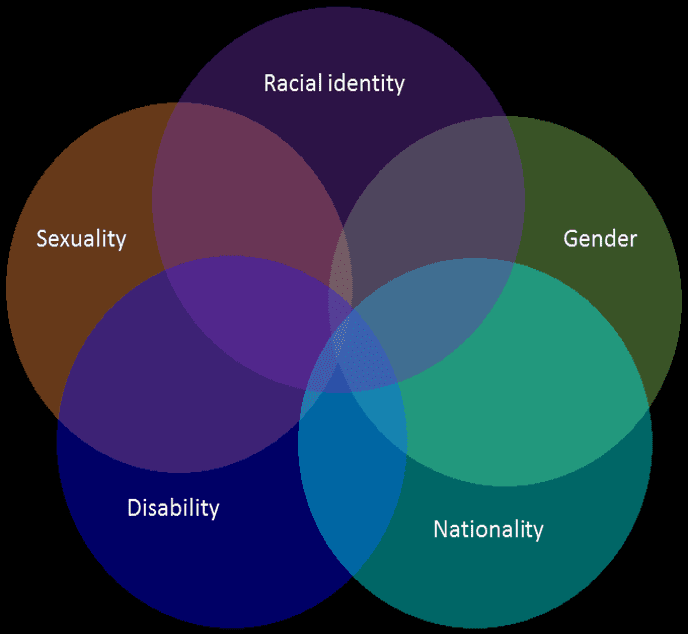
This apprehension has many causes, most obviously among them the lack of a materialist understanding of how capitalism directly causes and then informs other oppressive systems and beliefs such as racism, nationalism, imperialism and sexism. Such a flawed idealist conception of the world can be seen quite clearly in the broadly accepted notion of “Intersectionality” within the non-communist left. Taken definitionally, intersectionality is:
“The interconnected nature of social categorizations such as race, class, and gender, regarded as creating overlapping and interdependent systems of discrimination or disadvantage; a theoretical approach based on such a premise.”
-Oxford Dictionary
At first glance, this seems to be a correct understanding of how the world works. Certainly we do not deny that Capitalism is interconnected with systems such as Racism, Sexism, and Imperialism. Where we do disagree is in the notion that class is (if even present) portrayed as on equal footing to and in some respects independent of other forms of oppression. Such is a notion that has been demonstrably proven false historically. Modern racism as a social institution did not exist prior to mercantilist (early capitalist) chattel slavery, which necessitated its creation to justify its means of exploitation. Sexism has existed since ancient times, yet its manifestation has always been dependent on the class relations that enforced and created it. Imperialism became a global institution only as capital, driven by its own growth, necessitated new markets for continued growth and exploitation.
A lack of such understanding, and more importantly its consequences, can be seen in the propaganda and subsequent actions of the various non-communist left organizations that constantly pin the genocide on individuals, ideas, or nations; rather than on the all encompassing global system of capitalism. And which subsequently argue (purposefully or unwittingly) that we must fight these individuals, ideas, or nations rather than their source, capitalism. Take for example the Party for Socialism and Liberation’s article “Trump a full partner in Israel’s onslaught against Iran, risks wider war”2 which states:
“Donald Trump is the co-architect of the Israeli war against Iran and shares full responsibility with Benjamin Netanyahu for the extraordinary danger facing the whole world.”
-The Party for Socialism and Liberation
Notably, this article contained zero mentions of capital, capitalism, capitalists, profit, socialism, labor, the proletariat, or workers. Something which is certainly strange for a supposedly socialist organization. Surprising even to us was their decision not to even mention as much as the fact that such imperialist policies were similarly taken by the government prior to Trump. As a result, they place the blame squarely on the shoulders of individual heads of state and feuds between particular nations, rather than on the ruling class of all nations, the international bourgeoisie. Essentially repeating the nationalistic propaganda of the ruling class and spinning it as communist rhetoric for them.
Claim as they may that such blatant abandonment of the class struggle was partaken as part of a strategy of “meeting the working class where they’re at,” the result of such a strategy is the same; venting of actual class struggle into reformism. They betray the fact that they do not wish to overturn the existing bourgeois world system, but instead see themselves as the vanguard of international bourgeois law by their statement in the same article:
“Make no mistake, the Israeli war against Iran is a clear violation of the UN Charter, and thus a violation of international law.”
-The Party for Socialism and Liberation
Refusing to spread the actual aims of communism is non-communist, but to reify the institutions of bourgeois control over the world is undeniably anti-communist. Such doctrine comes not from thin air, but as a direct result of an idealistic understanding of what causes atrocities such as the Palestinian genocide.
Why Does Capitalism Cause Such Atrocities?
Put most simply, Capitalism causes such atrocities due to its tendency to make redundant swathes of the working class through its necessary development of capital accumulation. Such is not a novel or new tendency that must be uniquely resisted separate to capitalism (nor can it be), but an intrinsic part of the system that has existed for as long as capitalism itself.
As a brief explanation of why this occurs, the bourgeoisie (who gain their wealth only by the expropriation of surplus value produced by the proletariat), due to their competition amongst one another are forced to produce commodities for as little value as possible. Value (which under capitalism is determined solely by socially necessary labor time) must in this way be optimized either by using capital (machinery) to reduce the labor time spent on the production of any given commodity, or by increasingly exploiting the working class (paying them less for their labor, etc). What this means is that due to their own competition, the bourgeois must lay off workers whose jobs are made redundant, leaving vast sections of the proletariat impoverished. A further explanation of the actual economics behind this has been linked at the bottom of the work.
What is important for the topic at hand here is that in response to this mass impoverishment, the proletariat, in leaps and bounds, realizes its collective interest against the system, and will take whatever course of action they feel will best preserve their own survival. This radicalism within the working class, brought about by the material conditions of capitalism represents the source of capital’s destruction; but is also something which the bourgeoisie, in an effort to preserve their own survival as a class, has learned to warp through obfuscation and lies into non-communist forms through the division of the working class via arbitrary distinctions such as nationality, race, religion, sexuality, and gender.
In the United States, this process can be seen most clearly through the historical shifts in immigration policy taken at different stages in capitalism’s development, and the subsequent spread of racist attitudes and oppression that followed. It is possible to track like clockwork the cyclical nature by which the bourgeois state, according to the needs of the class it represents, either allows or expels migrants from abroad. During both the first and second world wars, the state, in a situation in which capital necessitated large amounts of growth, relaxed immigration policy to allow large numbers of migrant workers to enter the country. Programs that were then reversed and replaced with state oppression of migrants in the following periods of stagnation.
Such oppressive government policy was undertaken not because the government was evil, but because the proletariat, faced with impoverishment as a consequence of their increasing redundancy, could only be prevented from overthrowing capitalism by sacrificing a section of themselves to prolong their usefulness to the rest of the economy.
This is not a uniquely American phenomenon, of course, as similar patterns are visible globally. The Holocaust3, the Armenian Genocide4, and of course the Palestinian genocide are but a few examples of how economic realities under capitalism lead to genocide. The Nakba quite clearly began not due to an intrinsic Jewish hatred towards the Palestinian population or vice versa, but because Palestinians needed to be forced out to allow for the appropriation of property for the vast number of Israeli settlers that capital felt best suited their interests to have inhabit the region. Palestinians have since been kept in the region by capital as a disenfranchised reserve army of labor, callable upon when necessitated by capital’s growth, and dismissible when necessitated as a concession from capital to the Israeli proletariat. In the current economic conditions of both Israel and the rest of the global capitalist system, there simply is no room for Palestinians in the capitalist economy. To attempt to resist this specific manifestation of capital without resisting the system of capitalism in its entirety is to try to change the laws of nature.
The role of communist militants must always be to connect the struggles of any particular section of the working class at any one time to the historical oppression of the whole working class. Our task is to continually point to the fact that similar genocides have occurred in the past and that it is possible to not only discern why they occurred (as we have just done) but also to use the lessons learned in blood of how they were opposed in the past, in order to teach those who want to truly oppose genocide what will and will not achieve this goal. In furthering this theoretical understanding we help inform strategy and action, ensuring that the misconceptions and pitfalls of various kinds that have been fallen into in the past are avoided. This is not a history lecture; it is a critical analysis of the mistakes and successes of our past, it is the continuation of lessons the militant workers of the world have learned themselves through lifetimes of effort. When we criticize these ideas and those who believe them, it is for the benefit of future victims of imperialist slaughter and for all of humanity, who serve to be liberated by our cause.
Against Full Support of National Liberation
The most clearly non-Communist and thus ineffectual form that this activism has taken is through the organizations that proclaim full support for the national liberation of Palestine (and as such the concept of nationality) as a worthwhile or necessary end in and of itself. These organizations fall into two broad categories. Firstly, those that solely exist to advocate national liberation. Secondly, those who falsify the doctrine of Socialism, and as such claim that it should support such national liberation. Both of these groups ultimately fail to address the underlying causes of the genocide, and it is these organizations that advocate for nationalism and national liberation as part of a socialist strategy that represent the most dangerous tendency within the left. Hereafter, we will refer to the organizations that comprise this ideological tendency, which advocates national liberation as a method to advance Communism, with an unsettling yet accurate title for their beliefs, National Socialists.
Advocating solely for the national liberation of Palestine as the National Socialists do, is ultimately a disservice to the people who are being genocided along its national lines. This approach only addresses the imperialist component of capital without challenging the greater system that ultimately produces it. Anti-imperialism without anti-capitalism is ultimately fighting a symptom rather than a cause, and this avenue will lead only to further genocides and imperialist wars. Such an approach fundamentally leads to a struggle that (if it succeeds) will only lead to a new state which must then itself engage in the imperialist system of capitalism. Such a fact is not merely theoretical but backed up by the history of national/ethnic liberation movements.
Would these National Socialists have supported the struggle of the Hutu people to overthrow the colonial backed Tutsi regime in Rwanda prior to 1990? It is undeniable that prior to their overthrow, the Hutus were oppressed by the Tutsis in a very real and material way. Similar to Israel, the Tutsi regime was also backed by the Imperialist capitalist blocs for the purposes of neocolonialism. The circumstances are of course different in the way that the Tutsi did not themselves come from abroad and force the Hutus off the land, yet if genetic ties to land or historical tradition is the sole reason for a supposedly socialist organization’s stance on which nations should be supported in their right to violently take claim to a piece of land, it is hopefully clear that they are not at all socialist, but reactionary defenders of the doctrine of blood and soil.
For decades, various Hutu ethnic liberation groups attempted to overthrow the Tutsi regime and failed quite similarly to the Palestinian national liberation movement. This of course, all changed when the imperialist powers decided it was in their best interest to instead back the Hutus instead of the Tutsis. While the interests of American capital are today very linked to that of the Israeli state, it is already known today that Hamas was funded by Israel and Qatar. It is also a readily available fact that Syria and Iran have participated by proxy in the region’s conflict.
In 1972, an issue of “Workers Vanguard” (A Trotskyist newspaper with which we do not fully share our views with) wrote “Nor is the nationalism of the oppressed any more noble. Let it not be forgotten that the Palestinian Arabs are victims of the nationalism of the oppressed turned oppressor. In Burundi, had the Hutu’s coup against the ruling minority Tutsi been successful, the tribalism of the oppressed would have translated itself into the genocidal nationalism of the oppressor, All nationalism is reactionary, for successful nationalism equals genocide.”5 Certainly a shockingly clairvoyant prediction given our hindsight of what happened in 1994 when the Hutu indeed did succeed in their coup against the Tutsi.
While it may be hard for us to today comprehend a world in which the tables suddenly flip and it is the Palestinians who have the power under capitalism to engage in an ethnic cleansing campaign against the Israelis (who contrary to the racist dogmatism of National Socialist parties like PSL are not are all nepo babies who willingly came to Israel from Brooklyn), all that it would take for the balance of power in the region to suddenly shift would be for the Western powers to decide that support for a Palestinian satellite state is better suited to their goals or for Chinese capitalism to decide that competition against the western powers in the region is necessary for its continued growth and for it to successfully enforce the creation of a Palestinian state within their sphere of influence.
In such a turn of events, the entire movement of entryism and rallying around the national liberation of Palestine would all at once turn on the National Socialists’ heads and, as all non-communist movements do, be co-opted by capital into something that even more directly serves its interests.
Though it’s impossible to tell whether or not a Palestinian national liberation movement would succeed at overthrowing Israeli nationalism; the results of either the failure or success of such a movement are, from analysis of history, crystal clear. Rwanda is but one example. We could also look to Cambodia under the Khmer Rouge, Bosnia in 1995, Darfur since 2003, the Rohingya in Myanmar, Tigray in Ethiopia, or currently the Masalit, a non-Arab population in Sudan to see the same process repeating itself across time.
There is no method by which national liberation can be in any way a building block of Communist society, and there is no method by which Communists can support it without themselves becoming the pawns of Capitalism.
What Does it Actually Mean to Support or Not Support National Liberation Movements
With this in mind, we must also ask what such support given by such organizations within the non-communist left actually means. Within this wider discussion, we see a lot of confusion and false understanding about the nature by which we can actually give support to Palestinians in their resistance to this genocide. Contrary to the lies repeated by the propaganda machine of the ruling class, no American protester is sending weapons to Hamas. No, all that the talk and moralizing of support for national liberation amounts to is using mechanisms of political pressure on our ruling class through protest campaigns with the hope of forcing them to stop the genocide.
This objective of the Pro-Palestine protest movement, putting pressure on our government to stop sending weapons, will absolutely never be enough. Under capitalism, protest movements do not and cannot force these concessions to happen. Because the power lies fully with the ruling class, they are fully able to choose how long to ignore any given protest movement or any minority political movement asking them for some demand. All that political pressure achieves in the decision making process of the ruling class is to help them calculate exactly what mechanisms are best to achieve their goal (profit extraction through ethnic cleansing and Israeli settlement). If the US is forced to stop sending weapons, it can give those weapons to Germany and in turn Germany will give the IDF the weapons instead. Alternatively, the US military could decide that because this is a conflict, it can simply hide its activity from the public, claiming to stop assisting this genocide while continuing to do so. We fundamentally do not live in a society where working people have full knowledge of exactly what any government is doing, we only know what they themselves tell us. Accordingly, there are endless ways that the ruling class can co-opt, mislead, or fully ignore pressure put on them by the protest movements of the working class who ask them for change, because this process is all taking place in a situation where the ruling class holds all the leverage.
This lack of effect that declaring support for the various national liberation movements around the world actually has (even in helping the national bourgeois of any given region to establish their own exploitation of one sect of the international proletariat over another imperialist bloc, which is all that national liberation actually represents) must then be contrasted with the immense destructive impact such blatant disregard for internationalism has on the function of any organization that calls itself Communist in the actual struggle between the proletariat and bourgeoisie. Communist organizations cannot themselves defend the rights or lives of workers under capitalism, they cannot lead and win the revolution themselves, and they cannot in any serious way lead capitalism towards better outcomes. The sole vector by which organizations of militant workers (or anyone) can actually do anything to save both our species and our planet from the all encompassing system of global Capitalism is by preparing to turn the crisis of capital into a revolution that will supersede it. Key to this preparation is being the consistent body that develops the memory of the class as to its historic interests and the consistent voice that spreads this knowledge amongst the working class. In both of these domains, support for national liberation by Communist organizations serves only to play into the abstractions of the capitalist system and to divide the international among nationalist lines. For this reason, it can be considered only to be an anti-communist and counter-revolutionary practice, and one which actual Communists must make a concerted point to denounce as such.
Against Opportunist Critical Support
In contrast to full support for the national liberation of Palestine, there is a countervalent logic within certain sects of the left who, rather than support the national liberation of Palestine as an end goal in and of itself, advocate it on the grounds of national liberation weakening “The Empire” and being an example of successful working class mobilization that can push further action. We often even see a hybrid approach where a group may flip back and forth between both perspectives. For example the PSL says in a separate article of theirs:
“This (support of national liberation) is not only a morally correct position for the U.S. movement but a strategic necessity. The capitalist class that supports and profits from the oppression of Palestinians is the same capitalist class that creates poverty, inequality, and insecurity within the United States. Thus, if those capitalists lose their domination over Palestine, the working class movement here will benefit. So too would the Palestinian liberation struggle benefit if those capitalists lose their domination over the U.S. working class. International solidarity is a necessary tool to build a strong working class movement on many fronts against a common enemy.”
It would be understandable to read this position and agree that it represents true proletarian internationalism, they are correct after all, that we have a duty to fight against our own national bourgeoisie during all wars and with the necessity of international solidarity. The problem arises when we look at what is meant by their exact form of solidarity with “Palestinian liberation” because in effect they mean support for the national liberation of Palestine, not support for the liberation of the Palestinian working class.
If we confuse national liberation for a substitute for or a stepping stone to international proletarian revolution, then we continue in a direction away from Communism. Nationalism of all kinds, even underdog nationalism, is an anti-communist goal. Class collaboration is similarly a measure that has only led to disaster and death for those who want to bring about a liberated humanity without borders or a ruling class.
Because we exist in a world with large imperialist power blocs constantly competing with one another for influence, we have to ensure that our theory and actions are directly opposed to the capitalist system itself, rather than in support of one component of the system or one section of the ruling class against another.
We know that the leadership of Hamas operates as a militia for the capitalist ruling class of other imperialist blocs, principally Iran, and it uses an ideology of Palestinian nationalism for propaganda to cloak its particular form of oppressive control. This means that if we hold our noses and give critical support, we are opening the door to a very dangerous move, collaboration and sympathy with nationalist movements and capitalist states. If there is any lesson that Communists have learned in the last 100 years of counterrevolution, it is that we cannot work with, or support in any form, any cause that does not support our goal of a united and liberated humanity. It should be clear that the creation of an independent Palestinian state, regardless of other effects, would not assist the international working class in its task of organizing a revolution and the establishment of a new society.
As the Internationalist Communist Tendency so eloquently puts it:
“The project of national liberation, the so-called “right of nations to self-determination” is the project of the bourgeoisie that was completed as the imperialist phase of capitalism began. Today [the] ability of a national bourgeoisie to realize its project of national liberation hinges entirely in its capacity to mobilize backing and capital from a major imperialist power. This was clear from the very struggles that created Israel itself”7
-The Internationalist Communist Tendency
The dissolution and creation of nation-states is firmly in the framework of competition and struggle between the various capitalist blocs, and therefore not for the workers of the world to treat with any real legitimacy. This is evidenced when the Soviet Union supported the creation of the state of Israel in 1947, both diplomatically by being the first state to officially recognize them and by materially sending arms from Czechoslovakia, then part of the Soviet bloc, to aid them in their establishment. Such support was given by the “great and authentic” Soviet Union, not because they wanted to support the right of national determination for a group who had just come out of a genocide, but because they felt it would deal a decisive blow to the imperialist British and French control of the region and support their own ambitions as a bourgeois world power.
“As we know, the aspirations of a considerable part of the Jewish people are linked with the problem of Palestine and of its future administration. This fact scarcely requires proof. … During the last war, the Jewish people underwent exceptional sorrow and suffering. …
The United Nations cannot and must not regard this situation with indifference, since this would be incompatible with the high principles proclaimed in its Charter. …
The fact that no Western European State has been able to ensure the defence of the elementary rights of the Jewish people and to safeguard it against the violence of the fascist executioners explains the aspirations of the Jews to establish their own State. It would be unjust not to take this into consideration and to deny the right of the Jewish people to realize this aspiration.”
-Soviet ambassador Andrei Gromyko 14 May 1947
What Should We Actually Be Doing?
If supporting national liberation will not actually save Palestinian lives or bring an end to capitalism, but will more likely than not achieve the exact opposite, then what is it that we can actually do to end the genocide?
We express our solidarity with Palestinians, not a Palestinian nation, because nations are merely a form of political division of people. We express our support for the working class of Palestine through our continued struggle to achieve true liberation alongside them, as a part of our shared liberation along the identity that we have in common, as members of the working class. We do not fetishize the Palestinian population as victims who need special treatment, but rather we treat them as human beings with the same agency and the same herculean task as the rest of us.
Support for the oppressive rulers of an oppressed people so that they won’t fall under the rule of a different ruling class is a massive disservice to a population that has already suffered incredible hardship. When we express solidarity with Palestinians, is it based on ethnicity, nationality, and political orientation, or is it because even though they live thousands of miles away, we have more in common with them than we do with our national ruling class?
To show solidarity with the working class of Palestine is important; in fact it is unavoidable for anyone with even a shred of empathy. But no matter the intention, the outcome of transforming this solidarity with Palestinians into critical support of its capitalist regime is a dangerous misstep that leads only to the continuation of the myths of nationalism and the legitimacy of the nation-state. In effect, this muddling of theory leads to confusion for the whole working class and its revolutionary movement, harming the possibility of freedom for the Palestinian people and all the workers of the world.
Until the time for global revolution is at hand we can only organize ourselves and the wider class so that all workers, including Palestinian workers, will be able to overthrow the oppressive system of capitalism that has caused such atrocities. When that time comes the Palestinian working class will play their own part in defeating the capitalist system in their own locale as well as the forces of counterrevolution that will inevitably attempt to respond to this radical act of liberation. Until then, it is nonsensical and directly harmful to give support to the very forces that play a role in the repression and control of the Palestinian working class.
Perhaps the hardest part of this struggle is to accept that as of now the class movement can only have a negligible effect on this ongoing Genocide, a massacre happening before the eyes of the whole globe. Yet the purpose of Communist organizing is not to do what makes us feel morally righteous, but to be radically honest with ourselves, to be brave enough to accept the truth of our abilities at this moment so that we may act in accordance with reality. We cannot stop this, neither through reformist demands nor rallying to the ideologies of National Socialists, opportunists, or outright reactionary nationalists.
We cannot stop this slaughter, in the same way we cannot stop the slaughters in Sudan, in Myanmar, or Ukraine. Our duty as Internationalist communists who hold solidarity for all the world’s workers, to tirelessly organize and further our capacity for change in this horrific world, which can only mean building towards an international revolution to overthrow this world encompassing system. This means continuous defense of our hard learned positions and strategies, not only in the times where it is easy to do so, but especially in the times such as these where it is most difficult.
We have a world to win, but we also have a world to lose. We can either learn from the mistakes of the past or repeat them. If you want to overthrow capitalism and build a world in which all people are free, only Communist organizations prepared to meet the revolutionary wave will be able to do so. If you want to support one imperialist bloc against another, join one of the various National Socialist organizations that warp the doctrine of Communism into the destruction of the working class.
And Remember…
Socialism or Barbarism, Communism or Extinction – There is no Third Way!
The Tempest Collective sees the activity of the vast majority of the world’s population whose ability to work is their only means of survival as the crucial factor in building the socialist movement and winning reforms. The socialist movement is the movement of the international working class orgnaized against the present state of things. Its commitment must be always to stand for abolition of capitalism and the establishment of communism. Reforms of capitalism directly support the continued existence of capitalism. The working class is the agent of social transformation – of ridding our society of capitalism, addressing the existential environmental catastrophe, and building a socialist society – if we can organize ourselves.
Struggle is the key vehicle through which the balance of class forces can shift and on which working class demands like Medicare for All, the Green New Deal, Defunding the Police, Gender Liberation, Open Borders, etc, Even if any of these reformist demands are met, they will come at the cost of reducing the radicalism of sections of the US working class. The system cannot be abolished by advocating these measures, so this amounts to continuing the existence of Capitalism and the innumerable horrors that are part of it. will be won. We support running socialist candidates for office, but we do not believe that amassing more socialist officeholders is the way we are going to win. People cannot be understood by the labels they claim or the words they say, they have to be understood by their role in the class struggle. Whatever else they may do, anyone who holds office in bourgeois government is someone who is taking part in the operation of that institution, which exists only to manage bourgeois control over the working class. It is good you dont see this measure as the main path to socialism, but it has to be understood that it is not even a stepping stone. It is a tactic that history has shown time and time again to actively harm socialist movements. However popular policy reforms are, historically these have not been won without a mass-based movement that involves millions of ordinary people.
Mass struggle would also be the key to a revolutionary break with capitalism that starts a transition to ecosocialism. By ecosocialism we mean a classless and stateless society of freedom in which people democratically plan production to meet their needs and repair humanity’s relationship with the rest of nature. This is literally just Communism. We have to assume that this choice in language was chosen deliberately so that the scary word “Communism” could be avoided. Efficiently, this confuses and waters down the meaning of a word that has a definition and centuries of precedent behind it, just for the purposes of recruiting those who would be scared off by the word “Communism” but not “Ecosocialism”. A transition to ecosocialism would have to be a liberatory process carried out by ordinary people themselves, running society through new radically democratic institutions.
Antiracism & Abolition
We are antiracists and abolitionists. The US working class has moved most forcefully and consistently when it has confronted racism, in particular anti-Black racism. We take this lesson seriously and prioritize antiracist struggle even when it is unpopular or appears to detract from broader ‘class-wide’ interests. The priority of anything above the class struggle is a fundamentally non-communist position. If the working class was especially interested in climate change activism at this moment would you then prioritize that struggle over the class struggle as well? If the socialist movement does not center the primacy of anti-oppression inside the working class, in all its diversity, it is not going to be effective. The George Floyd uprising was an important reminder of the power of Black-led resistance and how forcefully it can assert itself as a political actor, demonstrating the absolute necessity of systemic transformation. We seek not a transformation of the system, but its complete overthrow. The George Floyd uprising was indeed a key reminder of spontaneous working class power, but it is also a reminder of what happens when there is not a strong communist party capable of focusing that energy into the class struggle and towards the overthrow of capitalism. This is what allowed capital to co-opt and destroy that movement. Our response to this as communist is not just to blame the system, but to organize around the demand of revolution, something the system can by its very nature not co-opt. We see the anti-racist rebellion that took place in the summer of 2020 as the most important development of the current radicalization. Even with a movement still in development, its potential should not be underestimated.
Crucial to the politics of abolition is the recognition that the state under capitalism is a means of violent repression wielded to ensure the domination of the ruling class. In the U.S., prisons and police are indispensable tools of racist oppression. As socialists, we fight for the full abolition of the cops, the courts, the prisons, and the capitalist state.
Feminism & LGBTQ Liberation
Internationally, the feminist and gender justice movement is the leading edge of working class resistance. Structural gender oppression under capitalism shapes life and resistance in myriad ways. It has shown itself to be a potent vehicle for social transformation.
Standing against sexual violence, domestic violence, and femicide are questions of principle that socialists must develop ways of addressing – politically, but also organizationally, as very few groups can point to processes that have helped address grievances inside left organizations.
We demand full equality and liberation for lesbian, gay, bisexual, transgender and queer (LGBTQ) people and unequivocally oppose the attacks against transgender people, especially transgender women of color. The resurgence of trans-exclusionary feminism on the Left must be challenged. The project of revolutionary socialism aims to build a world based on sexual and gender freedom and self-determination.
Disability Justice
Capitalism both creates the category of disability and discriminates against the disabled on that basis. Capitalism privileges bodies that can labor in ways optimal to the production of profit for employers. The fight against oppression based on ability is thus inherently a struggle for working-class liberation and against the capitalist system. It is also tied to the abolitionist project of destroying the carceral state. Yes, however, this is included in the struggle against the capitalist system. By separating this into a separate category, even if unwillingly, you allow for argumentation and organization to the contrary of this fact.
In the short term, we support reforms that can break down the systematic marginalization, impoverishment, and oppression of disabled people. While these are undoubtedly good things that would help the lives of disabled people, how exactly should such support of reforms be done? If this entails working within the capitalist state that was just rightly denounced, then it is an utterly anti-socialist statement. If terms besides working within the state apparatus are meant here, then this quote is generally acceptable.
But because disability oppression is endemic to capitalism and implicated in the carceral state, overcoming it requires a revolutionary abolitionist program. Tempest stands with the disability justice movement and its calls for intersectional, anti-capitalist politics and full equality and liberation for disabled people. In practice, we are committed to making spaces for meeting, organizing, and protesting fully accessible.
Electoral Strategy
Elections are a crucial tactic of working class organization, Yes, elections within independent mass assemblies, worker councils, the International Party of the Working Class, Communes, etc.
Elections as are meant here, elections in a bourgeois republic where one member or party of the ruling class is given years to enact their plan for what is best for capital, are inherently a tool of capitalist class domination and must be opposed alongside the rest of this rotten system. but they are not the motor-force of change. Elections can help develop and spread demands, contribute to concessions from the ruling class, Concessions from the ruling class do not come from electoral success but militant action of the working class. When they feel sufficiently threatened, reforms are given out to appease the masses and stablize their domination. Reforms are a tactical decision made by the ruling class when they deem it helpful, they are not a goal communists should aspire to enact. and project a socialist worldview. However, we do not believe that winning elections is the same thing as winning power or changing the balance of class forces. The capitalist state is an anti-worker apparatus that cannot simply be taken over by workers. For that reason, elections are a vehicle towards the development of struggle and independent working class institutions, not an end in themselves. Why would any worker trust a group who infiltrates the capitalist state, enganges with its archaic procedures, and involves itself in the active repression of the working class. You cannot expect any worker to support this party just because it claims, as all other bourgeois parties do, that the other parties are bad but this one is good.
Independent Working Class Institutions
We believe the Democratic Party cannot be reformed or realigned. Every previous effort to do so has weakened and undercut our ability to build the type of struggle organizations that could transcend the choices on offer under a two-party system. There are bourgeois democracies with 8 parties, 10 parties, even more. Is this what Marxists advocate for? The problem with capitalist government is that it is capitalist; it represents the interests of the ruling class. This fact has nothing to do with there only being two bourgeois parties to choose from.
We are for an independent working class membership party and we are open to different tactics and roads to get us there. However, we insist that this strategy and process cannot be deferred down the line to a more favorable moment. A new party can come together as struggle rises, Yes, an International Party of Communists working to help organize the working class towards an international revolution. Not another electoralist party, that history has shown will never be able to participate in or support revolution. we need to prepare for that now. Even people who support the Democrats over the Republicans in elections are more ready to criticize them and advocate a new party than ever before. Socialists should never be the people telling anyone who wants to break from the Democrats that they should stay inside. The socialist movement should be the home for those who yearn for political independence. Political independence must mean from bourgeois politics itself not from one or the other bourgeois parties. If a successful social democratic party were created in the US tomorrow it would follow the path of the various leftist electral parties from history. It would fade into irrelevance or be absorbed again into a larger party. This is because all capitalist parties have the same goal, win elections. Representing the actual interests of the working class is and must always be secondary.
The key ingredient in the formation of new working class organizations and parties is heightened working class self-activity and struggle that raises expectations and makes millions feel that change is possible. The growth of working class organization should go hand in hand with the growth of all wings of the movement, including a revolutionary one. This is the pole of the movement we aim to contribute to building, with the goal of a strong and vibrant revolutionary current, front or organization.
Democracy
Flowing from the centrality of struggle and working class self-activity is an insistence on democracy. Democracy is relevant in multiple ways – from ensuring that our organizations are run by the membership, to the need to defend and expand democratic rights, to the threat of far right authoritarianism. If this involves collaboration with the left wing of capital against the right wing of capital, then this is betrayal of the working class in the worst form. The only way to prevent fascism and other reactionary movements is with the abolition of the material conditions which create them and their rise to popularity, that is, the abolition of capitalism. We believe that the weakness of the organized left goes hand in hand with a lack of organizations through which working class people can participate in political, workplace and community decisions. Whether it is a tenant group, a labor union, a BLM organization, etc, democracy and participation is a crucial factor to the development of working class institutions. The lifeblood of socialist organization, in particular, is a thriving democratic culture.
Labor Strategy
We see working class self-activity and democracy – both inside and outside of the existing trade union movement – as the key roads to winning working class demands and power. Trade unions, which exist to mediate demands between the proletariat and bourgeoisie under the capitalist system, are at this point of capitalist development purely counter-revolutionary and anti-communist organizations similar to social democratic parties. The goal of socialists is not to win working class demands under capitalism, but to overthrow capitalism. We look to workers in their workplaces to organize themselves for their own interests, a rank-and-file labor strategy, which is a political and organizational orientation on the self-activity of workers inside the workers movement. We believe this will facilitate the creation of our goals more than a strategy of building influence through the labor bureaucracy or staffers in the existing unions. For us, the rank-and-file strategy is about much more than simply having socialists inside strategic sectors or getting union jobs. It is about building a socialist wing of the workers movement, fostering bottom-up organizing, and continuing to reverse the 40 year isolation that socialist politics have had from working class institutions. These all absolutely have to be done, but the reasons behind the current state of the socialist movements across the world are not really addressed anywhere in this text. It is not because of a lack of trade union activism (mistaking a symptom for a cause) or a random decrease in self organization. The period of counterrevolution that is only now ending is due to many factors including the large scale bastardization and conflation of Communism with state capitalism perpetuated by the USSR, China, etc, the lack of widely known and mature internationalist communist organizations, and the relative luxury that has up to now been enjoyed by workers within the imperial core, especially in the West. Without understanding the cause of the past failures of communist movements we cannot hope to rebuild as these sentences call for. Through the development of a socialist wing of the workers movement, a strategy for class power can become a reality by overcoming the strategic impediments that have hamstrung the organized labor movement for decades.
We are internationalists. We support working class self activity in every country and oppose the borders that physically, violently, and ideologically divide workers from one another. We are always on the side of ordinary people in their quest for democracy and self-determination and liberation against authoritarian rule. While we are not opposed to these per se. It is another selection of language that sows more confusion than clarity. The quest for Communism involves the establishment of the only form of true democracy, the only end to authoritarian rule, the only possibility for real self-determination free from the control of capitalist society. We must clearly and consistently call for only workers’ democracy, in a system of workers councils with delegates representing a specific mandate straight from the workers who elected that delegate. Specific language when talking about these concepts is necessary to avoid moralist or idealistic claims that rely on vague concepts rather than material aims.
We are principally opposed to imperialism, which we understand to be the manifestation of capitalist relations at the level of the nation-state. Imperialism is not an abstract concept, it is the inevitable outgrowth of a system built on profit and competition between capitalist states. As the economic crisis intensifies, so too will ramped up rivalries between different countries. Military activity is part of the package of attacks on working class people internationally.
We vehemently oppose US imperialism, which has destroyed the lives of our brothers and sisters across the world and has served as the justification for amped up islamophobia and xenophobia. We also hold a principled opposition to all imperial interests that are competing for international power. Instead of choosing sides with one imperial bloc over the other, we look to the strengthening of working class solidarity internationally as the central opposition to capitalism.
As socialists in the world’s biggest imperial power — in a country founded on settler-colonialism — we see our support for the struggles of indigenous, colonized and occupied people as a cornerstone of anti-imperialism. From Turtle Island to Palestine and beyond, our internationalism is inextricable from national liberation. If your internationalism “is inextricable from national liberation” than it is not worthy of the word. National liberation is the support of class collaboration within an “oppressed nation” as a means to uplift that country as a stronger actor on the bourgeois international stage. That is to say, rather than support of international revolution, this is the promotion of bourgeois nationalism, backed up only by a misplaced desire to assist particularly oppressed people along nationalist lines. By perpetuating this understanding you are doing a disservice to the working class of the nation/s at hand who will be brought from under the rule of one ruling class into the rule of another. The brutal legacy of imperialism can only be truly addressed when the working class of the whole world is free as one, and thus able to collaborate freely for the building of a new just system for all (communism). You are at the same time misleading the international working class into organizing around individual struggles that ultimately amount to reshuffling the capitalist world order rather than doing the essential work of preparing its downfall and replacement with communism.
We want DSA to free itself from the Democratic Party The Democratic Party is not itself the reason that capitalism cannot be reformed into socialism. It’s own capitalist character is only a symptom of the necessities of entering the electoralist system. To assume that this could be in some way changed is entirely Non-Marxist. and all other capitalist influences.
Marxist Unity Group strives to transform DSA into an independent socialist party. That is, to transform an apparatus of the bourgeois state into something revolutionary. Independence means establishing a distinct public profile for DSA with our own platform, branding, and rhetoric. It also means building our own institutions and our own party discipline in the halls of power. “The executive of the modern state is but a committee for managing the common affairs of the whole bourgeoisie.” -Marx Communist Manifesto. The ruling class has put all of its energy into ensuring that class struggle is relegated to their bourgeois electoral system. The halls of power are exactly where they want us. We would stand with unwavering confidence in our cause, never watering down our socialist vision or subordinating our interests to those of a capitalist party. Any party operating within the capitalist system with the goals of achieving electoral success under capitalism is in effect a capitalist party.
Together, we would cultivate a popular mandate for revolution Support for revolution comes not from idealist notions or belief in the supremacy of socialism, but from the realization brought upon by material conditions in the proletariat that they must either overthrow the system, or die. by running militant socialist candidates for public office—while simultaneously organizing grassroots institutions of working class power. We would create party-affiliated media, community services, mutual aid and defensive organizations. Within the labor movement, we would fight the existing labor bureaucracy, build militant and democratic unions, History has demonstrated that unions have become organizations which by their vary nature can no longer be progressive or helpful to the socialist movement. and strive to win these unions to socialist politics. As we nurture a vast ecosystem of socialist-allied institutions, our socialist party will simultaneously become a mass movement: a party-movement. Together, we would cultivate a popular mandate for revolution by running militant socialist candidates for public office—while simultaneously organizing grassroots institutions of working class power. We would create party-affiliated media, community services, mutual aid and defensive organizations. Within the labor movement, we would fight the existing labor bureaucracy, build militant and democratic unions, and strive to win these unions to socialist politics. As we nurture a vast ecosystem of socialist-allied institutions, our socialist party will simultaneously become a mass movement: a party-movement.
Marxist Unity Group calls for immediate steps towards political independence. We become a party by acting like one. For us, the ‘break’ with the Democrats The DSA and electoralism* is a continuous process that must begin in earnest right now. This will require courage and faith in our ability to succeed as an independent movement, but we believe that the socialist movement is worthy of that faith. We support a transition towards independent campaigns wherever ballot access laws make this readily achievable In other words, wherever the ruling class finds it useful to vent class tension with symbolic wins that do not threaten the base of their control. —even if this causes a temporary decrease in our number of electoral victories. Which is to say the end goal is continued and further venting of class struggle into the dead end of electoralism. Building a distinct socialist constituency is the paramount task of our political era, and independent campaigns help us cultivate loyalty that is completely disconnected from loyalty to the Democratic Party.
2. Programmatic Unity
We want a program to guide DSA’s political work.
To achieve political independence, we must learn to act with greater unity and determination. This is an idealist notion that pits the failures of reformism to progress humanity towards socialism, not on the inherent characteristics of reform (IE, a materialist understanding), but rather on the failure, ineptitude, and foolishness of previous reformists. We want a disciplined, self-reliant organization that is run democratically by its rank and file members. What holds parties together is agreement on final goals, not minor immediate tactical concerns. Let us take for example that one of our goals is, through the abolishment of capitalism, the end of homelessness. Given this goal, should we work with those that also wish to end homelessness, but rather than through revolution, by killing all homeless people. By the Marxist Unity Group’s own logic, such minor tactical concerns should be ceded in the name of programmatic unity. As non-idealists and communists however our answer is no. Reformism kills proletarians. This approach is called programmatic unity: unity based on common struggle for essential political goals, rather than on dogmatic purity That is to say, reforms over revolution. Unity of theoretical revolutionary final goals means nothing when the immediate actions taken by a group lead to the destruction of the class struggle. or vague slogans that obscure our true objectives. Acceptance of a political program with specific demands on the state is how the first mass socialist parties succeeded in winning the working class of their countries by the millions. This refers to a specific history of which only some is told. Here is the full story: The social democratic movements being referred to did indeed achieve popular success and win reforms, but when those same movements were faced with an imperialist world war (World War 1) they were so integrated into the bourgeois system that they shamefully supported the war as a means to preserve their movement’s credibility within the system. This led to 17 million people dying in the war which helped cause the Revolutionary wave starting in 1917. In response to this spontaneous action of the working class the social democratic parties aligned with the state to suppress the revolutions at every turn. They slaughtered revolutionaries, subverted class autonomy, and empowered the reactionary militias that would become a bulwark of early 20th century fascism. To evoke this movement as an example for the modern era is extremely distressing. A program provides direction on the political demands that will establish socialism and democratic rule by the working class without prescribing a narrow tactical route.
Marxist Unity Group works towards adopting a minimum-maximum program for DSA. We view both the ‘minimum’ and ‘maximum’ program as essential. The minimum program refers to the party’s comprehensive platform: the policies that it will immediately implement upon taking power to establish working-class political rule and place society on the path of a socialist transition out of capitalism. The maximum program refers to the results of this process: a world free of the market, borders, classes, and all other oppressive structures that exist under capitalism—in a word, communism. Centering programmatic politics will restore the sense of unity and purpose that socialists enjoyed during the Sanders campaigns. The campaign to elect a reformist social democrat to office. In otherwords an anticommunist movement. However, our program will have much more ambitious aims, and instead of belonging to a single candidate, it will be developed democratically by the entire socialist movement. They see the problem with this non-communist campaign not that it was non-communist, but that its strategy wasn’t extended to other bourgeois politicians as well.
We would like to make ‘program acceptance’ the basis of DSA membership. Acceptance does not mean agreeing with everything in the program. It simply means being willing to fight for the program as an expression of the movement’s democratically-elaborated aims. Members would have the right to organize for specific changes to the program at conventions. Members will be free to publicly voice disagreement with any majority decision, as long as they can accept the decision as legitimate and assist with its implementation. This is the true meaning of democratic centralism.
3. Electoral Discipline
We want socialist electoral candidates to represent the socialist movement Any movement involving electoral candidates in capitalism is by definition not a socialist one as socialism is the movement to abolish capitalism through international working class revolution.
Discipline and cohesion are another foundation of our political independence. If DSA candidates are truly dedicated to socialist politics, they should run together on a common DSA platform. Even if some are elected on a Democratic ballot line, they should form their own legislative caucuses, vote as a bloc, and refuse to join the Democratic Party caucus. They should also campaign for other socialists, refuse to endorse non-socialists, and only take the wage of a typical union worker. With these assertive political tactics, our candidates will rise as ‘tribunes of the people’: organized representatives of the socialist movement. DSA members have already implemented some elements of this approach in the New York state legislature, but we would like to formalize and universalize it. Horse-trading and spineless compromise have failed to truly advance socialist politics. We will always embrace the struggle for reforms, This passage speaks for itself. Reform of this system reinforces it, allowing its indescribable harm to all life on Earth to continue longer. but we want socialists to conduct that struggle out in the open and win concessions by acting as an intransigent opposition. Instead of cutting backroom deals as a junior coalition partner, socialist electeds can use their platform to raise the expectations of the working class and mobilize it to force concessions from the capitalists.
4. Nationwide Struggle
We want socialists to treat U.S. politics as a nationwide While this document acknowledges the international nature of imperialism, it is telling that no section takes the position that, at the very least, the primary focus of their group is within national confines, but the entire movement must be international. Rather than uniting with Communists around the world to form a unified party, MUG seeks to unite with liberals within the united states and fight US imperialism within national boundaries as the full extent of its so called “internationalism”. struggle for power
As socialists in the United States, we live in a reactionary political culture that encourages us to think small. Americans are taught to believe that all problems should be solved locally, and socialists often accept this logic by confining themselves to isolated local campaigns, assuming that this is where ‘real change happens.’ Yet despite our backwards federal system, the United States is not an alliance of city-states or a network of 20,000 police departments. It is a colossal empire propped up by the most powerful military on Earth. Even local police are armed, trained, and integrated by the federal government. If we ignore national politics, we will become blind to the true nature of our oppressors. We will obscure their nationwide abuse of the working class, not to mention their imperialist crimes in every corner of the world. Local organizing is an indispensable foundation of our movement, but it will be infinitely more effective when it is connected to a nationwide, pan-American, and global vision for working class revolution.
Marxist Unity Group will work to increase DSA acting as a nationwide organization. We will build nationwide collaboration and debate through DSA’s national committees and also through developing a lively party press. We support efforts to lift chapters out of parochialism by increasing member communication across chapter lines, maintaining staffing levels required to make member-led organizing possible at the national level while ensuring fair pay and working conditions, and by integrating locals into larger state-level organizations. It is also why we want DSA to run an organized slate of socialist candidates to contest the House of Representatives. By conducting principled agitation in the halls of Congress, socialists can deliver a common message to every corner of the country. While we use the federal government as a bully pulpit, our candidates could also use their public profiles to support state and municipal organizing efforts. Federal, state, and local struggles—strikes, electoral campaigns, and mass demonstrations—will all be fused together in one grand movement that demands nothing less than a working-class, socialist revolution.
5. Fight the Imperial Police State
We want socialists to challenge the repressive structures of the capitalist state.
U.S. socialists have a duty to stand firmly against militarism and police tyranny, beginning with a clear opposition to the imperialist designs of our own state. In the belly of the American empire, any socialist program must firmly oppose (neo)colonialism and advance the principles of national self-determination“the working class has no nation” -Marx, The Communist Manifeso. Capitalism in the 21st century entails a system where nation states form together in imperialist blocs which compete with one another for economic control, that is, who has the right to exploit the workers and natural resources of certain regions. National Liberation amounts to supporting the creation of a new national ruling class from that nation that will go on to join alongside one imperialist power bloc or another and will continue to exploit the working class of that territory.—that each country must be sovereign to decide its own affairs, free from military coercion or economic extortion. This means taking a defeatist stance against our country’s All*wars, including those engaged by proxies and through military alliances like NATO, as well as cruel economic sanctions and military and diplomatic cover for colonial occupation, police repression, and ethnic cleansing.
But a defeatist stance against U.S. imperialism must exist alongside a revolutionary commitment to politically-independent international action. A lasting transition to socialism in any one country is impossible, and the working class can only emancipate itself on an international scale. The decline of much of the socialist movement in the 20th century into variant forms of nationalism and popular frontism —from the official communist ‘national roads to socialism’ to the earlier capitulation of social democracy to ‘defense of the nation’ during WWI—have equally led to strategic dead-ends and tragic defeat. Though the working class of any country must first of all ‘come to terms with its own bourgeoisie,’ domestic reforms are only partial victories for an international class.
The socialist movement takes a leading role in expressing this international character in several ways, such as coordinated international strike action — like the historic May Day strikes —fiercely combating anti-immigrant chauvinism, and organizing to defend and extend the civil liberties of the migrant working class. Yet how does the MUG propose this is done? For them, this means engaging in electoralism for the defense of civil liberties. As actual communists, we do not organize to defend the civil liberties of the migrant working class (which are in reality only the right to be exploited more efficiently), but the migrant working class itself through the abolition of the very system that exploits them. As its far-reaching political objective, our party should commit to building fraternal ties with class-independent socialist parties towards the horizon of a new International.
With every tool available to us, we must erode the political, cultural, and physical hegemony of the U.S. police state. The affirmative votes of DSA-endorsed electeds for military and cop budgets, arms shipments to US vassal states, and the legal condemnation of anti-Zionism, all serve to weaken the socialist project for human emancipation. It is insufficient for socialist legislators to rhetorically criticize excessive military spending. They should be bound by our program to force a genuine public confrontation over the matter by refusing to vote for military, police, national security and intelligence budgets. By building a genuine and disciplined party infrastructure, DSA legislators and councilors would be on the forefront of a nation-wide confrontation with the imperialist state, exposing the interconnectedness of police and military brutality.
As we wage immediate struggles against repressive capitalist institutions like police departments and ICE, a socialist vision for abolitionism requires concrete, programmatic commitment to alternative, radically democratic political institutions, recognizing that abolition is impossible without the working class taking state power into its own hands. Agreed! The problem is that your definition of “seizing state power” is by playing by the rules of a system established by and for the ruling class. Rather than engaging within these systems (which has lead to failure over and over again) it is clear that the working class must overthrow and entirely supercede the ruling class and it’s governments that exist only to maintain its rule as a class. “the working class cannot simply lay hold of the ready-made state machinery, and wield it for its own purposes” Marx, The Civil War in France The racist militarized border regime will be replaced by an open border, Yes but to be more exact it would be better to say that borders as a concept would no longer exist. With the abolition of nations there are no borders, open or closed. with complete freedom of movement for all peoples and universal citizenship for residents. The armed forces of international capital—the prison industrial complex, police, and the military—will be replaced by a democratic and popular militia, flowing from the working class and the oppressed’s organs of self-defense established under capitalism—defined by the right to bear arms, the sovereignty of the people, universal service and training, and a rigorous community control coexisting with the democratic rights of members.
6. Fight the Contitution
We want socialists to fight to overthrow the Constitution This is still technically reformism. Why the Constitution? The constitution didn’t form capitalism, it doesn’t give the ruling class its power. It was created by the ruling class after it had established itself as such. We must overthrow the entire capitalist system and replace it with a Communist one. Destroying the Constitution will be but one part of this process.
Marxist Unity opposes a constitution that was written by a ‘holy alliance’ of capitalists and slavers to make the United States a perpetual oligarchy. Oligarchy is just one form that capitalist firms can take the shape of. This implies that capitalism without oligarchy is what we aim for or is at least preferable as a form of capitalism. As Communists, we simply cannot pick and choose which kind of capitalism is best, because we seek its abolition no matter its exact manifestation. There can be no question of submitting to a political order that exists to divide and conquer the working class, that slices up the government and divorces it from the will of the people—that is set in stone and almost impossible to amend. Black people cannot be free under a constitution written by slaveholders; Capitalism* indigenous people cannot win sovereignty under a constitution designed to facilitate their elimination; women cannot be free under a constitution written before they had the right to vote, Capitalism.* and working people cannot be free under a constitution that enshrines private property. Capitalism* No one can be truly free if they are forced to bow to a reactionary constitution written by the dead. We want socialist leaders to erode the popular legitimacy of the U.S. Constitution through combative political agitation: never bowing to the old order, and always acknowledging the need for a working class revolution in the United States.
The socialist revolution will not base its legitimacy on the laws of the slaveholder constitution. Capitalism is not bad because it had slavery at one point, and owning slaves is not the reason why the words of these bourgeois revolutionaries who we are taught are our “founding fathers” are illegitimate. They were bourgeois revolutionaries who established a bourgeois republic, which means it is inherently against the interests of the entire working class. It is because these institutions (established by people who owned slaves) stand in material opposition to our interests as a class that we oppose them, not because of their ethical character. We will base it on a democratic majority mandate for socialism. This majority may be expressed by the popular vote of an election, but it does not have to take that form if the state represses our ability to contest elections. We stand for the right of the working class to take power by any means necessary. To win a socialist republic, millions of working people must be mobilized in their workplaces, at the ballot box, Again, mobilization towards the left wing of capital only encourages radicalized workers to fall for bourgeois reformist lies. and in the street. We recognize that the capitalist class relies on the minoritarian rule of the U.S. Constitution, and they will not give it up peacefully. The working class will need armed self-defense to protect itself from the inevitable violence of reaction. We also recognize that we must fight for the democratic rights of enlisted U.S. soldiers. This piece speaks at length about the abolition of the very document that ensures these bourgeois rights, the constitution. Yet later it says we should fight for the “rights” of other proletarians in the hopes this will win them over, rather than class based organization around the fact that we must unite along our shared interest in abolishing all of capitalism and its false “democratic rights” along with it. As a section of the working class, soldiers share our inherent interest to overthrow the very system that guarantees these supposed “rights” (bourgeois ideology designed to placate the masses and uplift the property rights of the ruling class). To complete a successful revolution, we must win a decisive section of the military rank and file over to our side.
7. Demand a New Republic, Finish Reconstruction
We want to wina plurinational democratic socialist republic in North America. In other words, the establishment of a newer, larger, and more efficiently deceptive capitalist republic in the likes of modern china.
We fight the Constitution to win a democratic socialist republic in North America, to complete the partial overthrow of the constitutional order by the Civil War and the abolition of slavery, and to finish the project of Reconstruction by establishing a multiracial and multinational democracy ruled by the toilers of society. Forged in revolution, this continental republic will strive for the global liberation of all working and oppressed people. We desire the widest possible geographic scope for such a state so that it can most effectively carry out this mission, but we also recognize the principle of national self-determination. To reiterate, nation states (which all counties are) are a method of social organization that inherently requires a ruling class to enforce their existence (borders do not exist without armies or checkpoints to enforce them). We cannot organize around the desire for any ethnic group, imagined community, or historical nationality to have a ruling class of its own. To advocate for this is to advocate for anti-communism. All indigenous and colonized peoples must win sovereignty, including those living within the current borders of the United States. No oppressed nation will be incorporated into the socialist republic against its will. In effect meaning that the subject that holds sovereignty is not classes, not even individuals, but nations. If a new nation with a new ruling class is formed within the borders of the current US, this document tells us we would have to accept their domination over whatever territory they could control through force. Should you find yourself as a worker on a native reservation or whatever other circumstance this quote applies to, you would simply be subjected to the rule of a new ruling class.
Alongside ecological and economic crises, the minoritarian and sclerotic constitutional order will contribute to massive political crises in the coming decades. This period of crisis will provide our class with an opportunity to topple the old order and convene a revolutionary Popular Assembly: a majoritarian constitutional convention elected by all the people. Again utterly infeasible given the history of bourgeois democracy in the US. This would take generations of effort to build towards and even then it could only achieve goals that are within the framework of the original government set up by the bourgeois centuries ago. Under the democratic leadership of a victorious socialist party, the Popular Assembly will proceed to construct the socialist order. It will dismantle the slaveholder constitution and write the founding documents of the new republic.
Immediately upon taking power, socialists will implement a sweeping minimum program to cement working class political rule. We will need to destroy every institution that denies the people an authentic popular democracy, abolishing the Senate, the Electoral College, the Supreme Court, and the independent presidency. We will implement direct, universal, and equal suffrage. Supreme power will rest in the hands of a popular, unicameral assembly elected by proportional representation. All power must be held by workers councils and assemblies. The establishment of this system the only method for bringing about a truly socialist society. What they propose instead is simply a more progressive form of the bourgeois republic. A direct example of independent workers councils being replaced by the bourgeois form of government that republican assemblies are occurred during betrayal of the Communists by the Social Democrats in the 1918 German revolution.Delegates will be recallable at any time and will receive no more than a skilled worker’s wage. This implies two problematic elements, first, that we retain wage labor. Second, that the members of the governmental bodies of socialist society (the councils) are not also workers themselves. All parties that accept the laws of the new revolutionary order will be free to operate. Local organs of government will have a wide degree of autonomy. Unrestricted freedom of speech will be guaranteed to all. To make good on the unfulfilled promise of Reconstruction, our republic will launch social programs of targeted wealth redistribution, striving to eliminate all racial inequalities. The socialist republic will put political power and economic resources into the hands of all racially oppressed and colonized people.
Our broader economic program will include unimpeded labor and union rights, a massive reduction in working hours, and a truly universal welfare state that provides for all citizens from cradle to grave. We will create programs to reduce the power of bureaucrats and teach administrative skills to all workers. Worker self-management will be encouraged to the greatest extent achievable in every industry. Large industry will be placed under collective ownership early on, and we will progressively socialize the rest of the economy as we build our capacity for democratic economic planning. We will pursue crash course programs to address the ecological crisis and establish resilient forms of production, distribution and habitation. Climate refugees will be welcomed into our republic with open arms.
With the shackles of the old order broken, the working class will finally have the power to remake society on egalitarian lines. In cooperation with the global socialist movement, we will move closer with every passing year to a fully liberated classless society: communism. Communism abolishes money, class distinctions, racial discrimination, patriarchy, national boundaries, oppressive gender roles, the mental/manual division of labor, and all other forms of social oppression. It is a society truly based on the principle “from each according to their ability, to each according to their need,” where humanity collectively plans its economic activities through a free association of labor. Communism brings freedom to both society and the individual and will be the true beginning of human history.